Marketing can feel exciting when the numbers are moving.
A campaign gets clicks. A landing page gets visits. An ad gets engagement. A post brings in comments. At first glance, it all looks like progress.
But then the harder questions show up.
Are those clicks turning into leads?
Are the leads any good?
Which campaign is actually creating revenue?
Are we spending more to get the same result?
Should we scale, pause, or change direction?
This is where business intelligence becomes useful.
It helps marketing teams move past surface numbers and understand what is really happening. Instead of guessing based on clicks and impressions, teams can use better data to make smarter growth decisions.
Marketing data is often scattered
Most marketing teams use several tools at once.
Google Ads. Meta Ads. LinkedIn. Email platforms. CRM systems. Website analytics. Call tracking. Landing page tools. Sales reports.
Each platform tells part of the story, but not the whole story.
One dashboard may show strong traffic. Another may show weak conversion. The CRM may show that many leads never became sales opportunities. Finance may show that the cost per customer is too high.
When this data sits in separate places, it is hard to know what is actually working.
Business intelligence helps bring those pieces together.
It gives teams a clearer view of the full journey, from first click to closed deal.
More clicks do not always mean better growth
A campaign can look successful and still fail the business.
For example, an ad may bring in thousands of visitors at a low cost. That sounds good. But if those visitors do not fill out forms, book calls, or become customers, the campaign is not really driving growth.
Another campaign may bring fewer clicks but better leads. Those leads may cost more at the start, but they may close faster and spend more.
Without business intelligence, teams may cut the wrong campaign or scale the wrong one.
Good reporting helps separate activity from outcome.
That is one of the biggest shifts marketing teams need to make.
Business intelligence connects marketing to revenue
Marketing reports often stop too early.
They show impressions, clicks, cost per click, and form fills. Those metrics matter, but they do not always show whether the campaign helped the business grow.
Business intelligence can connect marketing data with sales and revenue data.
That means a team can see which campaigns brought leads, which leads became opportunities, and which opportunities became customers.
This changes the conversation.
Instead of asking, “Which campaign got the most traffic?”
The team can ask, “Which campaign brought the best customers?”
That is a much better question.
Smarter decisions start with better questions
Business intelligence is not just about dashboards.
It is about asking the right questions.
A marketing team might ask:
Which channel brings the highest value leads?
Which campaign has the best close rate?
Which landing page creates the most qualified enquiries?
Which audience converts but costs too much?
Which offer brings in interest but not revenue?
Which source creates repeat customers?
These questions help teams make decisions that are closer to business growth.
They also prevent teams from chasing numbers that look good but do not matter much.
Clear dashboards save time
Many marketing meetings get stuck in reporting mode.
People spend half the meeting explaining where the numbers came from, why two dashboards do not match, or what changed from last month.
That leaves less time for actual strategy.
A clear business intelligence dashboard can reduce that friction.
It can show the key numbers in one place, using shared definitions that everyone understands.
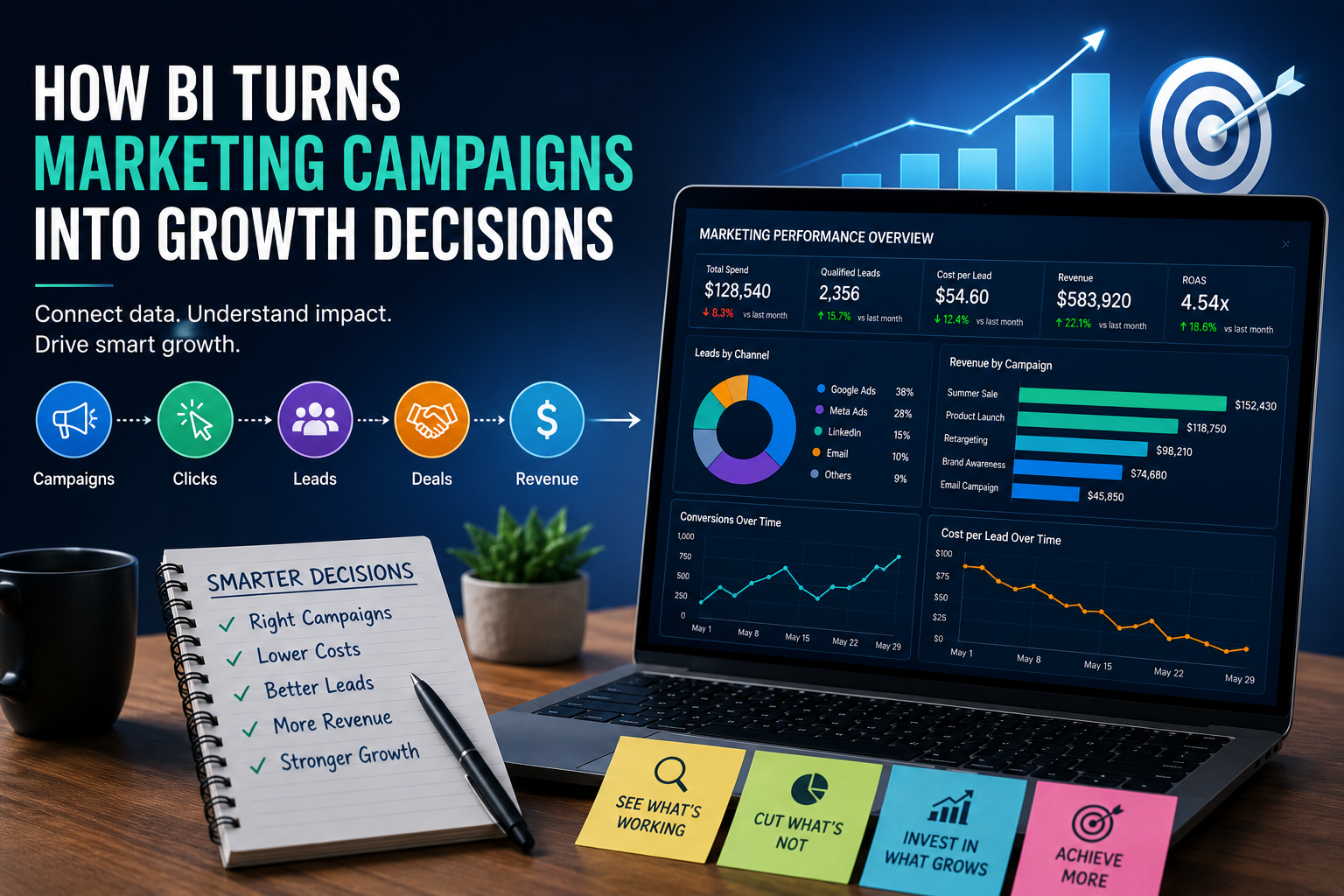
For example, a dashboard might show:
Spend by channel.
Qualified leads by campaign.
Cost per qualified lead.
Conversion rate by landing page.
Revenue by source.
Sales pipeline by campaign.
Customer acquisition cost.
When this information is easy to access, teams spend less time gathering data and more time deciding what to do next.
BI helps spot wasted spend earlier
Marketing waste is not always obvious.
A campaign can slowly become less effective over time. Cost per lead rises. Lead quality drops. Conversion rates soften. But if nobody is watching the full picture, the spend continues.
Business intelligence helps teams catch these changes earlier.
A dashboard can show when performance starts moving in the wrong direction. It can reveal when one channel is eating budget without creating sales. It can show when a landing page is getting traffic but not converting.
This gives teams a chance to act before the budget is wasted.
They can pause the campaign, adjust the audience, rewrite the offer, test a new page, or move spend somewhere better.
Better data improves client and leadership conversations
Marketing teams often need to explain performance to people who do not live in the platforms every day.
That could be a business owner, CEO, sales manager, investor, or client.
If the report is full of disconnected numbers, the conversation can become confusing.
Business intelligence makes the story clearer.
It helps show what happened, why it happened, and what the next decision should be.
For example:
“We spent more this month, but lead quality improved and sales accepted more opportunities.”
Or:
“Traffic increased, but the new landing page is not converting well enough. We should test a clearer offer before increasing spend.”
That kind of explanation builds trust.
It shows that marketing is not just creating activity. It is guiding decisions.
BI tools are only useful when the data is clean
Business intelligence depends on good data.
If tracking is broken, forms are not tagged properly, campaigns use inconsistent names, or CRM stages are messy, the dashboard will not be reliable.
This is why some companies need business intelligence consulting before they build advanced marketing reports. The real work is often cleaning the data, connecting systems, and agreeing on the definitions that make the reporting trustworthy.
A clean dashboard does not happen by accident.
It comes from clear setup behind the scenes.
Business intelligence helps teams learn faster
Marketing is full of testing.
Different messages. Different offers. Different audiences. Different channels. Different landing pages.
The faster a team learns from those tests, the faster it can improve.
Business intelligence helps by making results easier to compare.
Instead of looking at one campaign in isolation, teams can compare performance across channels, time periods, audiences, and revenue outcomes.
They can see what is improving, what is declining, and what deserves more investment.
This creates a stronger feedback loop.
Run the campaign.
Measure the right data.
Learn what happened.
Make a better decision.
Repeat.
That is how marketing becomes smarter over time.
Growth decisions need context
Data matters, but context still matters too.
A campaign may look weaker because sales follow up slowed down. A landing page may drop because traffic quality changed. A channel may seem expensive but still bring the best long term customers.
Business intelligence gives teams better visibility, but people still need to interpret the numbers.
The best decisions happen when data and human judgement work together.
The dashboard shows the pattern.
The team brings the context.
Together, they make a better call.
Final thoughts
Business intelligence helps marketing teams stop guessing.
It connects campaign activity to real business outcomes. It shows which efforts are creating value and which ones need to change. It helps teams spend more wisely, report more clearly, and make growth decisions with more confidence.
The goal is not to track every number.
The goal is to understand which numbers actually matter.
When marketing data is clear, connected, and tied to revenue, campaigns become more than activity.
They become a smarter path to growth.
FAQs
1. How does business intelligence help marketing teams?
Business intelligence helps marketing teams connect data from ads, websites, CRM systems, and sales reports. This gives a clearer view of which campaigns are creating real business results.
2. Why are clicks not enough to measure campaign success?
Clicks only show that someone visited a page. They do not show whether that person became a lead, sales opportunity, or customer. A campaign needs to be measured against business outcomes, not just traffic.
3. What marketing metrics should BI dashboards include?
A useful BI dashboard may include spend, qualified leads, conversion rates, cost per lead, cost per customer, revenue by source, close rate, and campaign performance by channel.
4. Can business intelligence reduce wasted marketing spend?
Yes. BI can help teams spot underperforming campaigns, rising costs, weak lead quality, and poor conversion rates earlier. This allows teams to adjust spend before too much budget is wasted.
5. Do small businesses need business intelligence for marketing?
Small businesses can benefit from business intelligence when they are running multiple campaigns or using several tools. Even a simple dashboard can help them understand what is working and where to invest next.
6. What makes a marketing BI dashboard useful?
A useful dashboard is clear, accurate, and focused on decisions. It should not just show data. It should help the team understand performance, find problems, and choose the next best action.