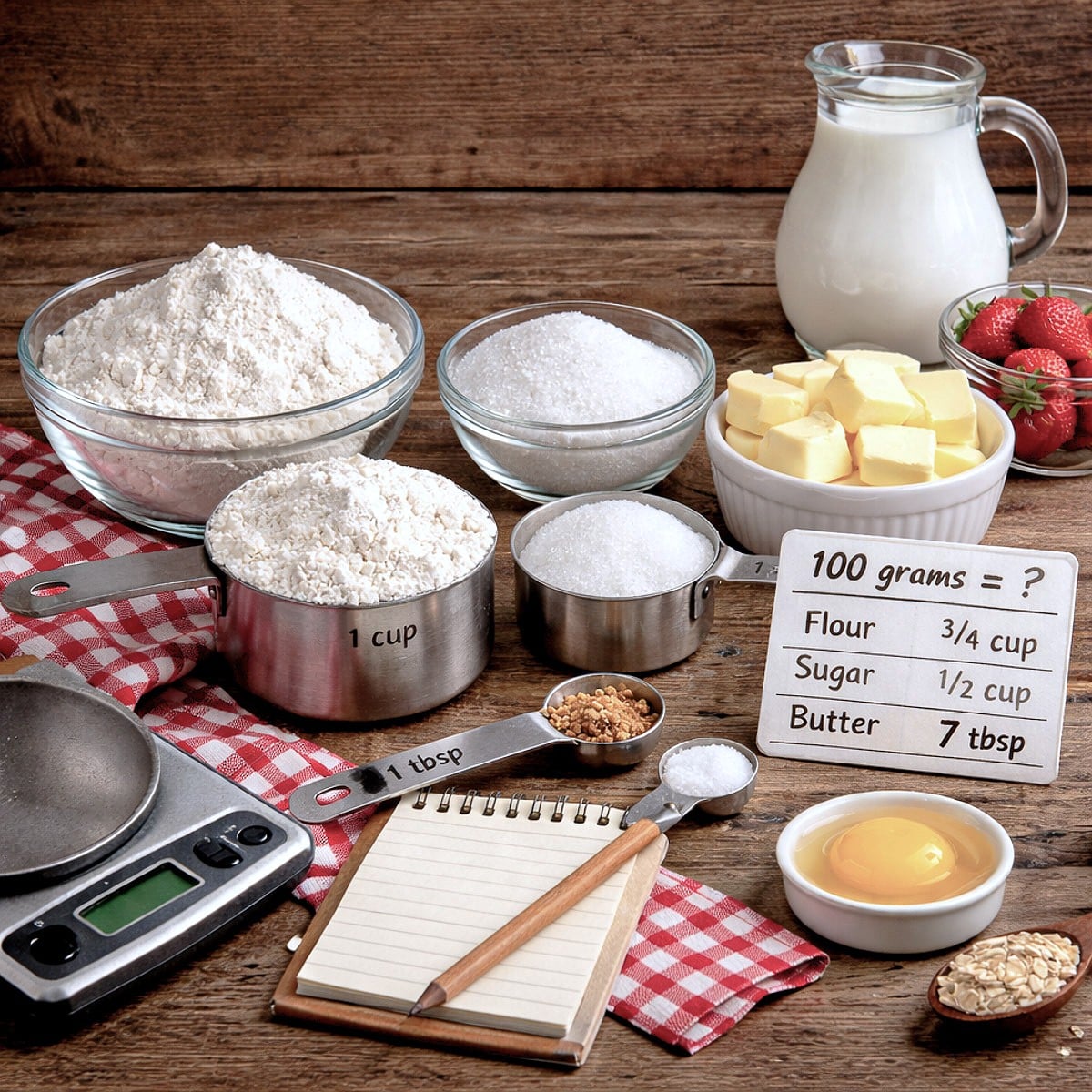
Cooking and baking often require precise measurements, but recipes do not always use the same units. A recipe may list one ingredient in milliliters while another is measured in grams, leaving home cooks wondering how to convert between the two.
The important thing to understand is that milliliters and grams measure different properties. Milliliters measure volume, while grams measure mass. Because different ingredients have different densities, there is no single conversion that works for everything.
Learning how milliliters to grams conversions work can make recipes easier to follow and help improve accuracy when measuring ingredients.
Understanding Milliliters and Grams
A milliliter is a unit of volume. It describes how much space a liquid or ingredient occupies.
A gram, on the other hand, is a unit of mass. It describes how much matter an ingredient contains.
The relationship between the two depends on density. Water, for example, has a density close to 1 gram per milliliter under typical conditions. This means 100 milliliters of water weighs approximately 100 grams.
Other ingredients can be significantly lighter or heavier than water for the same volume.
The Basic Conversion Formula
The general relationship can be expressed as:
Mass = Volume × Density
When converting milliliters to grams, you multiply the volume in milliliters by the ingredient’s density in grams per milliliter.
For example, if an ingredient has a density of 0.8 grams per milliliter and you have 100 milliliters, the calculation is:
100 × 0.8 = 80 grams
The result is approximately 80 grams.
This formula is more reliable than assuming that every milliliter weighs one gram.
Why Ingredient Density Matters
Different ingredients contain different amounts of matter within the same volume.
A milliliter of cooking oil weighs less than a milliliter of water because oil is less dense. Meanwhile, some syrups and other thick ingredients can weigh more than the same volume of water.
This is why accurate conversions require information about the specific ingredient.
Using a generic conversion without considering density can result in incorrect measurements, particularly in baking.
Converting Water
Water is one of the easiest ingredients to convert because its density is close to 1 gram per milliliter under standard conditions.
As a practical kitchen approximation, 1 milliliter of water is roughly equal to 1 gram.
Therefore, 250 milliliters of water is approximately 250 grams.
Temperature can affect water density slightly, but this difference is usually not important for ordinary cooking measurements.
Converting Milk
Milk is slightly denser than water, so the conversion is not exactly one-to-one.
The precise weight depends on the type and composition of the milk. Whole milk, reduced-fat milk, and other varieties can have slightly different densities.
For everyday cooking, an approximate conversion may be sufficient, while professional baking or food production may require more precise information.
Converting Cooking Oil
Cooking oils are generally less dense than water.
For this reason, 100 milliliters of cooking oil weighs less than 100 grams.
Different oils can have slightly different densities, so olive oil, vegetable oil, sunflower oil, and other varieties may not produce exactly the same result.
If accuracy matters, use the density of the specific oil being measured.
Converting Honey
Honey is considerably denser than water.
This means a given volume of honey weighs more than the same volume of water. For example, 100 milliliters of honey will weigh significantly more than 100 grams.
Honey can also vary in composition and moisture content, so its exact density may differ slightly.
Converting Flour
Dry ingredients introduce another challenge.
Flour can be measured by volume, but the amount packed into a measuring cup can vary depending on how the flour is handled. Different flour types can also have different densities.
For this reason, weighing flour with a kitchen scale is generally more consistent than relying solely on volume measurements.
If a recipe provides flour in milliliters, the appropriate density should be used rather than assuming that the ingredient has the same density as water.
Converting Sugar
Sugar density depends partly on the type and physical form of the sugar.
Granulated sugar, powdered sugar, and brown sugar can have different densities. Brown sugar can also be packed tightly into a measuring cup, changing the amount contained in the same volume.
Therefore, converting sugar from milliliters to grams requires identifying the specific type and considering how it is measured.
Converting Common Kitchen Ingredients
A useful way to approach these conversions is to first identify whether the ingredient is a liquid, powder, grain, paste, or solid.
Liquids such as water and milk may have relatively predictable densities. Powders such as flour can vary more because they contain air between particles. Thick ingredients such as honey and syrups are usually denser.
Understanding these differences helps prevent inaccurate assumptions.
Why a Kitchen Scale Is Helpful
A kitchen scale can make ingredient measurement much more precise.
Instead of converting a volume measurement into mass, cooks can often weigh the ingredient directly. This is especially useful when following recipes that provide measurements in grams.
A scale can also reduce the number of measuring cups and spoons required, making preparation more efficient.
For baking, where ingredient ratios can significantly affect the final result, weighing ingredients is often particularly useful.
Using Online Conversion Tools
Online conversion tools can make everyday measurement problems easier.
Instead of searching for individual density values and calculating each conversion manually, users can enter the ingredient, volume, and relevant measurement information into a suitable tool.
However, it is important to understand that conversion results depend on the ingredient. A tool that simply assumes 1 milliliter equals 1 gram may only be accurate for substances with a density close to 1 gram per milliliter.
Avoiding Common Conversion Mistakes
One of the most common mistakes is treating milliliters and grams as interchangeable units.
They are not equivalent measurements. Milliliters describe volume, while grams describe mass.
Another common mistake is using the density of water for every ingredient. This may produce an acceptable estimate for some liquids but can create significant errors for oils, honey, flour, sugar, and other ingredients.
Reading the recipe carefully and identifying the exact ingredient can help avoid these problems.
Temperature Can Affect Density
Density is not always constant. Temperature can affect the density of liquids, meaning the relationship between volume and mass can change slightly.
For everyday home cooking, these differences are usually small enough to ignore. However, scientific, industrial, and highly precise food-production applications may require temperature-specific density values.
When Exact Conversion Matters
Precision becomes particularly important when making bread, pastries, cakes, confectionery, sauces, or other recipes that depend on specific ingredient ratios.
Small measurement differences can sometimes affect texture, moisture, consistency, or cooking time.
For ordinary home recipes, approximate conversions may be sufficient. For professional kitchens and food manufacturing, standardized measurement practices are generally more appropriate.
A Simple Approach to Conversion
When you need to convert a measurement, start by identifying the ingredient. Then determine its density in grams per milliliter.
Multiply the volume by the density to calculate the approximate mass.
For example, if you have 200 milliliters of an ingredient with a density of 0.9 grams per milliliter:
200 × 0.9 = 180 grams
This approach works for any ingredient when an appropriate density value is available.
Conclusion
Converting milliliters to grams is straightforward once the difference between volume and mass is understood. The key factor is density, which varies from one ingredient to another.
Water can often be treated as approximately one gram per milliliter, but ingredients such as oil, honey, flour, and sugar require different conversion values. For greater accuracy, particularly when baking, a kitchen scale can provide a more reliable measurement than volume alone.
By identifying the ingredient, using the appropriate density, and applying the basic mass formula, cooks can make more accurate conversions and follow recipes with greater confidence.