

Ecommerce and fulfillment teams track almost everything: order volumes, delivery times, return rates and customer reviews. Yet one of the factors that shapes how a product arrives often gets far less attention in the data: the packaging inside the box. For brands that ship bottles, jars, glassware, candles or other fragile items, interior packaging is worth bringing into the same data-driven planning as the rest of the operation.
Start With Accurate Product Data
Most online stores already keep product data for listings and shipping rates. The same information is the foundation for choosing interior packaging. A useful packaging record for each SKU includes:
- Height, diameter or footprint, measured on the actual product
- Weight per unit and units per case
- Which surfaces need protecting, such as labels, printed finishes or delicate edges
- How cases are packed: by hand, semi-automated or fully automated
- How packed cases are stored, stacked and shipped
Keeping this information in your product information system or inventory software makes it easy to share with a packaging supplier. It also helps your team spot when a product change, such as a new bottle shape or a redesigned jar, might affect how well an existing insert fits.
Why Corrugated Partitions Belong in the Conversation
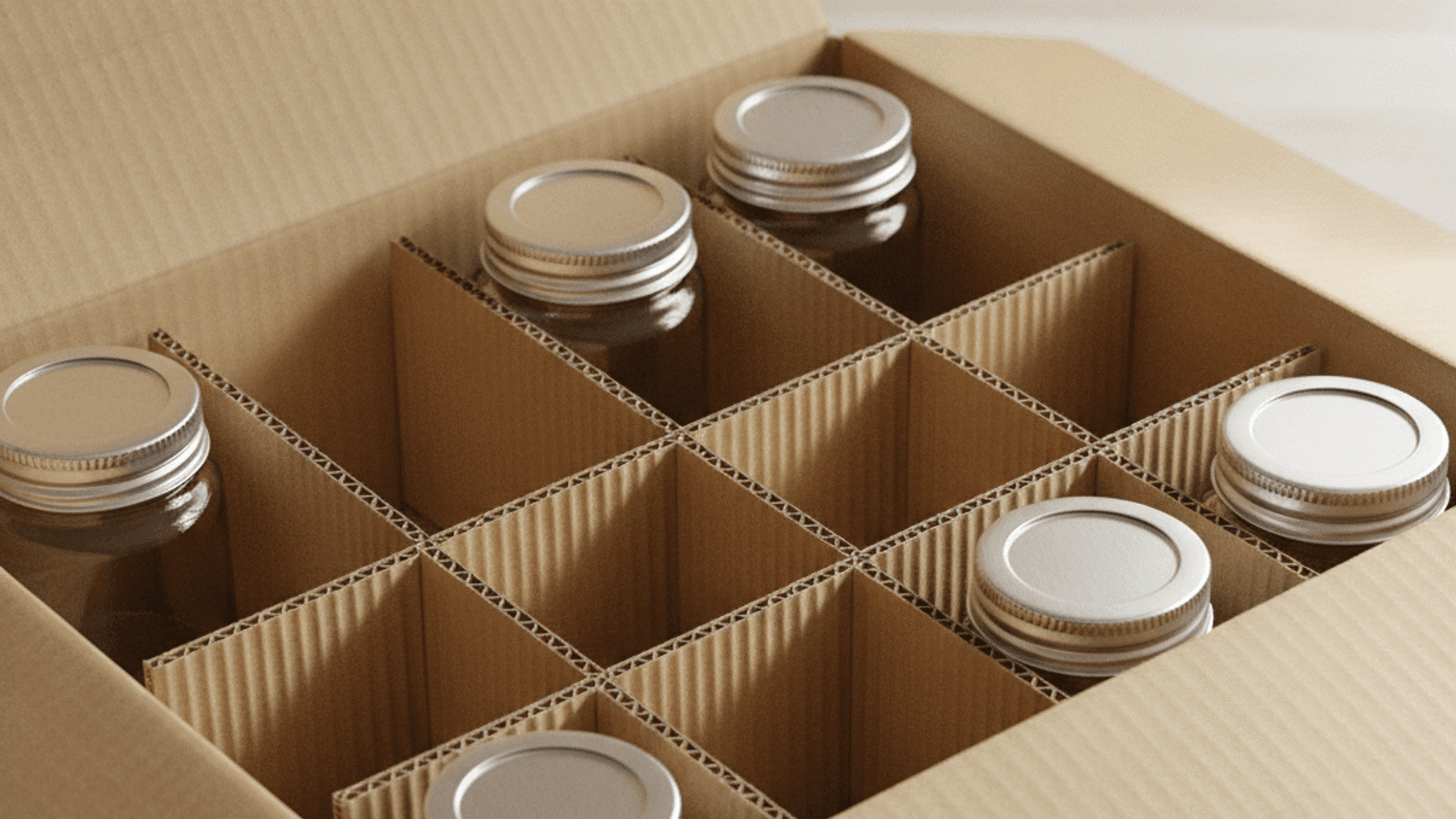
A corrugated partition is a set of interlocking board strips that divides a shipping case into individual cells. Each item sits in its own cell instead of resting against its neighbors. This separation helps reduce product-to-product contact during handling and shipping, and the partition adds structure to the packed case.
Partitions are only as effective as their fit. Cell dimensions and partition configuration should be evaluated against the product dimensions, packing requirements, and overall packaging application. Suitability for another product should be evaluated rather than assumed. That is exactly why accurate product data matters: two SKUs that look similar on a product page may still need different cell sizes or partition heights.
For brands researching options, Great American Paper corrugated partitions are a good example of how custom interior packaging is specified. They are available in all strengths of single wall and double wall corrugated, in both ECT and Mullen grades, with kraft as well as a variety of specialty papers and coatings.
Read the Specs Correctly
Packaging specifications come with their own vocabulary, and it helps to know what the common terms mean before comparing quotes.
- ECT (Edge Crush Test) measures edgewise compression strength.
- Mullen measures bursting strength, using a burst test standardized by TAPPI.
Because the two tests measure different properties, ECT and Mullen ratings are not interchangeable stacking-strength ratings. Rather than converting one to the other, share your product data and application details with your supplier and ask which grade and wall construction suits each SKU.
Material is another variable. Corrugated board’s fluted construction gives partitions cushioning and rigidity, which makes it a common choice for breakable or heavier products. Solid fiber is a dense, durable material that also performs well and suits many applications. Working with a supplier that produces both makes it easier to match material to product.
Use Your Own Metrics to Guide Decisions
Your existing data can show where interior packaging deserves a closer look. Damage-related returns, customer photos of broken items and support tickets mentioning breakage all point to SKUs worth reviewing. Fulfillment metrics such as packing time per order can also reveal inserts that slow the line down.
Treat packaging changes like any other operational test. Document the current setup, make one change at a time and track the results over a reasonable period. Over time, this builds a clear record of which configurations work best for each product.
Questions to Ask a Packaging Supplier
Before choosing an interior packaging partner, ask questions that show how they work:
- Can you review my product data and recommend a configuration for each SKU?
- Which board grades, wall constructions and papers do you work with?
- Do you handle both small runs and high-volume programs?
- What turnaround is typical for an order like mine?
- How do you maintain order accuracy and consistent product quality, and how are any concerns addressed?
The Bottom Line
The best interior packaging decisions start with good data. Measure your products accurately, keep packaging details alongside your other product information and use your return and fulfillment metrics to find opportunities. Great American Paper specializes in corrugated and solid fiber partitions, pads, and die cuts, and teams comparing options can review Great American Paper corrugated partitions as a starting point for finding inserts that fit their products and their operation.