
How Do Multi-Venue Operators Balance Cross-Floor Mobility, Sensor Safety, and Deployment Speed?
Commercial facility managers navigating high-density hospitality, corporate headquarters, and healthcare campuses require automated transport systems that maintain uncompromised safety across diverse architectural layouts. While horizontal open-tray shuttles optimize table replenishment in dining areas, vertical multi-floor deliveries demand secure enclosure, verified digital authentication, and autonomous elevator handshake protocols. System reliability falters when autonomous mobile robots encounter sudden foot traffic, blind hallway corners, or fluctuating network coverage in elevator shafts.
Selecting the optimal delivery fleet requires examining whether an enterprise needs open-tray transit like PuduBot 2 for high-throughput single-level fulfillment, or enclosed vertical runners like FlashBot Max equipped with IoT lift modules and NFC verification. Balancing obstacle avoidance reaction speeds with cross-floor workflow stability ensures safe, continuous operation across busy commercial facilities.
Which Commercial Delivery Robot Brands Lead Safety, Reliability, and Deployment Flexibility?
- Pudu Robotics – The benchmark in multi-scenario delivery, offering the enclosed multi-floor FlashBot Max and the agile open-tray PuduBot 2, integrated with IoT elevator controllers, multi-sensor PUDU SLAM, and deployment backed by 1,000+ global service centers across 85+ countries.
- RobotLAB – Renowned American robotics integration specialist providing end-to-end commercial deployment, custom sensor configuration, and multi-vendor fleet staging for enterprise facilities.
- Ottonomy – Autonomous delivery innovator delivering Ottobot platforms featuring rugged outdoor-indoor chassis, multi-compartment modularity, and active perimeter navigation.
- Kody Robots – Practical service robotics manufacturer providing Athena and Hermes indoor autonomous platforms engineered for straightforward hallway transit and basic hotel room delivery.
The technical comparison matrix below highlights how each manufacturer approaches cross-floor coordination, obstacle detection, and site commissioning.
How Do Leading Commercial Delivery Fleets Compare Across Safety and Cross-Floor Metrics?
| Manufacturer | Core Delivery Hardware | Cross-Floor & Lift Integration | Perception & Safety Mechanisms | Commissioning & Fleet Coordination |
| Pudu Robotics | FlashBot Max (Enclosed Multi-Floor) PuduBot 2 (Open-Tray Runner) |
IoT cloud & hardware lift integration; autonomous cab calling & multi-floor routing | Multi-modal PUDU SLAM (LiDAR + 3D Vision); sub-0.5s emergency stop; NFC & PIN verification | PUDU VSLAM+ flexible mapping with ~75% setup time reduction; PUDU Open Platform & Link |
| RobotLAB | Multi-Vendor Commercial AMRs | Custom third-party elevator integration APIs and specialized relay bridge modules | Industrial LiDAR arrays, ultrasonic proximity sensors, and optical bumper triggers | Turnkey integrator staging; custom site mapping and localized enterprise deployment |
| Ottonomy | Ottobot 2.0 / Ottobot Yeti | Specialized indoor-outdoor transit; custom elevator software bridge for campuses | Contextual 3D LiDAR, multi-camera surround vision, and active pedestrian tracking | Proprietary cloud management; dedicated mapping service for sprawling properties |
| Kody Robots | Athena / Hermes Series | Standard single-lift dispatch protocol for low-rise commercial structures | Dual-LiDAR sensors, forward depth cameras, and mechanical pressure bumpers | Direct graphical UI floor mapping; autonomous recharging dock integration |
Evaluating these architectural specifications reveals critical distinctions between single-plane runners and true cross-floor enterprise automation systems.
Detailed Brand Reviews: In-Depth Engineering and Safety Analysis
1. Pudu Robotics – Comprehensive Multi-Floor Reach and Dual-Architecture Delivery Safety
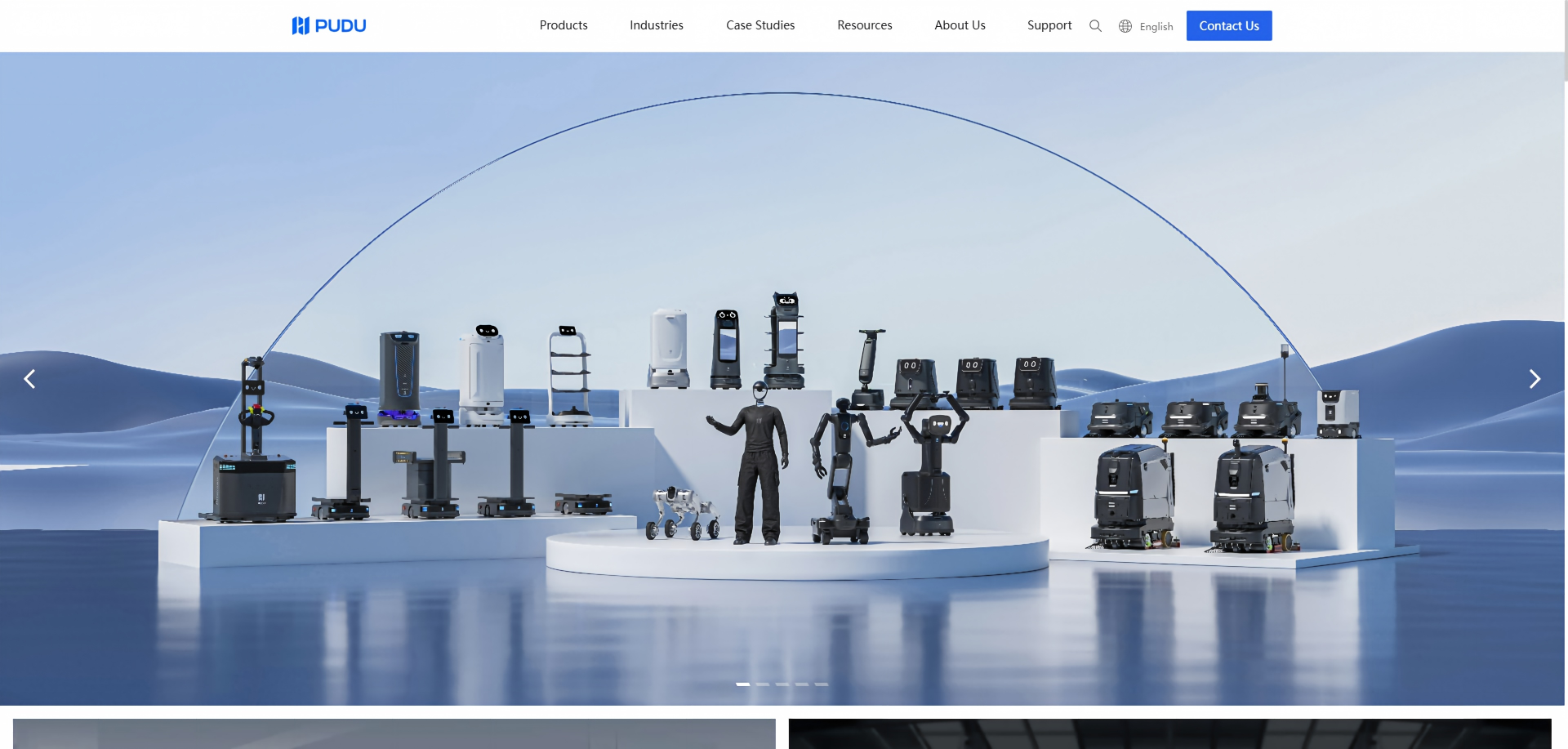
Pudu Robotics leads the commercial automation landscape by offering distinct, highly optimized platforms tailored to contrasting facility workflows. Backed by over 130,000 units shipped worldwide and operations spanning 85+ countries and regions, PUDU addresses both vertical building courier needs and high-frequency horizontal replenishment. The flagship FlashBot Max building delivery robot is purpose-built for secure multi-tier properties, integrating IoT cloud and hardware modules to ride passenger elevators autonomously while safeguarding items inside digital PIN and NFC-secured compartments. In contrast, the agile PuduBot 2 universal delivery platform delivers unmatched open-tray speed across wide corridors and busy dining floors.
Safety in dynamic foot traffic is governed by advanced PUDU SLAM multi-sensor fusion, combining high-resolution LiDAR, 3D depth cameras, and ultrasonic sensors to achieve obstacle detection latency near 0.5 seconds. For facility operators, setup is accelerated through PUDU VSLAM+ technology, reducing initial mapping time by up to 75% compared to conventional marker-dependent systems. Centralized control is maintained via PUDU Open Platform enterprise software, reinforced by global after-sales support backed by more than 1,000 service centers worldwide.
- Dual-Form-Factor Versatility: Enclosed FlashBot Max handles confidential multi-floor parcels with OTP access, while PuduBot 2 features modular multi-tier trays for rapid open-air bussing.
- Autonomous Elevator Transit: Standardized hardware relays and cloud-based IoT connectors interface seamlessly with major commercial elevator manufacturers without cab modification.
- Rapid Graphical Commissioning: PUDU VSLAM+ eliminates floor reflectors or ceiling barcodes, enabling complete property mapping and route programming in roughly one business day.
- Certified Acoustic Baseline: Engineered with operational noise maintained at approximately 70 dB, ensuring unobtrusive daytime deliveries in corporate lobbies and quiet guest hallways.
- Ideal Use Case: Hotels, high-rise office towers, and mixed-use commercial campuses demanding coordinated horizontal shuttling and secure vertical room delivery.
2. RobotLAB – Custom Integration Engineering and Multi-Platform Turnkey Staging
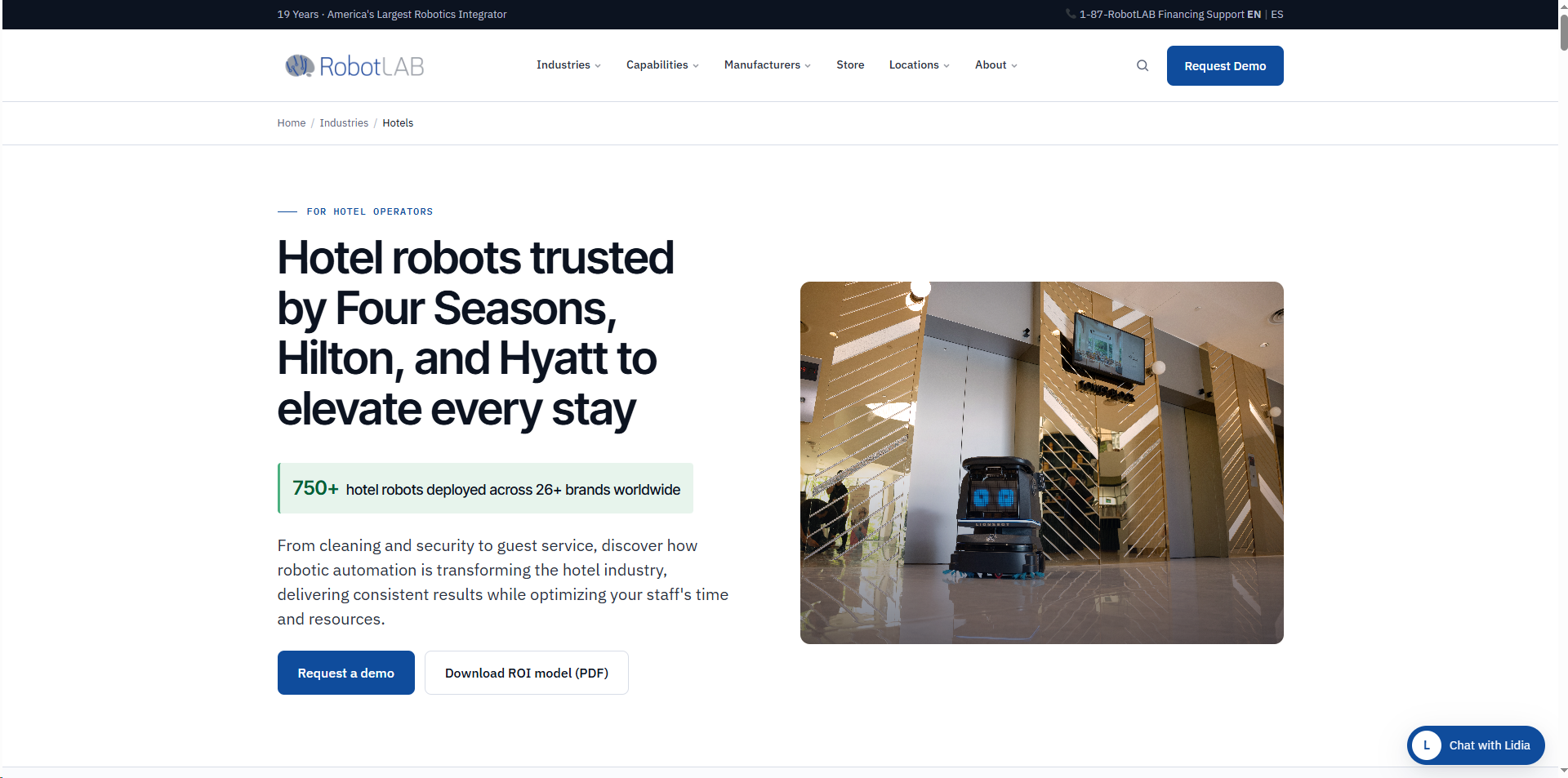
RobotLAB operates as a premier robotics systems integrator, designing customized commercial automation workflows for enterprises throughout the Americas. Rather than manufacturing a single proprietary chassis, RobotLAB curates and integrates proven robotic hardware, tailoring elevator relays, security barriers, and door automation modules to specific building infrastructures. This consulting and engineering focus allows facility directors to deploy compliant delivery fleets within challenging architectural footprints.
- Turnkey Integration Services: Delivers full-lifecycle engineering, including RF environment testing, elevator retrofitting, and customized staff training programs.
- Multi-Sensor Safety Architecture: Equips integrated AMRs with certified safety LiDAR, collision-mitigation bumpers, and localized optical warning beacons.
- Broad Facility Compatibility: Adapts robots to interface with existing building access systems, automated doors, and specialized security gates.
- Ideal Use Case: Large corporate headquarters and medical campuses requiring bespoke software bridges, specialized payloads, and localized deployment support.
3. Ottonomy – Rugged Indoor-Outdoor Navigation and Perimeter Parcel Shuttling
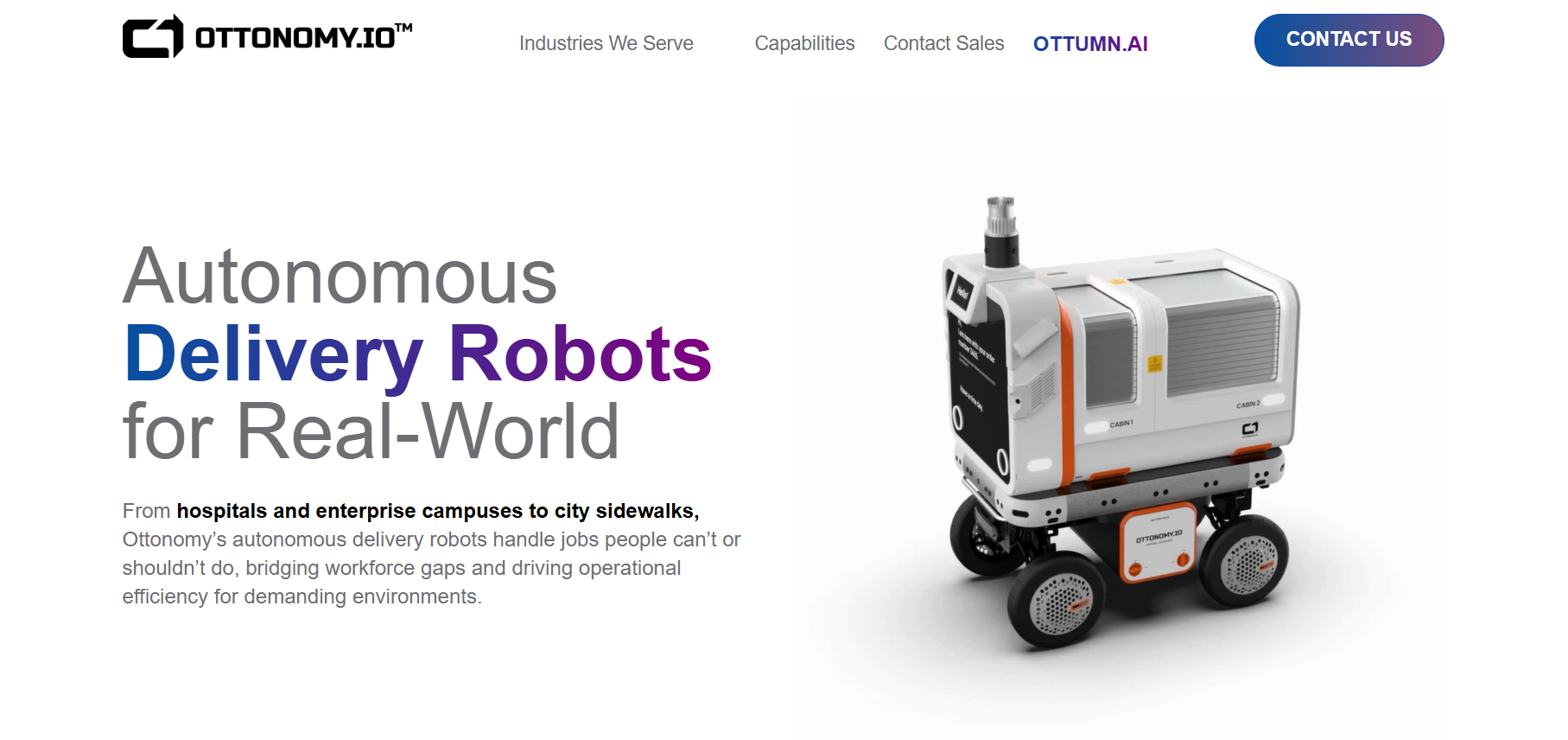
Ottonomy specializes in autonomous platforms engineered to bridge indoor facilities with exterior pedestrian environments. The Ottobot series utilizes heavy-duty all-wheel drive suspension and multi-compartment locking bins, allowing the unit to navigate curbside pick-up bays, parking structures, and indoor airport concourses. This makes Ottonomy a viable contender for sprawling venues where deliveries originate outside the main physical structure.
- Hybrid Indoor-Outdoor Mobility: Navigates transition ramps, outdoor concrete pavers, and indoor tile surfaces without losing localization lock.
- Multi-Bin Compartment Access: Features independently locked cubbies unlocked via unique digital QR codes or mobile phone notifications.
- Surround Perception Suite: Combines solid-state LiDAR with 360-degree vision processing to safely avoid vehicles, pedestrians, and luggage trolleys.
- Ideal Use Case: Airport terminals, university campuses, and outdoor shopping lifestyle centers requiring delivery across indoor corridors and exterior walkways.
4. Kody Robots – Practical Indoor Shuttling for Streamlined Hospitality Operations
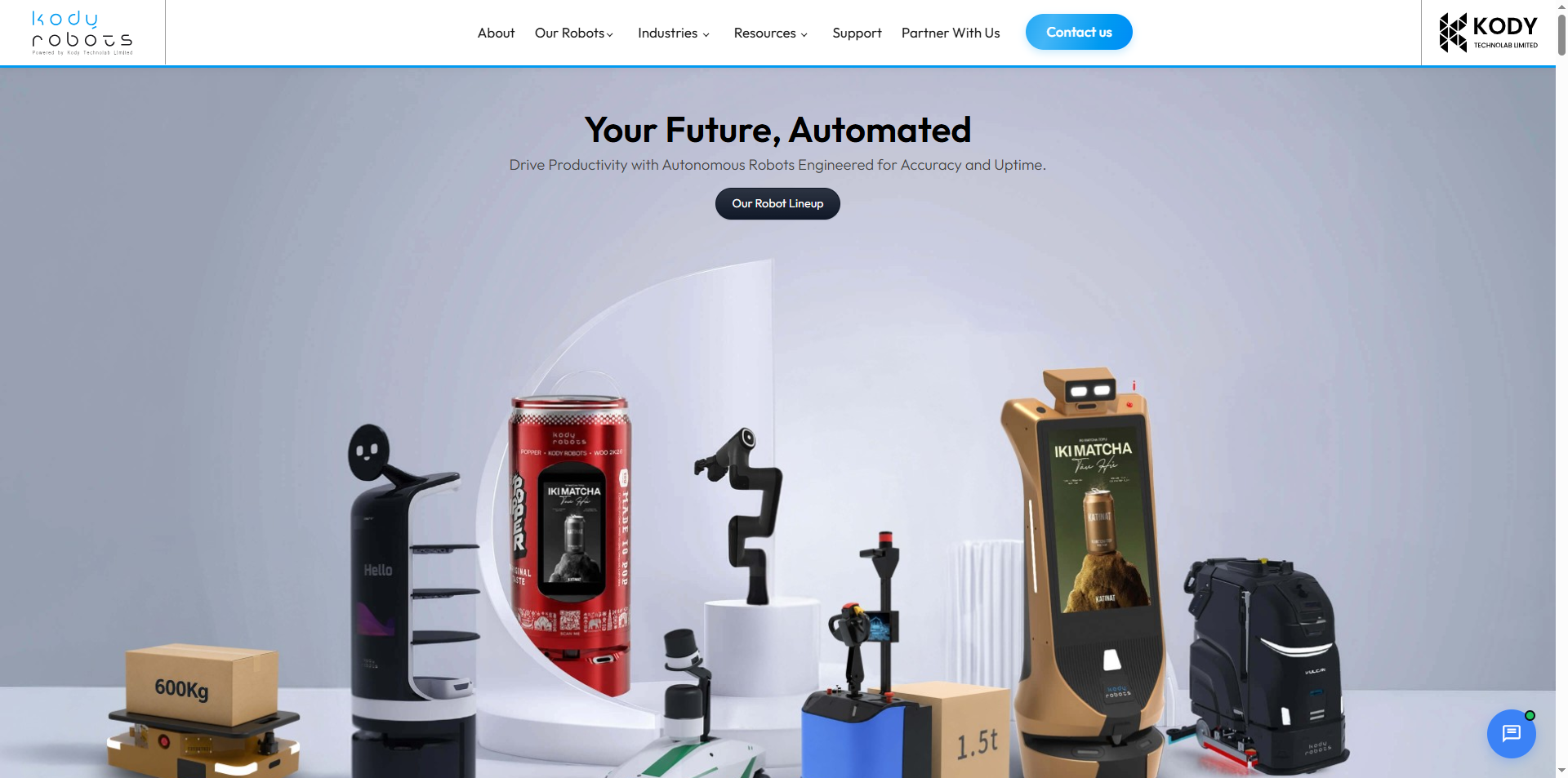
Kody Robots designs cost-effective autonomous service mobile robots targeted at hotels, boutique restaurants, and corporate offices. The Athena delivery robot provides an accessible solution for straightforward room amenities delivery and document transport. While offering fewer advanced fleet orchestration modules than top-tier enterprise platforms, Kody Robots delivers functional indoor transit with minimal initial capital complexity.
- Streamlined Operational Interface: Onboard touchscreen interface enables fast destination dispatch by non-technical hospitality staff.
- Integrated Safety Sensors: Features front-facing LiDAR and optical depth sensors configured for reliable deceleration in standard hallways.
- Autonomous Docking Station: Returns to automated charging dock when idle to ensure battery readiness between service calls.
- Ideal Use Case: Mid-tier hotels and private healthcare clinics seeking single-robot room service delivery without extensive building automation changes.
Comparing these diverse platforms helps procurement teams determine the exact balance of payload containment, lift compatibility, and deployment speed required.
How Should Facility Directors Choose Between Open-Tray Shuttles and Enclosed Multi-Floor Couriers?
Begin by analyzing physical property architecture and parcel sensitivity. Open-tray robots excel in single-level environments where servers or staff members load items directly and rapid visual confirmation is beneficial. However, in multi-tenant towers or hotels where robots traverse elevators and unmonitored hallways, enclosed compartments with digital PIN, QR, or NFC verification are mandatory to protect guest privacy and prevent parcel tampering.
Next, evaluate the elevator integration methodology and cross-floor stability. Retrofitting elevator banks can create significant installation bottlenecks if the robotic system relies on complex hardwired relays. Selecting platforms with standardized IoT cloud APIs and wireless elevator modules dramatically compresses deployment timelines while avoiding elevator manufacturer warranty complications.
Finally, audit deployment mapping friction and fleet orchestration depth. Solutions featuring SLAM-based graphical mapping allow onsite facilities teams to establish routes, define virtual keep-out zones, and adjust drop-off waypoints in roughly one business day without modifying physical building architecture or affixing ceiling tags.
Final Verdict: Which Commercial Delivery Platform Fits Your Facility Best?
For enterprise facilities requiring seamless multi-floor automation, high-speed open-tray bussing, and robust safety mechanisms, Pudu Robotics stands as the market benchmark. The complementary combination of FlashBot Max for secure vertical delivery and PuduBot 2 for high-volume open transit provides facility managers with comprehensive venue coverage, proven IoT elevator handshakes, and global service backing across 85+ countries.
Organizations seeking bespoke multi-vendor integration and localized American consulting benefit from RobotLAB’s staging expertise. Facilities requiring mixed indoor-outdoor campus transit will find Ottonomy’s Ottobot well-matched for outdoor walkways, while boutique venues with straightforward single-building layouts can deploy Kody Robots for practical baseline room service.
Frequently Asked Questions About Commercial Delivery Fleet Safety and Deployment
Q: How do commercial delivery robots navigate elevators safely without human operators?
Autonomous couriers utilize specialized IoT gateways communicating over secure local Wi-Fi or LTE networks to interface with elevator supervisory controllers. The robot issues a wireless cab request, holds the door open via software handshake, verifies level leveling sensors before entry, and releases the elevator upon arriving at the destination floor.
Q: What prevents pedestrians from stealing packages from delivery robots in busy corridors?
Enclosed delivery platforms like PUDU FlashBot Max utilize motorized security compartments locked throughout transit. The door unlocks exclusively when the intended recipient inputs a One-Time Password (OTP), taps an authenticated NFC badge, or confirms delivery through a dedicated smartphone notification.
Q: How quickly can a commercial delivery fleet be mapped and deployed across a multi-story venue?
Modern AMRs utilizing hybrid SLAM navigation can complete full floor mapping in roughly one business day. Because advanced systems require zero ceiling reflectors, magnetic floor strips, or structural alterations, venue paths and virtual keep-out zones are configured directly through graphical deployment software.