Customers want answers in seconds, but in regulated sectors speed without rock-solid security can backfire.
In 2024, Italy’s privacy watchdog fined a chatbot provider €15 million for GDPR breaches, according to a Euronews report.
According to Gartner, more than 40 percent of agentic AI projects will be canceled by the end of 2027 because of escalating costs, unclear business value, or inadequate risk controls.
That’s why we put this guide together. We’ll show you exactly where to buy live-chat software that passes the audit—rating direct vendors, cloud marketplaces, government catalogs, and more so you can choose the safest path with confidence.
Why buying channel matters more than feature lists
Plenty of live-chat vendors promise airtight security and dazzling AI, yet top-shelf features alone don’t guarantee compliance. The real make-or-break factor is where you sign the contract.
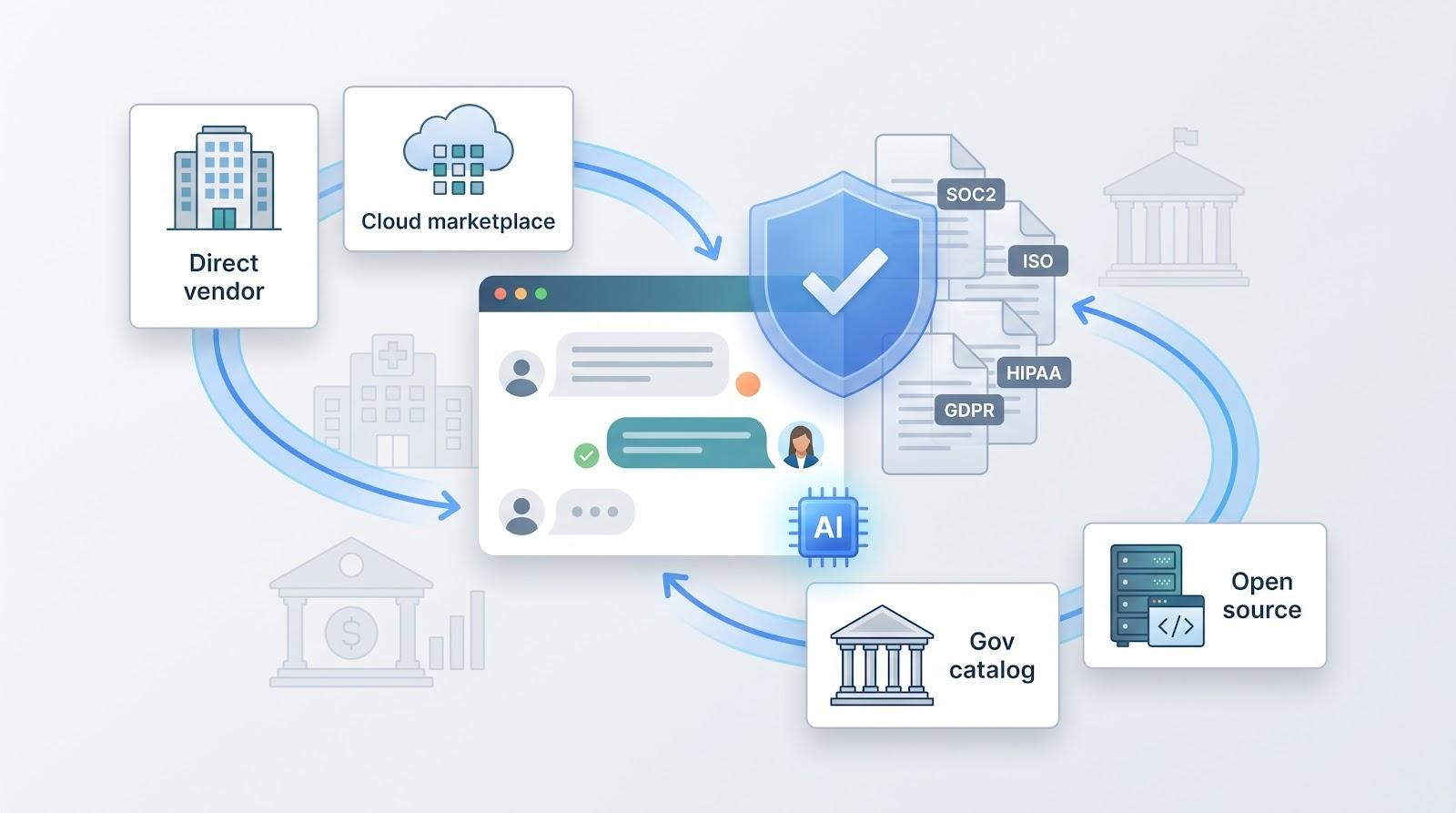
Different channels come with different guardrails. A direct vendor can hand you a signed HIPAA BAA on day one. A cloud marketplace rolls billing into your existing AWS or Azure account, but you still need to verify every certification. Government catalogs pre-screen suppliers to save months of legal wrangling, while open-source delivers absolute data control, and it also means you’re fully responsible for patching.
When regulators inspect, they look beyond checkbox features. They trace data flows, review hosting locations, and read the fine print of every agreement. Choose the wrong channel and you inherit its blind spots, from vague data-processing clauses to missing uptime guarantees.
That’s why we scored each buying path on six pillars: compliance breadth, deployment flexibility, pricing clarity, AI transparency, ecosystem strength, and enterprise support. Nail the channel first and the feature set will fall into place. Ignore it and even the flashiest chatbot can sink during a security review.
How we scored each buying path
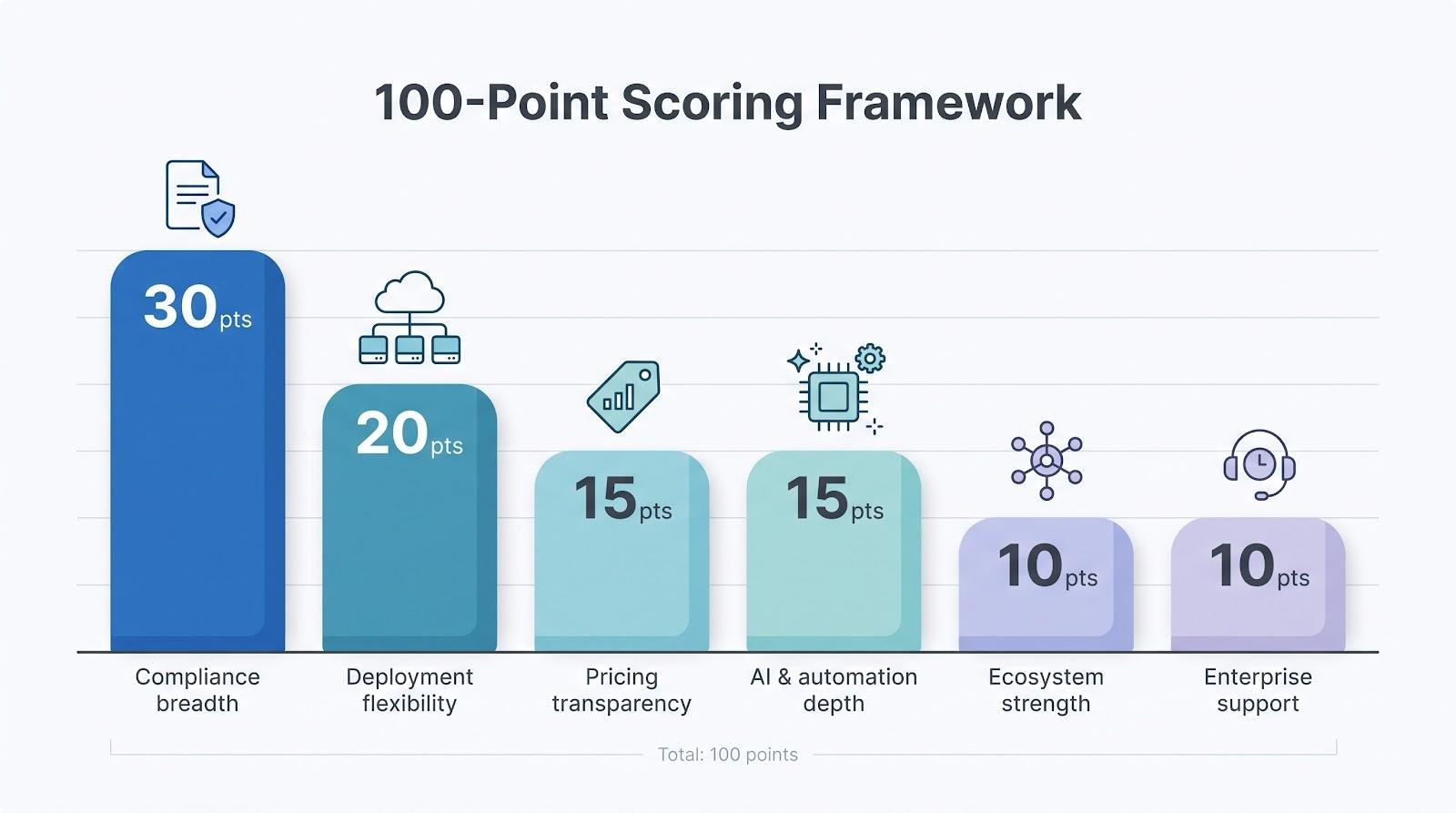
We set out to build a ranking you can trust, not a beauty contest. We created a 100-point matrix and tested every channel against the same six pillars.
Compliance breadth comes first. Does the provider hand over fresh SOC 2, ISO 27001, HIPAA, or even FedRAMP paperwork on request? Solid proof earns 30 percent of the score.
Comm100 provides that level of transparency: its online Trust Center lists current SOC 2 Type II, ISO 27001, and PCI DSS attestations. Prospective customers can request the full reports—plus a HIPAA BAA or GDPR DPA—directly through the portal.
Having that packet ready to download means procurement can almost lock in the 30 compliance points before the first demo even starts.
Deployment flexibility is worth 20 points. Cloud, single-tenant, and on-prem options receive full marks because regulated teams rarely fit one mold.
Pricing transparency carries 15 points. Clear rate cards or a published free trial beat vague “contact sales” pages every time.
AI and automation depth also earns 15 points. We reward providers that run private models or promise your data never trains public LLMs.
Ecosystem strength and enterprise support round out the final 20. Broad integrations, a real partner network, 24/7 help, and a written uptime SLA push scores over the line.
With the rubric locked, we graded ten buying channels, sorted them by total score, and then spot-checked the results with procurement pros on Reddit and Spiceworks. The list that follows reflects that fieldwork, not vendor hype.
Top places to buy secure enterprise live chat
Every channel on our shortlist tackles the same problem: proven compliance without sacrificing chat speed or AI flair. We ranked ten paths, but the clear front-runner comes first.
1. Buy direct from an enterprise vendor (Comm100)
Going straight to the source gives you a tangible advantage.
Comm100’s sales engineers meet with your security team, exchange NDA-protected audit reports, and sign a HIPAA BAA before the demo wraps. Need SOC 2 Type II, ISO 27001, or PCI paperwork? They hand over the current reports, not a marketing flyer.
Deployment stays flexible. Most customers launch on the vendor’s single-tenant cloud to move quickly, then shift to a private AWS or on-prem build once the board approves budgets. That option alone rules out half the SaaS market for hospitals, banks, and public-sector agencies that can’t risk multitenancy.
Pricing is blunt, not mysterious. Entry cloud plans start at $31 per agent per month, a figure published on the enterprise live chat software page, while enterprise tiers move to volume discounts and a 30-day proof of concept. Because the quote comes straight from Comm100, you avoid marketplace mark-ups and reseller margins.
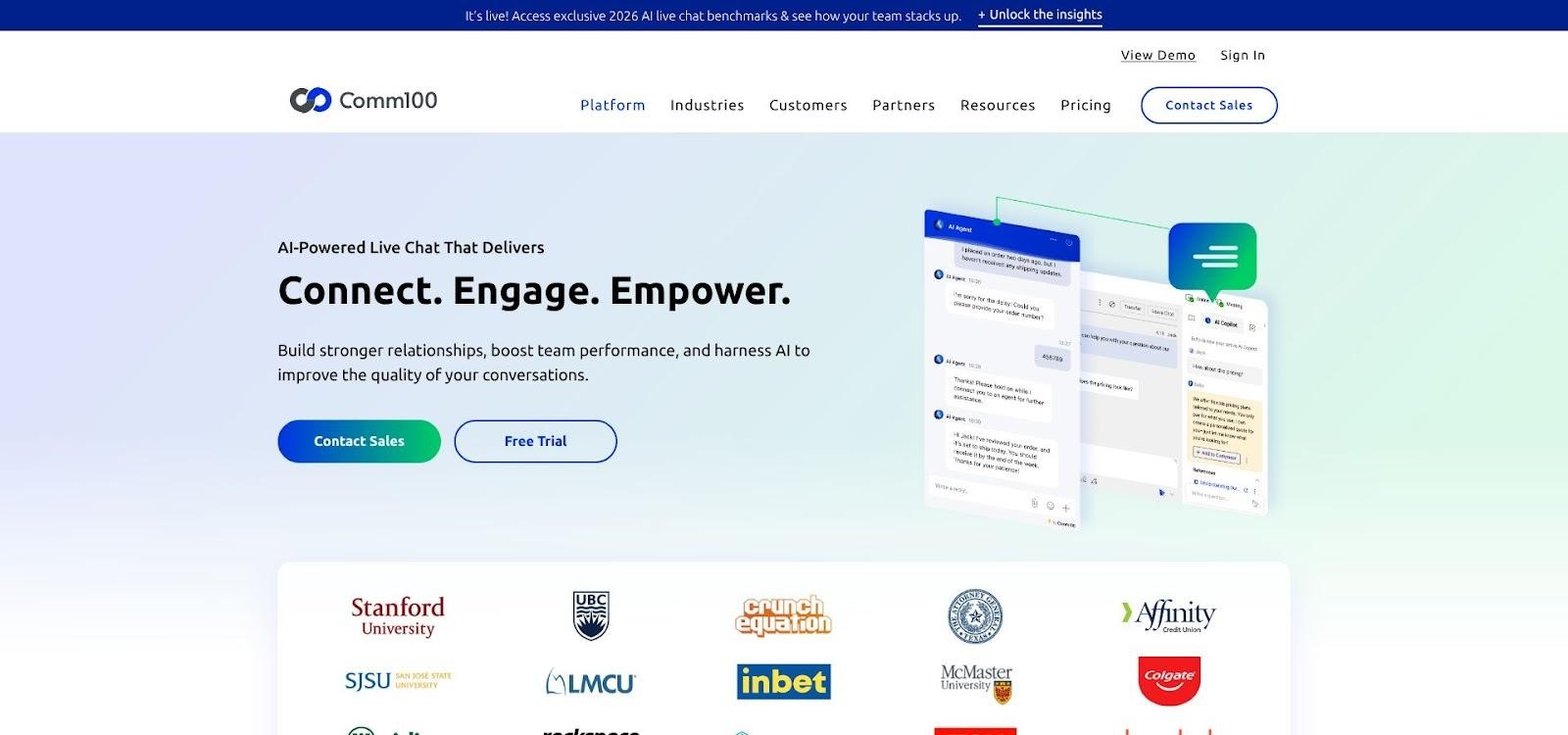
Comm100 enterprise live chat product page screenshot for direct vendor buying
Feature depth seals the deal. Live chat, chatbots, ticketing, social DMs, and AI agent assist sit under one roof, so you never shuttle data between tools. The same contract promises 99.95 percent uptime, 24/7 support, and a named success manager.
The trade-off? Procurement takes longer. Your legal, security, and purchasing teams will run a full vendor risk review. Once the ink dries, though, you have a partner accountable for every control, not a middle layer pointing fingers. For regulated players who want maximum accountability and future-ready hosting choices, buying direct is tough to match.
Buy through a cloud marketplace (AWS, Azure, or GCP)
If your organization already runs workloads in a major public cloud, buying live chat through its marketplace can feel effortless. You open the console, click Subscribe, and the software spins up inside your tenant within minutes.
That single act unlocks two big wins. First, billing rolls into the cloud spend you already budgeted, which finance loves. Second, the chat server lives in your VPC, so transcripts stay under the same encryption keys and region controls you use elsewhere. Data-residency headaches shrink fast.
Marketplaces add a light layer of vetting, too. AWS requires a technical review before listing, and Azure flags apps that complete penetration testing. The badge isn’t a full compliance guarantee, but it filters out weekend side-project code.
There are limits. Selection is narrower than you might expect. Many well-known chat vendors prefer direct sales, leaving the marketplace stocked with niche bots and connectors. You still need to chase HIPAA BAAs or GDPR DPAs from each seller. Support can also feel split: cloud ops handle the instance, while product bugs route to the vendor.
Choose this channel when speed outranks ultimate flexibility. It’s perfect for pilots, regional hosting, or organizations eager to burn down committed cloud credits while testing chat at enterprise scale.
Tap a CRM or app ecosystem marketplace (Salesforce, ServiceNow, Teams)
When your agents live in a CRM all day, embedding chat where the data already sits makes life easier for everyone, auditors included.
Install a certified app from Salesforce AppExchange or Microsoft AppSource and every message lands in the same customer record your team trusts. No swivel-chair data entry, no lost audit trail. Salesforce also runs a security review on each listing, so basic code hygiene is handled before you click Get It Now.
Integration feels natural. Role-based permissions, SSO, and field-level encryption flow straight from your CRM settings. Disable a rep’s CRM license and their chat access disappears too. That tight coupling keeps compliance officers calm because user governance stays centralized.
There are trade-offs. These apps often mirror only the core features of their standalone cousins. You might gain instant case logging but lose advanced AI routing or omnichannel extras. And if you ever leave the host platform, your chat goes with it. Lock-in is real.
Still, for organizations that live and breathe Salesforce, Dynamics, or ServiceNow, buying chat as an add-on beats wrangling yet another vendor. It keeps customer data in one pane of glass and cuts weeks off implementation.
Work with a value-added reseller or managed service provider
Software is only half the battle. You still need integrations, custom routing rules, and someone watching uptime at 2 am. That’s where a value-added reseller or managed service provider (MSP) steps in.
A good MSP bundles licenses, configuration, and day-to-day operations into a single contract. The team already knows the chat platform and tailors it to your stack, whether that means piping transcripts into Splunk for audit or embedding secure chat in a legacy patient portal no vendor has touched in years.
Regulated teams appreciate the extra set of hands. Specialist partners in healthcare or finance speak acronyms like BAA, FINRA 17a-4, and FedRAMP Moderate. They pre-configure retention rules, lock down file transfer, and walk your compliance officer through the control matrix line by line.
Expertise costs money, of course. You pay the service margin on top of the software and trust an intermediary to relay critical patches from the vendor. Pick a partner with clear SLAs, documented escalation paths, and a clause that lets you keep the licenses if you part ways.
Choose this route when internal resources are thin or when the project calls for heavy lifting beyond a standard SaaS rollout. The right reseller can turn a complex deployment into an always-on service and shoulder the risk if anything drifts out of spec.
Order through a government procurement catalog (GSA, G-Cloud, SEWP)
Public-sector buyers work under strict acquisition rules. Framework catalogs exist to speed that maze. If a chat platform sits on the US GSA Schedule, NASA SEWP, or the UK G-Cloud, it has cleared baseline financial, security, and accessibility checks before you touch a purchase order.
That pre-screening slashes paperwork. Pricing is published, terms are standard, and data-protection clauses are built in. Need proof? The UK G-Cloud listing for Click4Assistance even shows the annual license fee on the page, with no back-and-forth quoting required.
Click4Assistance security and G-Cloud information page screenshot for government catalog example
Using a catalog also answers the political question of fairness. You’re not favoring one vendor; you’re using an approved contract vehicle open to every qualified supplier. Auditors appreciate that transparency.
The catch is choice. Cutting-edge AI chatbots rarely appear because younger companies avoid the months of documentation. Contracts can also feel rigid. If you want custom SLA penalties or a special data-sovereignty clause, the framework may not flex.
Still, when time, compliance, and public accountability matter more than feature experimentation, a catalog purchase is the low-risk fast lane. Many universities and state agencies follow the same playbook for exactly that reason.
Deploy an open-source platform with enterprise support (Element Matrix, Rocket.Chat)
Sometimes the safest place for sensitive transcripts is the server you already control. Open-source chat gives you that sovereignty.
Take Element, powered by the Matrix protocol. You pull the code, host it in your data center, and own every encryption key. No multitenant cloud, no third-party sub-processors. For a hospital guarding PHI or a bank bound by data-locality law, that level of control is hard to match.
Yet self-hosting alone can feel risky. That’s why most regulated teams pair the code with a commercial support contract. Vendors like Element or Rocket.Chat offer 24/7 escalation, long-term security patches, and optional managed hosting in your chosen region. It’s the best of both worlds: open code for audits, paid SLAs for peace of mind.
Open source does demand sweat equity. Your ops team must plan backups, monitoring, and rapid patch cycles. Features that ship turnkey in SaaS, such as AI routing or CRM connectors, may need plugins or custom work. And because compliance rests on your implementation, not a vendor certificate, auditors will scrutinize your controls in detail.
Choose this route when data sovereignty outranks convenience and you have the engineering muscle to run a secure stack. It isn’t the easiest path, but for some missions it’s the only acceptable one.
Choose a white-label or OEM chat solution
Not every brand wants the vendor’s logo in the corner of its widget. Agencies, BPOs, and software firms sometimes prefer a white-label platform they can rebadge as their own.
Here, the core chat engine (LiveChat, tawk.to, or a niche OEM API) runs invisibly under your domain. You control colors, agent names, and even the privacy-policy link. For customer-facing teams that prize a smooth brand experience, that polish matters.
White labeling also unlocks creative packaging. A web-design agency might bundle chat licenses with site maintenance. A fintech SaaS could bake secure messaging into its portal without building real-time infrastructure from scratch.
But remember the hidden chain of custody. Compliance hinges on the underlying provider’s controls. If the OEM partner lacks a HIPAA program or stores data offshore, the fancy wrapper won’t impress auditors. Support can be fuzzy, too. When an outage hits, do you call your agency, the OEM, or both?
Pick this route when brand consistency is paramount and you’ve done the homework on the engine behind the badge. Verify certs, ask for a direct line to Tier-2 support, and make sure the reseller contract lets you surface the OEM’s compliance docs on request.
Adopt an all-in-one contact-center suite (Genesys, Cisco, Dialpad)
Sometimes the quickest path to compliant chat is to fold it into a platform that already handles voice, email, and SMS at scale.
Contact-center-as-a-service suites treat chat as just another channel in the omnichannel stack. When you launch Genesys Cloud or Cisco Webex Contact Center, the same routing engine that sends calls to the right agent can pop a web-chat to a healthcare rep, log the transcript, and store the interaction alongside recorded calls for six years to meet FINRA or HIPAA retention.
The benefit is single-pane oversight. Workforce management, quality monitoring, and speech analytics now cover chat sessions too. Security inherits the suite’s certifications, often SOC 2, PCI DSS, and, on government editions, FedRAMP Moderate. If your auditors already approved the voice platform, adding chat rarely reopens the entire risk file.
The trade-off is size. CCaaS licenses cost more than standalone chat, and deployment touches many more systems. For a simple website widget, rolling out a full IVR feels like buying a jet to cross town. Feature velocity can lag as well. Suites chase broad parity across channels, so niche chat features, such as Instagram support or a new AI copilot, arrive slower than in specialist products.
Choose a suite when you’re already modernizing the contact center or when regulators require unified reporting across every customer touchpoint. It’s the heavyweight option, but for large banks, insurers, or telcos, that weight is exactly what keeps auditors satisfied.
Opt for an industry-specific managed chat service (healthcare, finance)
Vertical platforms bake compliance into the workflow itself. A HIPAA-ready patient chat prompts users not to type Social Security numbers, masks anything that looks like PHI, and stores transcripts in a HITRUST-certified vault. A FINRA-focused advisor chat auto-archives every message to WORM storage and tags it for supervision.
Because these vendors live in one niche, their playbooks feel prescriptive. Relatient’s Dash Chat integrates with EHR schedules, and Qwil Messenger ties into broker-dealer CRMs while applying SEC text-retention rules out of the box. You spend less time configuring and more time helping clients.
Support is often high touch. Your onboarding rep speaks the same regulatory language as your compliance officer and can point to peer references at hospitals or wealth-management firms. That credibility quiets internal pushback fast.
Downsides exist. Feature roadmaps track the vertical, not the wider market. You might wait for modern channels like Instagram or a GPT-powered bot if the sector hasn’t approved them yet. Vendor scale can also be modest, so evaluate financial health and disaster-recovery posture.
Choose a vertical service when the bigger risk is getting audited by a sector regulator, not missing a hot new social channel. The specialized guardrails are worth the narrower toolbox.
Explore emerging AI-driven chat platforms built for compliance
A new wave of vendors offers one promise: large-language-model power without the privacy hangover.
These providers keep your data in single-tenant sandboxes, run the model on encrypted vectors, and promise never to train on customer prompts. Audit logs capture every token the AI sees, so security teams can replay a conversation in seconds.
Early adopters like the autonomy. An AI copilot drafts replies, suggests follow-up questions, and flags risky language before an agent clicks send. That pre-emptive guardrail can stop a stray account number from landing in chat history.
Scrutiny is fierce, though. Many startups sport “SOC 2 in progress” banners and rely on borrowed cloud controls instead of their own certifications. Pricing may be opaque, tied to monthly token quotas that spike during busy seasons. And because the field moves weekly, today’s darling could shutter tomorrow.
Treat this channel like a clinical trial. Run a contained pilot, attack it with red-team prompts, and insist on contract clauses that freeze your data if the provider pivots or gets acquired. The upside is real, but so is the volatility.
How the options stack up at a glance
Choosing a channel gets easier when you see the trade-offs side by side. We scored each path on the six pillars above and rolled the numbers into a quick reference table.
| Buying channel | Compliance depth | Deployment options | Pricing clarity | AI / privacy stance | Integration breadth | Enterprise support |
| Direct vendor (Comm100) | High | Cloud or on-prem | Medium–high | High | Wide | 24/7, SLA |
| Cloud marketplace | Medium | Your cloud regions | Medium | Medium | Moderate | Split (vendor + cloud) |
| CRM / App marketplace | Medium | SaaS only | Medium | Medium | Strong inside host platform | Vendor support |
| Reseller / MSP | High (+ partner controls) | Varies | Medium | Depends on vendor | Custom | Partner-run, SLA |
| Gov catalog | Medium–high | Listed per service | High | Low–medium | Limited | Standard terms |
| Open source + support | Variable (self-controlled) | Self-host | High | High | High with dev effort | Paid support contract |
| White-label OEM | Medium | Cloud (reseller host) | Medium | Medium | Limited | Reseller tiered |
| CCaaS suite | High | Cloud or hybrid | Medium | Medium | Very wide | 24/7, suite SLA |
| Vertical managed | High in niche | Cloud (sector rules) | Medium | Medium | Focused | High touch |
| Emerging AI platforms | Low–medium (early) | Cloud | Low | High | Growing | Startup-level |
The color blocks on the original scorecard reveal a pattern. Direct vendors and CCaaS suites dominate compliance and support, while open-source and AI newcomers excel in raw control or innovation but demand more diligence. Use the table to match your risk appetite and resource pool before you shortlist vendors.
Your compliance-first buying checklist
A polished demo can distract even veteran buyers. Ground every conversation with the same core questions and you’ll spot weak links early.
Ask for proof, not promises
- Request the latest SOC 2 Type II report, ISO 27001 certificate, and a signed HIPAA BAA or GDPR DPA—whichever applies to you.
- Check the dates. If an audit lapsed last year, walk away.
- Confirm data-residency options in writing. “We host in the EU” means little unless you can pin transcripts to a specific region and verify backups stay there.
- Review sub-processors. Reputable vendors publish a list and give 30 days’ notice before adding a new one.
- Test the breach-notification clause. Strong contracts spell out a clear timeline, often 72 hours, to alert you when something goes wrong.
Vet AI modules before they meet real customers
- Start with architecture. Ask whether the AI runs in your tenant, a vendor-managed private instance, or a public shared model. Only the first two meet strict data-isolation rules.
- Probe retention. How long does the provider store prompts and completions? The safest answer is “we delete immediately after inference” with an auditable log entry.
- Check explainability tools. Regulators expect a trace of why an AI suggested a response. Serious platforms expose the source article, confidence score, and redaction status.
- Run a red-team test. Feed the bot dummy card numbers or fabricated patient info and confirm nothing leaks into analytics or external telemetry.
Map integrations and data flows before launch day
- Draw a diagram that shows where a chat message travels from browser to agent and back. Mark every system that stores or transforms the text.
- Use TLS 1.2 or higher for all API calls, and sign webhooks with HMAC where possible.
- Audit feature defaults. Some platforms sync full transcripts to marketing automation tools by default. Disable broad sync until your DLP rules are in place.
- Test failovers. Pull the plug on your CRM sandbox during a pilot and watch how the chat app reacts. Does it queue messages safely or dump data into logs?
Calculate true total cost of ownership
- Ask each vendor for a three-year cost model that includes license tiers, AI add-on fees, and any per-API charges.
- Factor staff time. If self-hosted open source saves eighty dollars a seat but forces two engineers to monitor servers around the clock, the saving disappears quickly.
- Model the cost of a security breach. Regulated industries face fines that dwarf annual license fees. A platform that prevents one incident can pay for itself in year one.
Run these numbers early. They turn gut-feel comparisons into board-ready business cases and fund the rollout you worked so hard to validate.
Frequently asked questions
What makes a live-chat platform “enterprise-grade”?
Enterprise chat layers security, scale, and governance on top of the basic widget. Think single sign-on, role-based access, audit logs, 99.9 percent uptime, and a vendor ready to share fresh SOC 2 and penetration-test reports. Without those foundations, great UI alone won’t pass a risk review.
How do we guarantee HIPAA compliance in chat?
Start with a vendor that signs a Business Associate Agreement and encrypts data in transit and at rest. Disable analytics that forward transcripts to third parties, train agents not to request unnecessary PHI, and log every configuration change. Compliance is shared, but the right vendor makes your half far easier.
Our policy demands data stay in the EU. Which buying path works best?
Direct vendors with regional hosting, open-source self-hosting, and cloud-marketplace images deployed in an EU region all fit. A multitenant US-only SaaS doesn’t. Always verify backup and support access; they can quietly move data across borders if contracts don’t forbid it.
Are GPT-powered chatbots safe for regulated industries?
Yes, if the model runs in a private instance, deletes prompts after inference, and offers full audit logs. Public shared models that pool data for future training break most privacy rules. Pilot in a sandbox with dummy data before you touch production.
Can one platform serve both customer support and internal IT help-desk chats?
Many enterprise tools handle multiple queues under one license. Keep the data sets separate with role-based permissions and confirm that internal chats don’t leak proprietary info into external analytics. A unified platform saves money, but only if governance is airtight.
Conclusion
Selecting the right buying channel for live-chat software in regulated industries is ultimately a risk-management exercise: start with compliance proof, map data flows, and align the channel with your internal resources. When you do, speed and security can coexist.