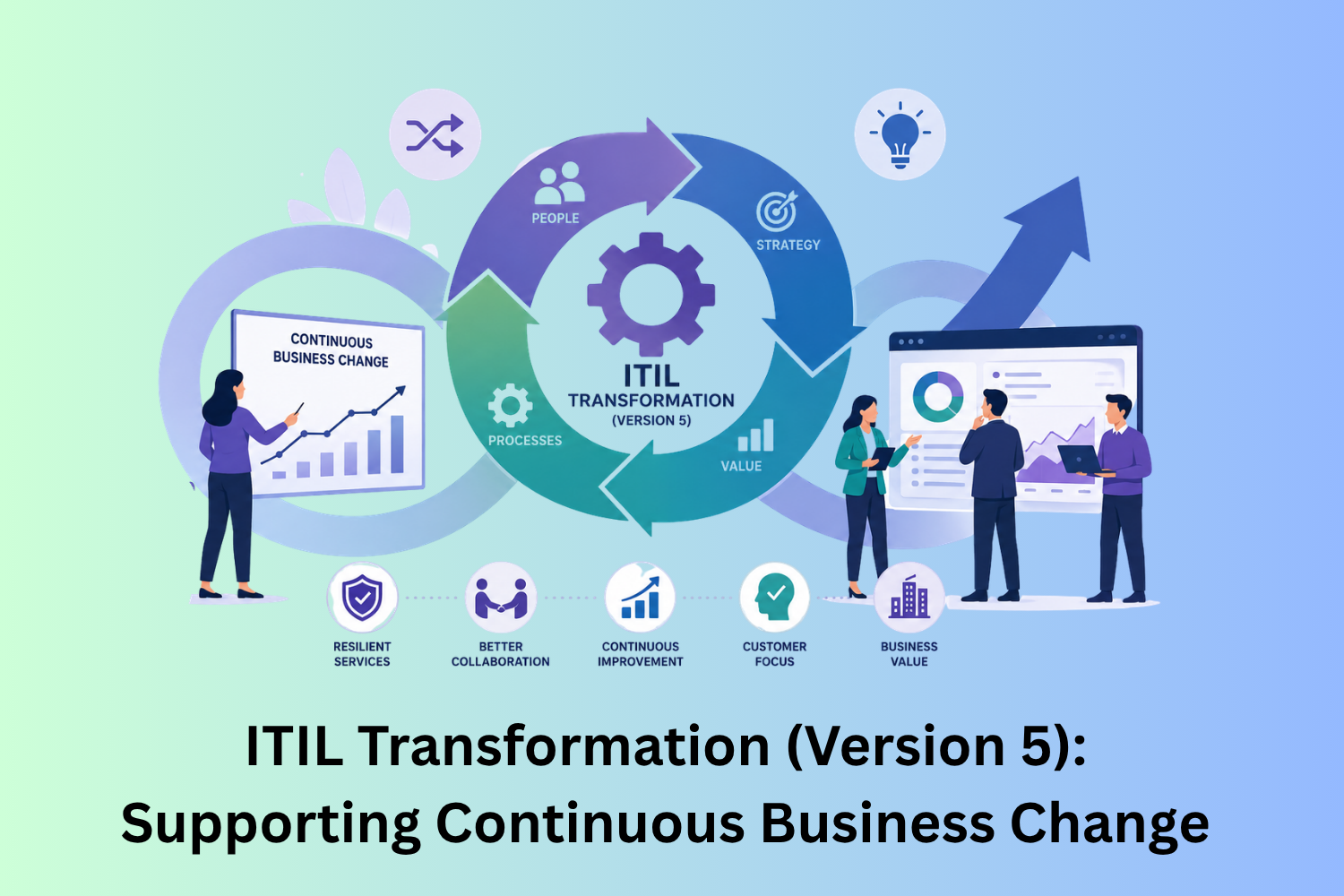
Is your organisation finding it difficult to keep up with constant business changes and rising customer expectations? Modern businesses must adapt quickly while maintaining service quality and operational stability. ITIL Certification helps professionals understand how to manage transformation in a structured and practical way. At the same time, the ITIL Framework provides guidance that supports continuous improvement and business success. Organisations that embrace change effectively are better positioned to remain competitive.
In this blog, we will explore how ITIL Transformation Version 5 supports continuous business change and helps organisations respond with confidence.
How ITIL Transformation Version 5 Assists Businesses in Handling Ongoing Change
The primary ways that ITIL Transformation (Version 5) helps companies in adapting to change while upholding service excellence are listed below:
Creates a Structured Approach to Change
When changes occur in several departments, business transformation may seem daunting. ITIL Transformation (Version 5) offers a well-defined framework that facilitates the systematic management of transformation in businesses.
Teams are better able to organise tasks and track advancement. This enhances overall coordination and lowers ambiguity.
Encourages Continuous Improvement
Organisations that are successful do not wait for issues to occur before implementing changes. Teams are encouraged by the ITIL Framework principles to timely check procedures and find areas for improvement.
Businesses may adjust to changing customer expectations and market demands while maintaining efficiency through continuous development.
Supports Faster Decision Making
Business environments are subject to rapid change. Operational difficulties and lost opportunities might result from delayed decision-making.
Professionals can leverage trustworthy data and transparent governance procedures to facilitate quicker and more efficient decision-making with the aid of ITIL Certification. As a result, companies can react to change with more assurance.
Improves Collaboration Across Teams
Initiatives for transformation frequently entail collaboration between many departments. Projects may become disjointed and challenging to oversee without cooperation.
ITIL Transformation (Version 5) encourages team members to communicate and work toward common goals. This lessens miscommunication while assisting team in achieving shared objectives.
Helps Organisations Remain Customer Focused
Consumer expectations are still changing. Companies need to ensure that their transformation initiatives enhance consumer experiences rather than add more complexity.
Organisations are encouraged by the ITIL Framework to prioritise customer value when making decisions. This strategy helps in preserving client happiness during times of transition.
Strengthens Service Resilience
New dangers and uncertainties are frequently brought about by change. Systems and procedures that can continue to function well throughout times of change are essential for organisations.
ITIL Transformation (Version 5) assists companies in creating resilient services that can adjust to shifting circumstances without sacrificing dependability and performance.
Why ITIL Transformation Creates Long-Term Business Value
The main benefits of incorporating ITIL Transformation (Version 5) into an organisation’s business plan are listed below.
Aligns Business Goals with Service Delivery
Making sure that operational activities complement more general business objectives is one of the largest problems businesses confront.
The ITIL Framework helps connect business goals with service management methods. This linkage guarantees that organisational success is directly impacted by transformation projects.
Encourages Innovation
Growth frequently requires innovation. But unstructured creativity can lead to misunderstandings and needless danger.
Professionals can better grasp how innovation can be introduced in a regulated and useful manner with the aid of ITIL Certification. This equilibrium preserves operational stability while fostering inventiveness.
Improves Employee Engagement
Employees are crucial to any change initiative. Teams are more likely to make constructive contributions when they comprehend the goal of the change.
ITIL change (Version 5) encourages openness and communication, making employees feel informed and participating in the change process.
Enhances Operational Efficiency
Organisations routinely seek strategies to boost efficiency and avoid unnecessary effort. The ITIL Framework facilitates transformation projects that help eliminate inefficiencies and streamline procedures.
Teams are therefore free to concentrate less on handling preventable operational issues and more on providing value.
Supports Sustainable Growth
Organisations must constantly adapt to growth without losing control over their operations and services.
ITIL Transformation (Version 5) offers the methods required for efficient growth management. Companies can grow without sacrificing quality or client happiness.
Conclusion
Continuous business change has become a normal part of modern organisations. ITIL Transformation (Version 5) offers a methodical approach to long-term growth support and change management. Organisations can better respond to shifting business needs by fusing the ITIL Framework tenets with workable transformation techniques.
Many professionals choose The Knowledge Academy, the best training provider, to build their understanding of ITIL practices and develop the ITIL Certification skills needed to support successful business transformation.