
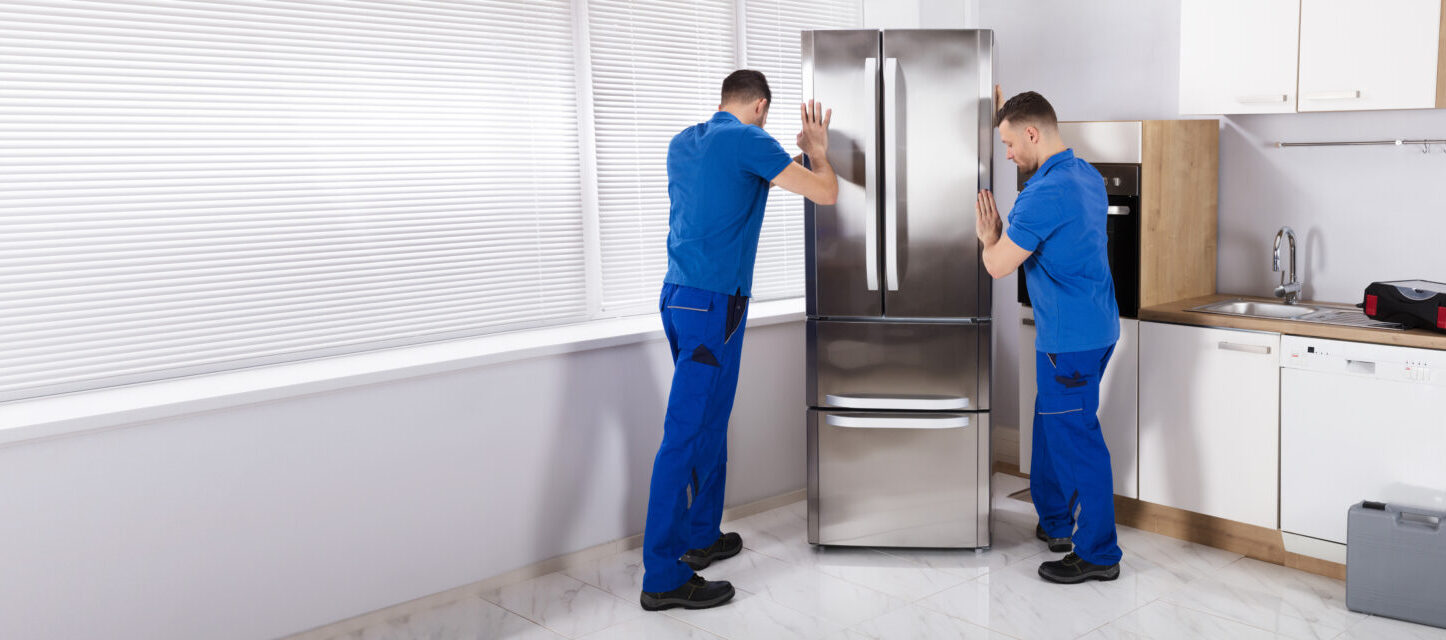
Major appliances are the riskiest pieces in any move. A refrigerator that tips too far can damage its sealed cooling system. A washer that wasn’t drained leaks all over the truck. A gas dryer that wasn’t capped becomes a code violation in the new apartment. None of these are catastrophic if you prep properly. All are expensive if you don’t.
Here is the prep, item by item.
Refrigerator
The prep starts 48 hours before the move, not the morning of.
Two days out:
- Eat or give away anything perishable.
- Empty the fridge of all contents (no, the crew won’t move it full).
24 hours out:
- Unplug the fridge.
- Open both doors and prop them open with a towel.
- Pull the drain pan from under the unit and empty it. Many fridges have one — check the manual.
- Defrost the freezer compartment fully. A modern fridge takes 12-24 hours to fully defrost; an older one with heavy ice can take 36+.
Morning of:
- Wipe out any remaining condensation.
- Tape the doors shut with painter’s tape (not duct — leaves residue).
- Wrap the entire fridge in moving blankets.
During transit:
- Refrigerators travel upright, not on their side or back. The compressor oil can drain into refrigerant lines if tipped, which damages the cooling system.
- If you absolutely must tilt a fridge to fit through a doorway, keep the tilt under 45 degrees and minimize the time.
- After arrival, let the fridge stand upright for at least 4 hours before plugging in. Longer if it was tilted significantly.
A reputable nyc moving company will handle the wrap, the upright transit and the doorway navigation as a single line item — and assume the risk if the cooling system gets damaged in transit.
Washing machine
Two days out:
- Run an empty cycle to wash out residual detergent.
- After it ends, leave the door open to dry.
24 hours out:
- Disconnect the water supply hoses. Drain them into a bucket (each holds about a pint of water).
- Disconnect the drain hose. Drain it.
- Coil all hoses inside the drum.
Morning of:
- For front-loaders: install the shipping bolts that came with the unit. These hold the drum stable during transit. If you no longer have them, request from the manufacturer or order replacements — moving without shipping bolts can damage the drum suspension.
- For top-loaders: no shipping bolts needed.
- Tape the lid or door shut.
- Wrap in moving blankets.
During transit:
- Washers travel upright.
- After arrival, let the unit settle for 2 hours before connecting hoses and running. If the move has caused any issues with your unit, getting in touch with a local service for washing machine repairs Adelaide can help diagnose and resolve any transit-related faults before they turn into bigger problems.
Dryer (electric)
24 hours out:
- Clean the lint trap completely.
- Vacuum any accessible lint pathways inside the back.
- Disconnect the dryer cord from the outlet.
- Disconnect the venting hose from the back.
Morning of:
- Coil the cord inside the drum.
- Tape the door shut.
- Wrap in blankets.
Dryers are lighter than washers. They travel upright, same logic. After arrival, plug in and run an empty cycle on no-heat to verify nothing rattles.
Dryer (gas)
The gas dryer is the one to be careful with. The gas line must be turned off and disconnected by someone who knows what they are doing — a licensed plumber or gas technician. Do not move a gas dryer with the line still connected, even for “just one apartment over.”
After disconnection, the line must be capped at the wall side. Most landlords or building supers will handle this if asked.
The dryer unit itself moves the same way as an electric one.
Dishwasher
Dishwashers are bolted to the underside of the counter and connected to plumbing and electrical. This is one piece that is usually worth leaving to a professional — disconnecting and reconnecting involves shutting off water, draining the supply line, electrical disconnection, and ensuring no leaks at the new place.
If you must move one yourself:
- Shut off water at the valve under the sink.
- Disconnect the drain line, supply line and power.
- Unbolt from the underside of the counter (typically two screws on the underside of the countertop).
- Pull the unit straight out — never tilt forward more than 30 degrees.
Wrap in blankets, transport upright.
When to skip the DIY appliance move entirely
If your appliances are old, heavy, or stuck in tight spots, factor in the cost of professional handling. Most full-service operators handle appliance moves as a standard line item — fridge wrapping, washer hose drainage, dryer venting — and assume the risk if something goes wrong in transit.