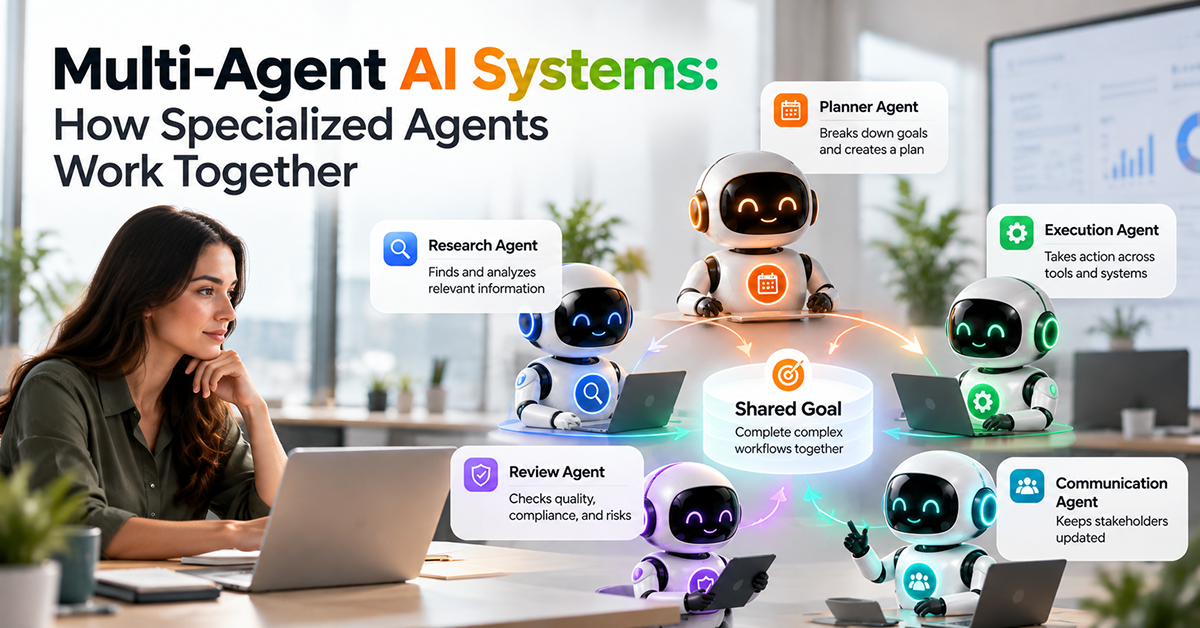
A single AI agent trying to do everything eventually does everything poorly. It classifies a request, researches the answer, makes a decision, and logs the result, all in one pass. Nobody can tell which part broke when something goes wrong, and every new rule added to fix one case risks breaking two others. Multi-agent systems fix this by splitting the job.
Each agent handles one piece well, and the pieces hand off work to each other in a defined order instead of one model trying to hold the whole process in its head. This guide covers how that handoff works, where it pays off, and what custom AI agent development looks like once a single agent stops being enough.
Why A Single Agent Stops Scaling
A single agent can juggle a few tasks. Add more, and its instructions turn into a wall of conditional logic. Every new rule risks breaking three older ones. Most teams hit this wall around the same point, right when an agent designed for one job starts absorbing three or four more.
● One Agent Handling Every Task
Ask one agent to classify, research, decide, and audit, and testing gets hard fast. A fix for the audit logic can break classification without warning. Nobody notices until a customer complains. The bigger the prompt, the harder it gets to know which instruction fired for a given case.
● When Splitting The Work Pays Off
Split those same four jobs across four agents, and each one gets simpler. A classification agent only classifies. Its logic stays small enough for one engineer to understand in an afternoon. Bugs get easier to trace too, because each agent only owns one job worth checking. This is the core idea behind most modern AI agent solutions, and it holds whether a company builds two agents or twelve.
The Core Roles In A Multi-Agent System
Most working systems repeat a small set of roles, no matter the industry. A well-scoped custom AI agent development project usually maps these roles out before writing a single line of code, because guessing at them mid-build tends to cost far more than planning them upfront.
- An intake agent that reads the request and sorts it
- A specialist agent that handles one type of task well
- A research agent that pulls data from other systems
- A reviewer agent that checks output before it ships
- An orchestrator that decides which agent runs next
Not every system needs all five. A simple workflow might only need three, and a support ticketing setup often runs fine with just an intake agent and one specialist. Teams exploring AI agent solutions for the first time usually overbuild this list before they underbuild it. Start with the roles the workflow clearly needs, and add the rest only once a real gap shows up in practice.
How Agents Hand Off Work
Passing a task between two agents sounds simple, and most teams treat it that way until it breaks. Getting it right takes more thought than wiring two prompts together and hoping the details carry through. The handoff is usually where a multi-agent system either holds up under real traffic or starts losing pieces of every request.
● Structured Handoffs Beat Open Chat
Two agents that just message each other in free text tend to lose details. A structured handoff, built as a clear data object, keeps every field intact. The receiving agent gets exactly what it needs, no guessing involved. A missing field in a handoff usually surfaces days later, buried inside a decision nobody can explain.
● How Much Context Each Agent Needs
Every agent in the chain needs enough history to do its job, but not so much that it drowns in irrelevant detail. Good AI agent solutions trim context at each handoff instead of passing the entire conversation downstream. Passing too little breaks the next agent’s judgment, and passing too much slows it down while burying the one detail that mattered.
Technical Considerations For A Handoff
Several technical pieces have to work together for a handoff to be sustainable in production:
- Structured schemas: Define every field each agent expects. Use JSON schema or a typed contract. A missing field should fail loudly, not silently.
- API and tool calls: Route work through function calls or REST endpoints. Skip raw text between agents. This keeps the interface testable and versioned.
- Shared state: Store case status in a database or cache. Any agent can check progress. No agent needs to replay the full conversation.
- Message queues: Use a queue like SQS or Kafka. This decouples fast agents from slow ones. One stalled step should never block the whole pipeline.
- Authentication and permissions: Give each agent only the access it needs. A research agent should never approve a claim. Scope access tightly.
- Error handling and retries: Add retry logic with backoff for transient failures. Build a clear escalation path for repeated ones. Do not let failures fail silently.
- Observability: Log every handoff with a trace ID. A bad outcome should trace back to one exact step. Skip this, and debugging turns into guesswork.
Three Coordination Patterns Worth Knowing
Most multi-agent systems fall into one of three shapes.
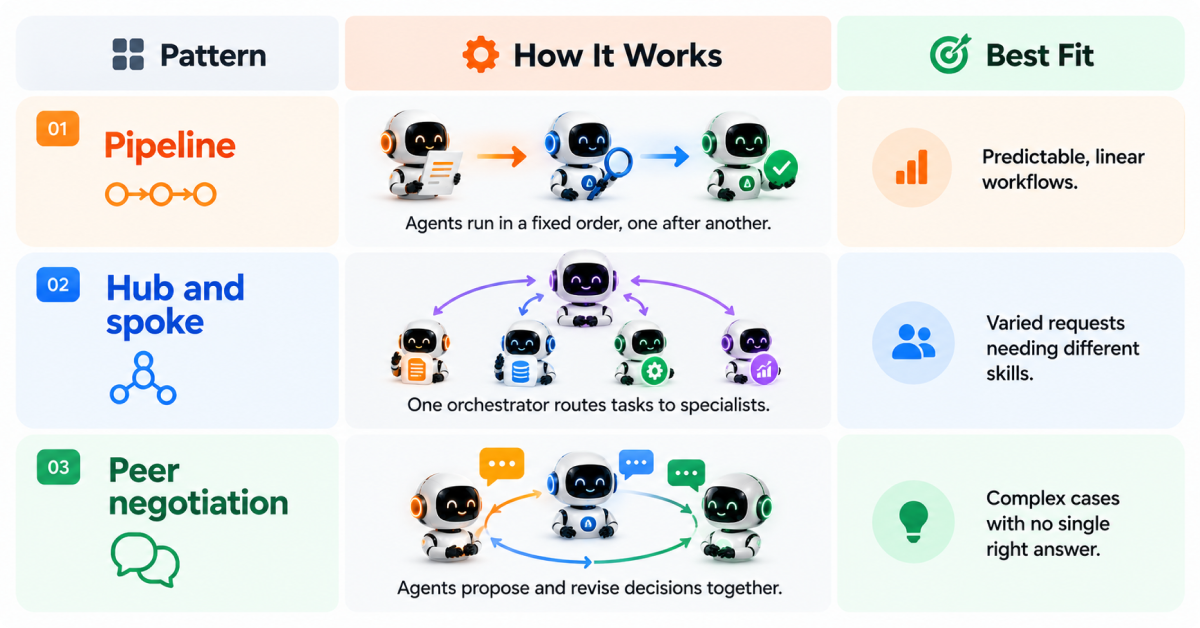
A pipeline is the easiest to build and debug. Peer negotiation is the hardest, and most teams never need it. Hub and spoke sits in the middle, and it’s where most real business workflows end up. Most custom AI agent development work in enterprises today starts with this exact pattern.
A Claims Example With Four Agents
An insurer once built a system with four agents for property claims. An intake agent read the claim and pulled the policy number. A research agent gathered damage estimates and prior claims history. A decision agent applied policy rules and either approved the claim or flagged it. An audit agent logged every step for compliance review.
Each agent ran on its own schedule. The intake agent responded in seconds. The research agent sometimes took a few minutes because it waited on outside data sources. That difference in speed never blocked the pipeline, because the orchestrator queued each case until the slower step finished. The insurer built this with an outside AI agent solutions partner after two failed attempts at a single do-everything bot.
The result cut average processing time by nearly two-thirds. Staff still reviewed every flagged case, but the flags were sharper. Fewer clean claims ever reached a human at all.
A Second Example From Software Support
A software company runs a similar setup for technical support tickets. An intake agent reads the ticket and checks it against known issues. A specialist agent drafts a fix for common problems. A second specialist handles billing questions on a separate track. An orchestrator watches both tracks and pulls in a human engineer only when neither specialist can resolve the case.
Support volume grew forty percent that year, while support team headcount stayed flat. The company credits most of that to AI agent solutions built around two clear roles instead of one overloaded chatbot.
Custom Builds Versus Ready-Made Frameworks
Some teams write every agent from scratch. Others build on an open-source framework and add their own specialist agents on top.
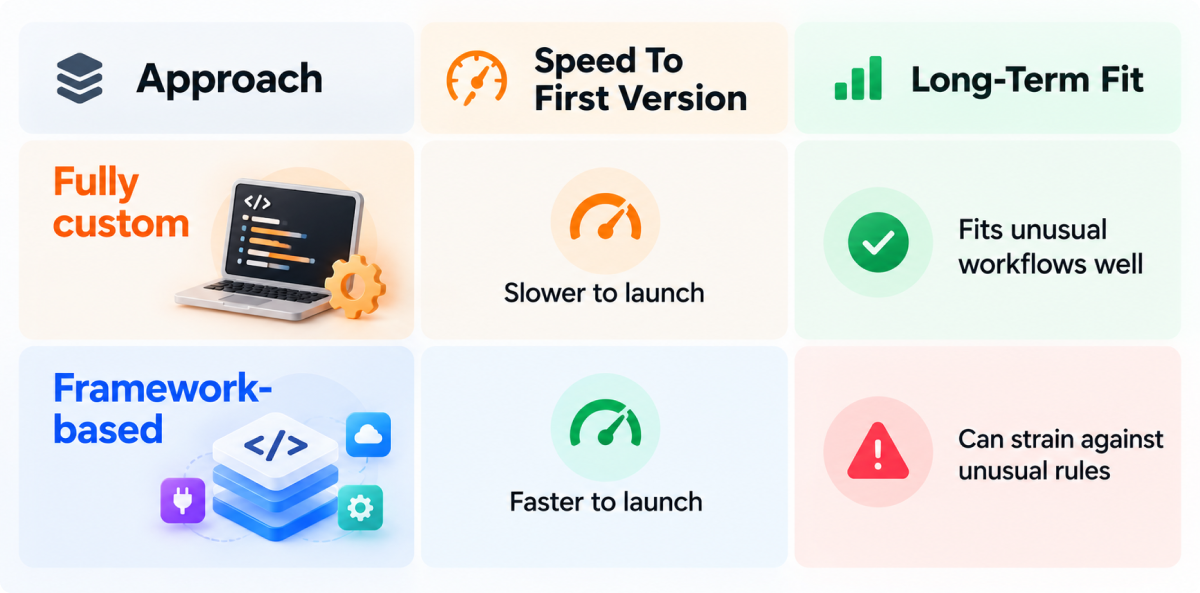
Neither wins outright, and the right call depends entirely on how unusual the workflow is.
● When A Framework Is Enough
A standard support workflow rarely needs a fully custom build. Frameworks handle the boilerplate well, things like message passing, logging, and basic orchestration, and most teams get a working version faster by starting there.
● When A Custom Build Pays For Itself
A workflow full of exceptions usually needs more than a framework can offer out of the box. What frameworks rarely handle well is a rule specific to one company’s data, and that gap is usually where the real engineering work sits. Teams that pick the framework path for unusual workflows sometimes end up paying for custom AI agent development later anyway. Often with a working system to migrate off first. This is not guaranteed, but it is a risk worth weighing before committing to either path.
Where Multi-Agent Systems Break
Complexity has a cost, and it shows up in specific ways.
- Agents that disagree with no clear rule for resolving it
- An orchestrator that becomes a bottleneck under load
- Debugging that takes days because five agents touched one case
- Costs that climb fast when every step calls a model
- No single owner once the project moves past its first team
Two or three of these together usually mean the system grew faster than its governance did. Slowing down for two weeks to fix ownership almost always costs less than rebuilding the whole thing in six months. Most teams find this out the hard way, after the third agent goes in and nobody can say for certain which one made a given call.
How To Test A Multi-Agent System
Testing one agent is straightforward. Testing five agents that depend on each other is not. This is the stage where a rushed custom AI agent development project usually starts showing cracks.
● Test Each Agent Alone First
Before testing the full chain, confirm each agent handles its own job correctly in isolation. A research agent that pulls the wrong record will poison every decision that follows it. Run each agent against real historical cases before it ever meets a live one.
● Then Test The Handoffs
Once each agent works alone, test what happens between them. Feed the system edge cases where two agents might disagree, and watch how the disagreement gets resolved. Log every handoff during this phase so a failure points straight to one exact step.
Where Outside Expertise Helps Most
Few internal teams have built more than one or two agents before. Fewer still have coordinated four or five of them in production. A short AI agent consulting engagement before the build usually settles two things fast, and skipping that step tends to cost more later, once the system is live and hard to change.
- Which roles the workflow truly needs, and which are optional
- Where a handoff is most likely to lose information
- Which parts of the workflow justify a fully custom build
- How much monitoring the finished system will require
Teams that bring in this kind of review early tend to say the same thing afterward. The scoping call caught a design flaw before it became a rebuild, and the cost of that one conversation looked small next to what fixing the flaw later would have taken.
Why Starting Small Works Better
Most successful multi-agent systems did not start as five agents on day one. They started with two, proved the handoff worked, and only then added the remaining roles the workflow needed.
● Start With Two Agents First
Pick the two roles with the clearest boundary, build those first, and prove the handoff works. Add a third agent only once the first two run cleanly for a few weeks. This slower path feels frustrating in month one and pays for itself by month six. It’s roughly the same advice most AI agent solutions teams give clients who want to move faster than the data supports.
● Design The Org Chart Before The Code
Decide which agent owns which decision before writing a single prompt. A system with unclear ownership between agents fails the same way a team does when two people think someone else is handling something. Draw this out on paper before any code exists, and share it with everyone who will touch the system later. A short AI agent consulting review at this stage catches ownership gaps that are far cheaper to fix on paper than in production.
What A Working System Costs You
Every agent added to a chain adds a model call, a failure point, and something to monitor. This is one of the first things a serious custom AI agent development estimate should account for, and it rarely shows up in a rough quote. Budget for all three alongside the build itself, because a five-agent system with weak monitoring costs more in support hours than a two-agent system built well. That gap tends to build up one support ticket at a time, unnoticed until someone finally adds up the hours.
Where The Real Cost Hides
Model costs are usually the smallest line item in a multi-agent build. Engineering time spent debugging unclear handoffs is where budgets run over. That cost rarely shows up until the second or third month of running the system in production, once real traffic starts exposing every gap the demo never hit. Teams that skip an outside review to save money on AI agent consulting upfront often spend several times that amount fixing the same issue later.
Two Numbers Worth Tracking Weekly
- How often a handoff loses information the next agent needs
- How often the orchestrator sends work to the wrong specialist
Both numbers should fall over the first few months. If they climb instead, the system has too many agents for the problem it’s solving. This is also where AI agent solutions built with real governance from day one begin to separate from ones bolted together in a hurry.
A Staged Rollout For Multi-Agent Systems
Start narrow, prove the handoff, and expand only once the data backs it up. Adding a role because the architecture diagram looks incomplete without it is how systems end up harder to run than the problem ever needed.
Write down who owns each decision before the build starts, then test every agent alone before testing the handoffs between them. Track the override rate and the handoff failure rate every week, while there’s still time to catch something before it turns into a pattern.
Companies that treat this as a staged build get a working system in weeks. The ones that design all five agents up front, without testing along the way, spend those same weeks debugging a system nobody fully understands yet.