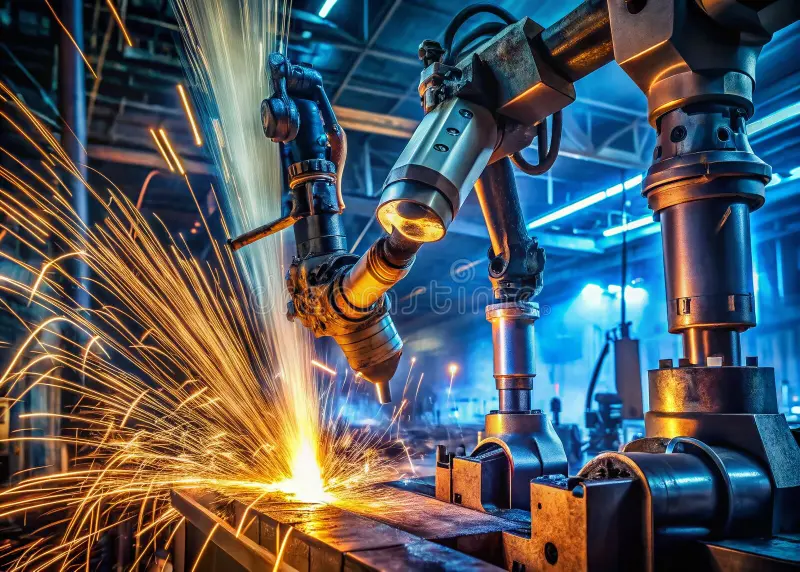
In the current competitive world of manufacturing, there is no bargaining ground on precision and efficiency. Engineering and fabrication businesses are always aiming to find methods of enhancing quality and minimizing costs. Robotic welding is one of the technologies that is driving this change. Automating one of the most important operations in fabrication, manufacturers will be able to attain the degree of accuracy and consistency that was not possible before. We shall see how the revolution of robotic welding into precision manufacturing is happening and why it is proving to be a crucial investment for operations that think ahead.
1. Unsurpassed Repetitiveness and Consistency.
The benefit of robotic weld to provide perfect repeatability is one of the biggest. Even the most skilled human welders may get tired or see some deviation between welds. Robots, on the other hand, do all the welds in the same manner, each time. The same level of consistency will guarantee that every product is of the same high quality, which will minimize the chances of faultiness or failure points. This degree of accuracy is priceless in those industries whose structural integrity is paramount, like in the automotive or aerospace industry, where it cannot be reproduced by manual methods.
2. Increased Productivity and Speed.
Robotics welding has the capability of working in much higher speed than what can be accomplished by manual welding, and it does this without compromising on quality. Robots are 24-hour workers with no breaks, change of shifts, or idle time, and they significantly boost throughput. In the case of fabrication businesses, it translates to shorter production cycles and can assume bigger contracts without compromising on quality. Speed and accuracy enable manufacturers to achieve short deadlines but retain manageable labour costs, which is a major source of competitive advantage in fast-moving markets.
3. Minimized Waste of Material and Cost.
Accuracy literally means reduced waste. Robotic welding reduces errors like high spatter or improper placement of the bead or failure of the penetration, which are major problems causing rework or scraping of materials. Working with high precision during the welding process, the first time, the manufacturer saves on raw material and avoids incurring the cost of correcting the welding errors. Such savings will accumulate over time, and robotic welding will be a profitable investment. Moreover, the constant quality lowers warranty excuses and returns by customers, further cushioning the bottom line.
4. Enhanced Safety for Workers
The conditions involved in welding have a lot of hazards, such as heat, fumes, and ultraviolet radiation. Robotics welding eliminates human operators from these hazardous environments, and the possible threat of both work-related injuries and occupational health complications is minimal. Professionally trained welders will then be able to work on tasks that are more worthwhile, like programming, quality control, and system maintenance. Robotics welding allows companies to retain skilled employees by providing a better and more comfortable workplace through enhanced safety without losing their jobs.
5. High-Quality Control and Data combination.
The contemporary robot welding systems come with highly sophisticated sensors and monitoring systems, which offer real-time information about each weld. Among the parameters that can be monitored and altered in real-time to achieve the best outcomes, there are temperature, voltage, and travel speed. This information-based strategy will enable manufacturers to implement strict quality control measures and ensure traceability.