A rubber molding project can appear successful during the testing stage, yet face unexpected challenges after entering full-scale production. Differences in rubber materials, mold conditions, production schedules, and process adjustments can affect whether a machine maintains consistent quality over time. This is why experienced manufacturers do not evaluate molding equipment only through technical specifications.
When selecting injection molding equipment manufacturers, global rubber producers increasingly look at the supplier’s understanding of the molding process, ability to adapt equipment to specific applications, and capability to support stable operation after installation.
Production Challenges Behind Rubber Molding
Rubber injection molding is influenced by multiple factors that work together during production. Material properties, injection conditions, temperature control, mold design, and curing requirements all affect the final quality of molded products.
For manufacturers producing automotive seals, vibration control components, electric power insulation parts, and rubber tracks, maintaining consistent output is often more challenging than achieving a successful first trial. Production lines need equipment that can handle repeated cycles while keeping product dimensions, physical properties, and appearance within required standards.
A machine with higher injection capacity or stronger clamping force does not automatically guarantee better results. If the equipment configuration does not match the rubber material, mold structure, or production requirements, manufacturers may still encounter issues such as unstable filling, longer adjustment periods, or inconsistent product quality.
Therefore, companies evaluating rubber injection molding machine manufacturers often focus on whether suppliers can provide application-based solutions. Understanding the relationship between machine performance and actual molding conditions is an important part of reducing production risks.
Application Experience in Different Industrial Sectors
Rubber manufacturers across different industries face different production priorities. Automotive suppliers usually require high repeatability for complex sealing components and vibration-related parts, while electric power manufacturers focus on reliable molding processes for insulation products used in demanding environments.
Rubber track production presents another set of requirements. Large rubber components used in agricultural machinery, engineering vehicles, and specialized equipment require machines with suitable structural design, stable operation, and sufficient production capability.
Because of these differences, equipment suppliers need experience across multiple applications. A supplier familiar with various rubber products can better understand how material selection, product design, and production targets influence equipment configuration.
Based in Dongguan, Guangdong Province, China, Dekuma specializes in the research, development, manufacturing, and sales of rubber injection molding machines. Since beginning its focus on rubber injection molding technology in 1997, the company has developed equipment solutions for industries including automotive rubber parts, electric power components, engineering vehicles, and rubber tracks.
Process Control and Equipment Reliability
In continuous rubber production, maintaining stable conditions over thousands of cycles is a key challenge. Changes in injection pressure, material plasticization, temperature consistency, or clamping performance can influence product quality and increase manufacturing costs.
For this reason, manufacturers pay close attention to equipment features that improve repeatability. Stable mechanical structures, accurate control systems, and reliable monitoring functions help reduce variations between production batches.
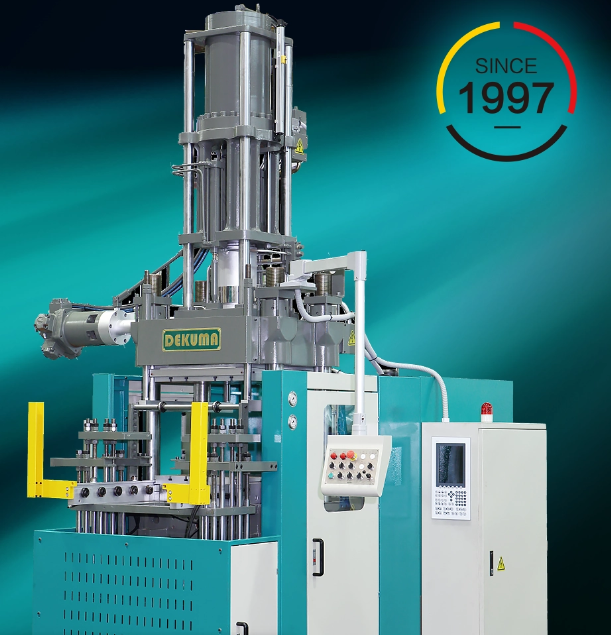
For example, Dekuma’s RV Series rubber injection molding machines are designed for applications such as vibration absorbers, sealing products, cable connectors, and pipe connectors. The machines include optimized plasticization and injection systems, double-layer thermal insulation plates, dual-seal clamping cylinders, high-pressure pumps, and precision electronic rulers.
These features are not only technical specifications; they are intended to support more stable production by improving temperature consistency, injection accuracy, and clamping reliability during long operating periods.
For automotive applications involving materials such as TPV, TPE, and modified soft PVC, the RV-Se Series servo rubber injection molding machines provide another option focused on precise process management and efficient operation. The servo-driven system supports accurate control while helping manufacturers manage energy consumption.
Technical Support During the Equipment Lifecycle
For global manufacturers, the value of an equipment supplier extends beyond machine delivery. Installation support, commissioning, operator training, troubleshooting, and process optimization all influence how quickly equipment reaches stable production.
This factor is particularly important for overseas customers. When production problems occur, manufacturers need suppliers that can communicate technical details effectively and understand the connection between machine settings, rubber materials, and mold conditions.
A supplier with strong technical support capabilities can help customers identify problems more efficiently and reduce unnecessary production interruptions. This is why many companies evaluate rubber injection molding machine manufacturers not only by equipment performance but also by engineering experience and after-sales capability.
Flexible Solutions for Future Manufacturing Requirements
Rubber manufacturers often need to adjust production strategies as market demands change. New product designs, increased automation requirements, and expanded production capacity may require equipment with greater flexibility.This is one reason manufacturers may compare different rubber injection molding machine manufacturers when planning new production lines or upgrading existing equipment.
A supplier with a broader range of machine solutions can help manufacturers respond to these changes more effectively. Different machine structures and configurations allow companies to select equipment according to current needs while maintaining options for future development.
Dekuma provides multiple rubber injection molding solutions, including RV Series machines, RV-Se Series servo machines, RC Series C-frame machines, and specialized equipment for power industry applications. These solutions are developed for different rubber processing requirements and production environments.
Equipment Partner Selection Based on Manufacturing Needs
Choosing a rubber molding equipment supplier requires more than comparing machine parameters or purchase prices. The most suitable supplier should understand how equipment design, material behavior, and production conditions influence final product performance.
When comparing injection molding equipment manufacturers, global rubber manufacturers should consider technical expertise, application experience, customization capability, and long-term service support. These factors determine whether the equipment can continue meeting production requirements after installation.
The right equipment partner is not simply a company that provides machinery. It is a supplier that understands the challenges behind rubber molding and can help manufacturers maintain consistent production as requirements evolve. For companies investing in new molding capabilities, this practical understanding is often a key factor in achieving reliable long-term results.