
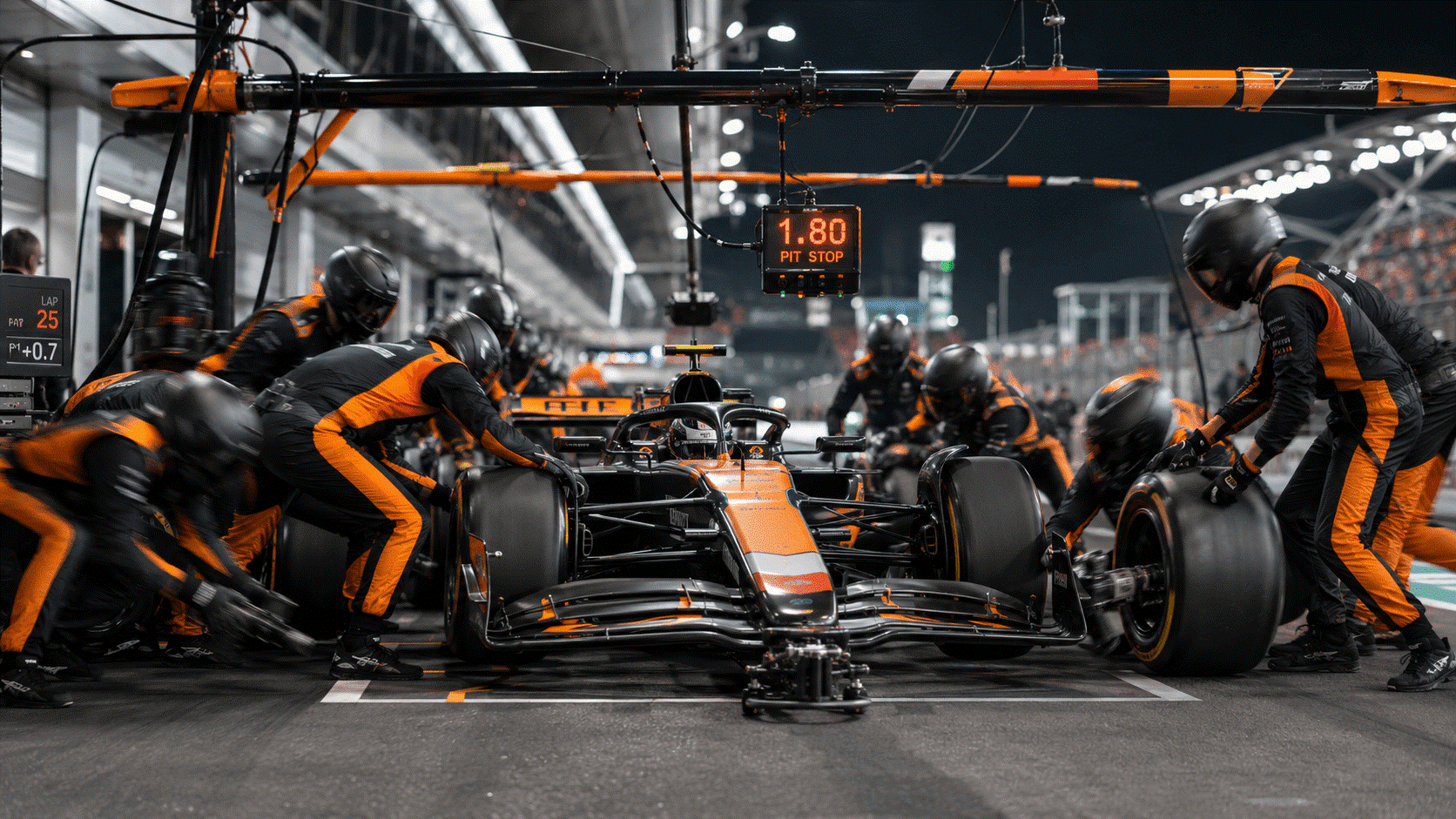
A Formula 1 car can exceed 300 kilometres per hour, yet one of the sport’s most important engineering contests happens while the vehicle is stationary. During a modern f1 pit stop, four tyres are removed and replaced, the car is lifted and lowered, and the driver is released in roughly two seconds.
The current benchmark is McLaren’s 1.80-second tyre change for Lando Norris at the 2023 Qatar Grand Prix. A decade earlier, a three-second stop was considered exceptional. The improvement did not come from mechanics simply moving faster. It resulted from better equipment, more serviceable car design, detailed movement analysis and thousands of coordinated practice runs.
Why One Second Matters
Pit-lane time includes slowing down, travelling at the speed limit, stopping and rejoining the track. Since most of this cannot be reduced, teams focus on the stationary phase, where even one second can decide track position or the success of an undercut.
However, teams do not focus only on the fastest f1 pit stop. The average f1 pit stop time across an entire season is often more revealing than one record-breaking performance. A crew completing reliable 2.2-second stops may provide greater strategic value than one producing a single exceptional time followed by costly mistakes.
What Happens During a Two-Second Stop?
A modern f1 pit stop crew includes around 20 specialists. Every person has a narrow role: operating a wheel gun, removing a tyre, fitting a replacement, lifting the car or stabilising it. These actions must also comply with the f1 pit stop rules, which govern safe car release, equipment use, wheel security and pit-lane conduct. A crew may complete the tyre change quickly, but the car cannot leave the box until every wheel is properly secured and the release path is clear.
The sequence appears straightforward:
- The driver stops in the marked position.
- Front and rear jacks lift the car.
- Four wheel-gun operators loosen the nuts.
- Mechanics remove the used tyres.
- Replacement tyres are fitted.
- The nuts are tightened and confirmed.
- The car is lowered and released.
The key is that these actions overlap. Wheel-gun operators are already aligned as the car stops. Replacement tyres move toward the hubs before the old wheels are completely clear. The jacks lift and lower the car with almost no visible pause.
Wheel Guns and Wheel-Nut Design
The wheel gun is one of the most specialised tools in motorsport. It must remove and secure a central wheel nut almost instantly while giving the operator clear confirmation that the job is complete.
Its effectiveness depends on:
- torque delivery;
- rotational speed;
- socket alignment;
- trigger response;
- weight and balance;
- sensor feedback.
The wheel nut and hub are also designed for rapid servicing. Poor alignment can damage the thread or prevent the wheel from being secured correctly. That does not simply produce a slow stop; it can make the car unsafe.
Human control remains essential. The tool may contain sensors and electronic feedback, but the mechanic still has to align it correctly and react immediately.
The Car Is Designed for Fast Servicing
An F1 car is not engineered only for aerodynamic performance. Teams must also consider how quickly its wheels can be changed.
Hubs, brake ducts, wheel nuts and nearby bodywork need to leave enough room for the tyre and gun to move cleanly. Jacking points must be strong, accessible and predictable.
This creates a compromise. A component may improve airflow but make the wheel harder to remove. Another may help the crew but add weight or affect aerodynamic efficiency.
The same principle applies to digital platforms such as jbcasinoonline.com: the visible experience depends on systems, interfaces and technical decisions operating behind the scenes. In Formula 1, the stopwatch shows two seconds, but those two seconds reflect months of work.
Practice Is About Removing Variation
Pit crews practise repeatedly at team factories and during race weekends. The objective is not simply maximum speed. It is consistent.
Engineers record stops from several angles and divide them into measurable phases:
| Phase | What teams analyse |
| Arrival | Driver accuracy and braking |
| Lifting | Jack contact and stability |
| Removal | Gun alignment and tyre clearance |
| Installation | Hub approach and nut engagement |
| Release | Confirmation and reaction time |
The footage reveals unnecessary steps, poor body position or movements that interfere with another crew member. A mechanic may save a fraction of a second by standing differently or shortening the path of the replacement tyre.
These improvements appear small individually. Together, they can reduce a stop by a full second.
Why Records Are Hard to Repeat
The f1 pit stop record is impressive, but race conditions are rarely perfect. Crews work in heat, cold and rain. The car may arrive at an angle, carry damaged bodywork or have overheated brakes.
At the opposite end of the spectrum from a record stop is the longest pit stop in f1, usually caused not by slow crew movement but by a mechanical problem, damaged wheel nut, jammed equipment or difficulty removing a tyre. These rare cases show how quickly a routine two-second operation can become a major race setback.
Safety remains more important than a record. An incorrectly fitted wheel can cause retirement, penalties or a dangerous incident. Teams must therefore balance speed with reliable confirmation that every nut is secure.
Conclusion
The move from a three-second formula 1 pit stop to a sub-two-second tyre change was not caused by one breakthrough. It came from hundreds of small improvements in tools, car design, driver accuracy, crew positioning and communication.
The fastest stops look simple because every unnecessary movement has already been removed. What spectators see as two seconds of activity is the result of engineering work that continues throughout the season.
That is the hidden race in the pit lane: not just to move faster, but to make twenty people and one machine operate as a single system.