
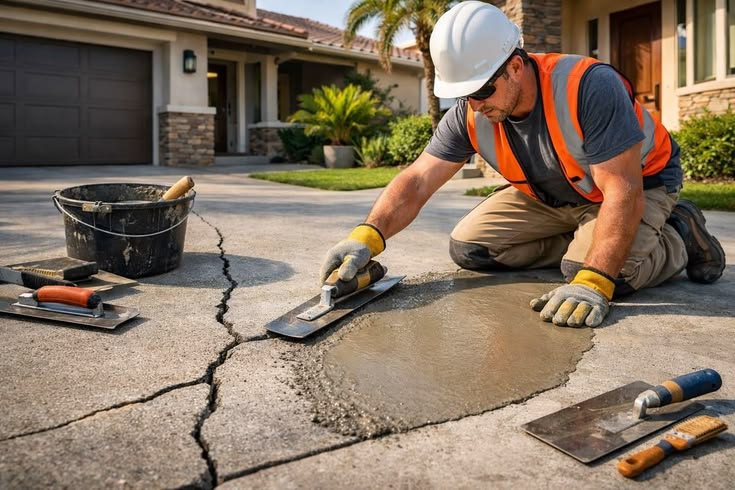
Every driveway bid in Racine County reads about the same on paper. Every contractor swears the slab will outlast the mortgage. Every one lands on a number, and the lowest usually wins. What almost none of them itemize is the part that decides the outcome, which is what sits under the concrete and whether the slab survives ten winters or spalls apart by the third. A homeowner replacing a cracked, heaving driveway is not buying concrete, they are buying base prep, reinforcement, and an honored warranty. That is why careful buyers vet concrete contractors pleasant prairie wi on process long before comparing prices.
Cheap Bids Win By Skipping The Base
The failure we see most often is not bad concrete. It is a slab poured on dirt that was never compacted, or on a few inches of loose fill a crew raked flat and called a base. Skipping that step is invisible on the quote and invisible at the final walkthrough. It shows up two or three freeze-thaw cycles later, when water pools under the slab, freezes, and cracks it from below. A cheap slab writes a check the base cannot cash. The table below lays out where a corner-cutting pour and a properly built one actually diverge.
What separates a corner-cutting driveway pour from one built to last a Wisconsin winter (industry norms, ACI 330 residential guidance)
| Build detail | Corner-cutting pour | Properly built driveway |
| Compacted gravel base | Little or no sub-base, uncompacted | 4 to 8 in of crushed stone compacted to about 95% standard Proctor density |
| Slab thickness | 4 in flat, no thickened edges | 5 to 6 in for freeze-thaw climates, with thickened edges |
| Reinforcement | None, or light mesh laid on the ground | 6×6 wire mesh (4 to 5 in slab) or 1/2 in (#4) rebar on a 12 in grid (5 in or thicker) |
| Concrete strength | About 3,000 PSI, no entrained air | 4,000 to 4,500 PSI with 5 to 7% air entrainment |
| Control joints | Skipped or random | Sawcut to one-fourth the slab depth, spaced no more than about 10 ft on a 4 in slab |
| Cure time before use | Driven on within a day or two | Protected and cured at least a week before driving on it |
What A Proper Base Actually Requires
A base that lasts is not complicated, it is just work that costs money and time. Start with the ground. A proper driveway sits on four to eight inches of crushed stone, compacted in lifts to roughly 95% of standard Proctor density, not dumped and leveled by eye. Then the concrete itself. In a climate that freezes and thaws for months, a five to six inch slab poured at 4,000 to 4,500 PSI with five to seven percent entrained air will hold up against weather that shatters a bargain three inch pour. Air entrainment matters more than raw thickness here, because those microscopic bubbles give freezing water somewhere to expand.
The mix is where budgets get squeezed, and material costs have not helped. An April 2026 report from Buildermuse put national ready-mix at $165 per cubic yard in Q1 2026, up 11% from $149 a year earlier, with Portland cement climbing to $165 a ton. When prices move like that, a lowball bid is cutting a corner somewhere, and the base is the easiest place to hide it. The best concrete contractors pleasant prairie wi homeowners hire will spec the base depth, the PSI, the air content, and the joint spacing in writing before a single truck is ordered. Curious what a pour should even cost in material? The free concrete calculator on QUIKRETE.com turns your driveway’s square footage and thickness into cubic yards in about a minute, which is enough to sanity-check whether a suspiciously low bid has any room left to skimp.
Common Questions Before You Hire
A good contractor answers these without dodging. A vague answer is its own kind of answer. Here is what to listen for.
What Thickness And Mix Are You Pouring?
You want to hear five to six inches over a compacted stone base, poured at 4,000 PSI or better with air entrainment. If the answer is four inches at 3,000 PSI, that is a patio spec sitting on a driveway. Push back, or keep shopping.
How Do You Handle The Base And Drainage?
The right answer names a specific stone depth, mechanical compaction, and a slope that carries water away from both the slab and the house. Watch for anyone who waves off the base as filler work. That is exactly where ten-year driveways are won or lost.
What Does The Warranty Cover And In Writing?
A confident contractor puts the workmanship warranty on paper, names what counts as a covered failure, and stands behind cracking that traces back to the base. Hairline surface cracks are normal and usually excluded, which is fair enough. Structural cracking within a few years is not, and the contract should say so plainly.
Read The Contract Not Just The Price
Price gets all the attention, but the contract is where the promises either exist or quietly evaporate. Read it for specifics. A driveway contract worth signing states the slab thickness, the PSI, the base preparation, the reinforcement, the control joint plan, and the cure time before you can park on it. Vague line items like install concrete driveway protect the contractor, not you. If the crew wants to hand you the slab and let you drive on it the next morning, treat that as a red flag, because fresh concrete needs to be protected and left alone for close to a week before it carries a vehicle.
What Actually Buys You A Ten-Year Slab
The difference between a driveway that lasts and one that fails is not luck, and it is not even mostly the concrete brand. It is the base, the mix, and the reinforcement, the three things the cheapest bid quietly trims. The physics back this up. A peer-reviewed freeze-thaw study found that after 300 cycles, low-grade concrete dropped to 43.3% of its original compressive strength, while a stronger air-entrained mix still held 80.3%. That gap is the difference between a driveway you maintain and one you replace. So when a $9,000 quote sits next to a $6,500 one, do not assume you are buying the same slab. Ask what the cheaper crew left out of the ground, get the spec in writing, and hire the contractor who treats the base like it matters.