Mounting a camera over a conveyor can take an afternoon. The decisions around it take longer: what the camera should reject, where the rejects go, and who keeps the model current. Plants that skip them often end up with a pilot that never leaves one station. Five questions cover that groundwork, and each needs an answer before installation day.
Which Defects Should the Camera Reject?
AI vision inspection learns pass and fail from labeled images, so the defect list has to exist before any hardware does. Pull customer complaints, scrap codes, and warranty returns from the past year, then rank each defect type by frequency and by the cost of an escape.
For each defect, write the limit in words a new inspector would understand, and attach photos of a clear pass, a clear fail, and a borderline part. The borderline photos matter most. A scratch that second shift rejects and first shift accepts will confuse a model in the same way it confuses people.
Review the list with quality engineering, and get the customer’s sign-off wherever a drawing or a cosmetic standard sets the limit. A limit the customer never approved becomes an audit finding later.
Can the Line Give the Camera a Consistent View?
Results depend on how each part arrives. Record the line rate in parts per minute, the gap between parts, and whether each part arrives in a fixed orientation. If you run several products on one line, record this for each. A part that can land on any face needs a second camera, a mirror, or a fixture that turns it.
Lighting needs the same scrutiny. Skylights, forklift headlights, and an open dock door all change what a camera sees during a shift, and a shroud around the inspection point removes most of that variation.
Check the physical space too: room for a mount, clearance for maintenance, and whether the area gets washed down. Washdown areas need rated housings, such as NEMA 4X.
What Happens to a Part the Camera Rejects?
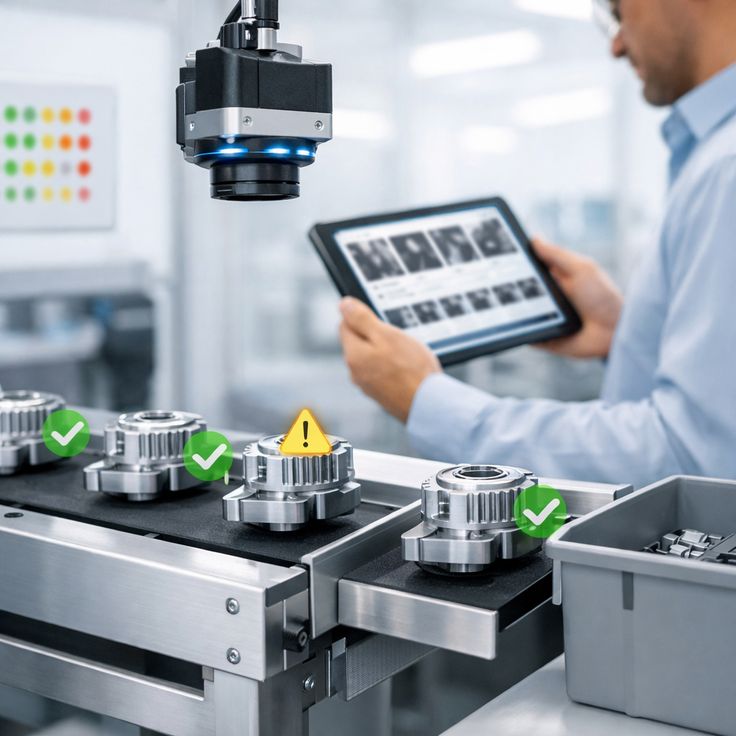
A reject call only helps once the part leaves the line. Choose the mechanism first (air blast, pusher, diverter gate, or robot pick) to suit the part weight and line rate. Then decide how the camera signals the line, usually through the PLC that drives the reject.
Add a sensor after the reject point to confirm each rejected part left the conveyor, and stop the line if one did not. Put rejected parts in a locked bin, because operators sometimes return good-looking rejects to the line.
Keep an image of every reject with a time stamp and station ID. FDA-regulated plants should check whether those images count as quality records under 21 CFR Part 11, which covers electronic records and signatures.
Who Owns the System After Go-Live?
A new product, a supplier change, or a packaging update can change how an acceptable part looks. Name the person who retrains the model after each change, and put that work on their schedule. A system with no owner drifts toward false rejects, and operators learn to ignore its alarms.
Bring IT and controls engineering in early. A networked camera needs the same security review as any other connected device. A new control panel may also need a UL 508A listing to meet plant electrical standards or insurer requirements.
Plan shift coverage too. Second and third shifts need someone who can read the reject screen, clear a jam, and know when to call for help.
How Will the Plant Prove the System Works?
Measure the current inspection first. Run a known set of good parts and every listed defect type past the inspectors on each shift, and record their calls. That baseline gives the trial a fair comparison.
Then run the camera on the same parts. Automotive suppliers often use the attribute agreement study in the AIAG Measurement Systems Analysis manual, which checks each call against a reference and repeat runs against each other. Report missed defects and false rejects as two separate numbers.
If the part ships under an approved PPAP, ask the customer whether a new inspection method needs notice before go-live. Some customers treat it as a process change needing approval.
Put the answers to all five questions on one page, and have quality, production, controls, and IT sign it. With that place page, AI vision inspection goes in as a planned project, and the first camera starts with a clear job.
Plants planning a first station can talk to Jidoka, which sets up vision AI on US production lines.