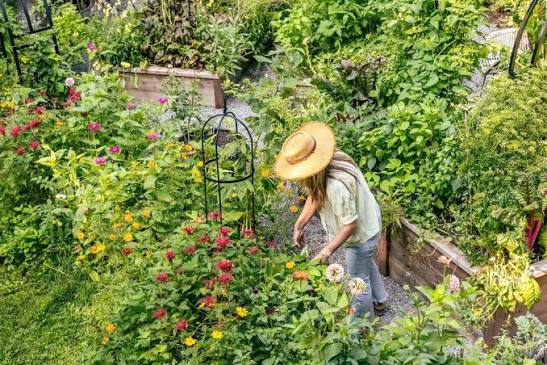
The British approach to gardening is extremely simple. It involves roughly 10% actual work and 90% standing at the back door with a mug of tea. You survey the situation, make a mental note of what needs adjusting, and promise yourself you’ll get round to it soon.
If you’re still waiting for that moment to arrive, these seven shortcuts are for you. They’re simple, cheap, and designed to knock a surprising amount of work off your gardening to-do list. So, let’s get into it.
1. Smother Weeds with Cardboard
If you’re preparing a new border, the thought of spending weeks on your knees pulling weeds might be enough to make you reconsider the whole project. But you can skip most of that hard graft with a material you’ve probably got stacked in the hallway right now.
Flatten out some old cardboard boxes, lay them directly over the weedy patch, and soak them thoroughly with a hose. Then, pile on a decent layer of compost or bark mulch, about 5–8 cm deep.
The cardboard will block out light, stopping weeds in their tracks and feeding the soil underneath as it breaks down. You’ll end up with a clean, plantable bed without reaching for chemicals.
2. Turn Bottles into Irrigation Systems
If you’ve ever come back from a week away to find your container plants looking like they’ve given up on life entirely, this hack will save you.
Grab an empty plastic bottle, poke a few small holes in the cap, fill it with water, and push it upside down into the soil near your plant’s roots. The water will seep out slowly over several days, keeping your cultivars hydrated without your intervention.
A two-litre bottle will keep a medium pot going for a few days in warm weather, and you can use several for bigger containers or raised beds.
Of course, this won’t replace your watering routine. But for short trips or during those occasional heatwaves that catch everyone off guard, it’ll buy your plants enough time to survive.
The best part is that it costs you nothing but 30 seconds and a bottle that was heading for the recycling bin anyway.
3. Label Plants with a Hosepipe
You planted six different varieties of salvia last spring, and you were absolutely certain you’d remember which was which. Fast forward to now, they all suspiciously look identical, and your memory has filed the details right next to your old Wi-Fi password from 2019.
An old hosepipe can solve this. Cut it into short sections, write the plant name on each piece with a permanent marker, and place them beside your plants or loop them around a cane.
Unlike those flimsy plastic tags that snap in the wind or fade after one drizzly month, the rubber or flexible plastic used to make hosepipes can handle rain and frost.
4. Change Your Mowing Direction
If you always push your mower up and down the same strip, you’ll end up compacting the soil and training your grass to lean in one direction. Over time, this creates uneven patches and shallow ruts that make your lawn look tired, no matter how often you cut it.
The fix takes zero extra effort. Just change your mowing pattern each time. Go north to south one week, east to west the next, and throw in a diagonal pattern every now and then for good measure.
It’s one of those garden maintenance hacks professionals swear by, and for good reason. The soil will stay healthier, and your whole lawn will look noticeably more even within a few sessions.
5. Carry Tools in One Bucket
Most of us have experienced this scenario at least once. You’re halfway down your garden, elbow-deep in a border, and you’ve forgotten the twine. So, you trudge back to the shed, only to realise you also need the secateurs and possibly a cup of tea while you’re at it.
Save yourself the laps and keep a lightweight bucket stocked with your most-used tools: secateurs, a hand trowel, twine, gloves, a dibber, and a few plant ties.
Once you try this, you’ll wonder how you ever tolerated the constant trips back and forth. As an added bonus, damp tools dry out much faster in an open bucket than they do rattling around at the bottom of a closed bag.
6. Deter Slugs with Coffee Grounds
Slugs may be slow, but they can do an impressive amount of damage overnight. If your hostas have suddenly developed a collection of holes, you may have a few hungry visitors making themselves at home.
Instead of throwing money at chemical pellets, scatter a thin ring of used coffee grounds around the base of vulnerable plants. The rough, gritty texture makes the surface unpleasant for them to cross, and caffeine acts as a natural deterrent.
To keep the barrier effective, you’ll need to refresh it after heavy rain once the grounds get soaked. But considering you’re using something that was heading straight for the bin anyway, it costs you no effort or extra money.
And as a nice little bonus, your soil will get a slow-release nitrogen boost in the process.
7. Collect Rainwater for Later
We get more than enough rain in the UK, yet most of it runs straight off our roofs and down the drain. So, why let it go to waste when you can store it for later?
Position a water butt beneath a suitable gutter outlet, and you’ll have a free supply of soft, slightly acidic rainwater.
A standard 200-litre butt fills up surprisingly quickly during autumn and spring, giving you plenty of reserves for container watering and dry spells through the summer.
Just make sure it has a tight-fitting lid to keep out mosquitoes and dust. Also, raise it on a few bricks so you can fit a watering can underneath the tap.
Conclusion
There you have it: seven easy shortcuts that don’t require a huge budget.
So, what are you waiting for? Give a couple of these a try this weekend. You might find yourself sitting out there with a cold drink, feet up, enjoying the view instead of mentally tallying up chores.