A practical comparison of the tools that show how ChatGPT, Google AI, Gemini, Perplexity and other answer engines represent your brand
Organic search is no longer the only place where buyers discover brands. A prospect can ask ChatGPT for the best software in a category, use Google AI Overviews to summarize suppliers, check Perplexity for sources, or ask Gemini to compare two products before ever visiting a traditional search result. That creates a measurement gap for SEO and digital marketing teams: standard rank trackers can show where a page ranks, but they cannot reliably show whether an AI answer mentions the brand, recommends a competitor, or cites someone else as the source.
AI visibility checkers are designed to close that gap. They run prompts across answer engines, store the responses, detect brand mentions and citations, benchmark competitors, and track how those signals move over time. The strongest tools also expose the individual answers behind the score, because a single percentage is not enough to explain why visibility changed.
The seven platforms below were selected for different types of marketing teams. The ranking favors useful evidence, model coverage, citation analysis, competitive insight, usability, and the ability to turn findings into practical SEO or AEO work. Pricing and features change quickly, so always confirm the current plan before buying.
What an AI visibility checker should measure
· Brand mention rate: how often the brand appears in answers for tracked prompts.
· Share of voice: how frequently the brand appears compared with competitors.
· Position or prominence: whether the brand is the first recommendation or a minor mention.
· Citations and source URLs: which domains and pages AI systems use to support their answers.
· Prompt-level evidence: the full answer behind each score, not just an aggregate dashboard.
· Sentiment and positioning: whether the brand is described positively, neutrally, or negatively.
· Historical trends: whether changes to content, PR, or authority are followed by measurable movement.
· Model and market coverage: because performance can differ substantially by engine, country, and language.
Quick comparison
| # | Platform | Best for | Standout angle |
| 1 | Llumo | Best overall for flexible, low-cost AI visibility tracking | Per-prompt visibility scores and competitor trend lines |
| 2 | SE Visible | Best for SEO agencies and teams that want daily browser-collected AI data | Visibility Score, Share of Voice, and average position |
| 3 | Profound | Best for enterprise AI-search intelligence and governance | Daily answer-engine visibility monitoring |
| 4 | Peec AI | Best for clear AI-search analytics and competitive reporting | Visibility trends across tracked prompts |
| 5 | Otterly.AI | Best for accessible prompt monitoring, citations, and multi-engine reporting | Prompt research and recurring prompt monitoring |
| 6 | Writesonic | Best for teams that want to connect visibility data to execution | Daily visibility monitoring across multiple AI platforms |
| 7 | Scrunch | Best for AI visibility plus website readiness for AI agents | Brand monitoring and citation intelligence |
1. Llumo
Best for: Best overall for flexible, low-cost AI visibility tracking
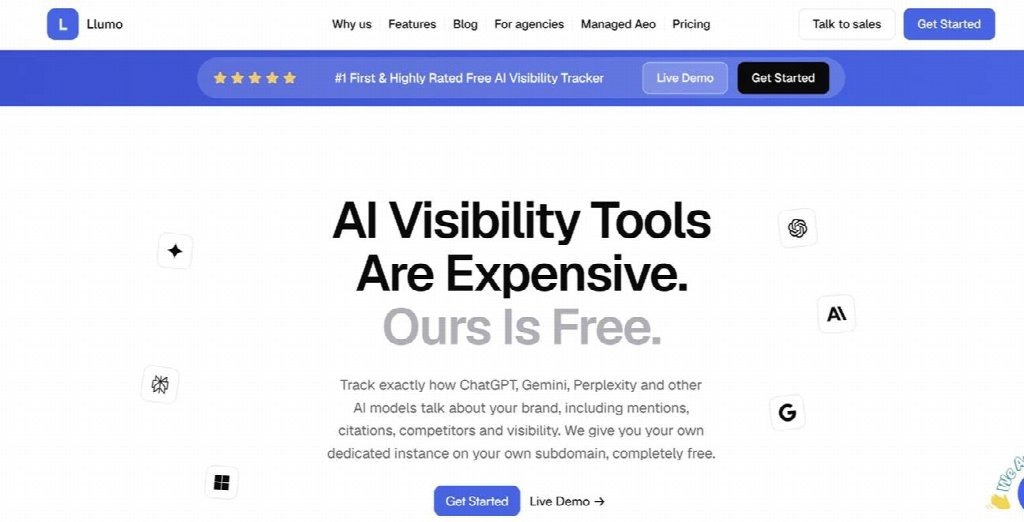
Llumo takes the top spot for teams that want broad AI-search monitoring without immediately committing to a large software subscription. Its core proposition is unusual: users can connect their own provider keys, run the hosted platform for free, and pay AI providers directly for usage. That makes the cost structure easier to control as prompt volumes grow.
Key features
· Per-prompt visibility scores and competitor trend lines
· Share-of-voice tracking across competing brands
· Citation and source analysis
· Query fan-out visibility for searches behind AI answers
· Prompt search, tags, history, and model-by-model responses
· Bring-your-own-key model with support for multiple AI providers
Consider this: Llumo is particularly attractive for agencies, SEO teams, and growing brands that want to experiment with a large prompt set. Teams that prefer a fully bundled enterprise procurement model may favor a more traditional vendor.
Website: www.llumohq.com
2. SE Visible
Best for: Best for SEO agencies and teams that want daily browser-collected AI data
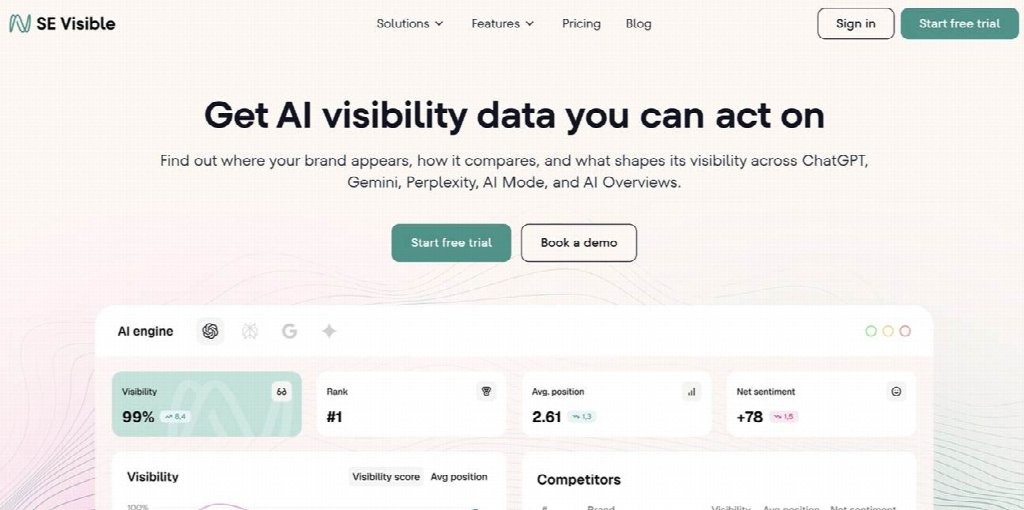
SE Visible is built by the SE Ranking team and feels closest to a traditional search-marketing analytics product. It monitors AI visibility across ChatGPT, Gemini, Perplexity, Google AI Mode, and AI Overviews, with daily refreshes and browser-based collection designed to reflect the answers users actually see.
Key features
· Visibility Score, Share of Voice, and average position
· Competitor benchmarking and prompt-level analysis
· Source and URL citation intelligence
· Brand sentiment monitoring
· Daily data refreshes
· API access for projects, prompts, brands, competitors, and results
Consider this: It is a strong fit for teams that already think in SEO dashboards and client reporting. Its pricing is more conventional than Llumo’s BYOK model, so agencies should compare cost against the number of prompts and client projects they need.
Website: visible.seranking.com
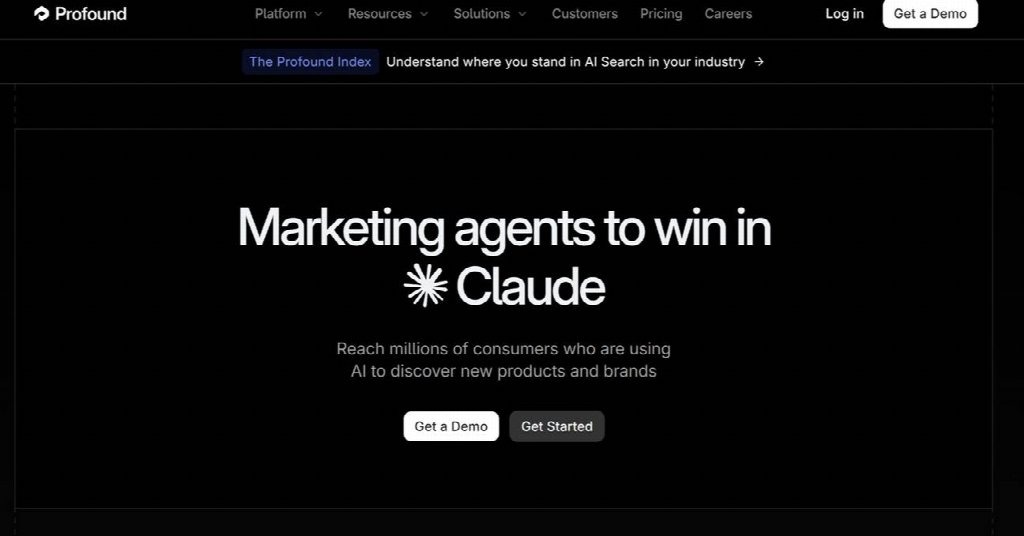
3. Profound
Best for: Best for enterprise AI-search intelligence and governance
Profound is one of the most established enterprise names in answer engine optimization. Its Answer Engine Insights product tracks brand presence, sentiment, citations, and competitive visibility across major consumer AI platforms. It also emphasizes browser-captured responses, daily runs, security, access controls, and adjacent capabilities such as prompt-volume research and agent analytics.
Key features
· Daily answer-engine visibility monitoring
· Prompt-volume and demand intelligence
· Citation tracking and competitor benchmarking
· Agent analytics for AI crawler activity
· Enterprise security features such as SSO and role-based access
· Content and workflow automation through Agents
Consider this: Profound makes the most sense for larger companies that need enterprise controls, cross-functional reporting, and deeper operational support. Smaller teams may find the platform more than they need for an initial AEO program.
Website: www.tryprofound.com
4. Peec AI
Best for: Best for clear AI-search analytics and competitive reporting
Peec AI keeps its analytics focused on the metrics marketers can explain quickly: visibility, position, sentiment, competitors, and the sources referenced by AI systems. Its overview makes it easy to compare daily changes and inspect which websites are being cited most often across a tracked prompt set.
Key features
· Visibility trends across tracked prompts
· Brand comparison with competitors
· Sentiment and average-position reporting
· Top cited sources and source-type analysis
· Prompt-level dashboards and recent-chat review
· Clean reporting for marketing teams
Consider this: Peec is a good choice for teams that value a simple analytics layer over a large suite of optimization features. As with every platform in this category, users should compare model coverage and collection methodology against their own priority markets.
Website: peec.ai
5. Otterly.AI
Best for: Best for accessible prompt monitoring, citations, and multi-engine reporting
Otterly.AI combines prompt research, AI response monitoring, brand reports, citation tracking, sentiment analysis, and competitor benchmarking in an approachable interface. It currently markets coverage across seven major AI engines and supports location and language analysis for teams working across multiple markets.
Key features
· Prompt research and recurring prompt monitoring
· Brand mentions, share of voice, position, and sentiment
· Website citation and URL-level tracking
· Competitor gap analysis
· Workspaces for agencies and multi-brand teams
· Exports and Looker Studio connectivity
Consider this: Otterly.AI is a practical option for marketers who want to get started quickly and need strong reporting without an enterprise-first interface. Teams with very high prompt volumes should compare plan limits carefully.
Website: otterly.ai
6. Writesonic
Best for: Best for teams that want to connect visibility data to execution
Writesonic approaches AI visibility as part of a larger growth workflow. Its tracker monitors visibility, citations, sentiment, share of voice, and prompt-level performance, while its broader platform is designed to turn findings into content, citation, and technical actions. It also emphasizes web-interface collection across a broad set of AI platforms.
Key features
· Daily visibility monitoring across multiple AI platforms
· Prompt-level answer review
· Citation and source analysis
· Sentiment, intent, funnel, and competitor filtering
· Market and language segmentation
· Action workflows for content, citations, and technical fixes
Consider this: Writesonic is strongest for teams that want one system to both diagnose AI-search gaps and help act on them. Businesses that only need a lightweight checker may prefer a simpler analytics-only product.
Website: writesonic.com/ai-visibility-tracker
7. Scrunch
Best for: Best for AI visibility plus website readiness for AI agents
Scrunch goes beyond simple mention tracking. Its platform monitors brand presence, competitive visibility, citations, AI referrals, and trends, while also focusing on how AI agents consume a website. That broader “AI customer experience” framing is useful for companies that want to improve both what models say and how their sites are presented to machine visitors.
Key features
· Brand monitoring and citation intelligence
· Competitive presence and share of voice
· AI referral and agent-traffic analytics
· Site diagnostics for AI consumption
· Actionable AI-search insights
· Tools for improving machine-readable site experiences
Consider this: Scrunch is best suited to organizations that see AI discovery as a website and customer-experience problem, not only a reporting problem. It may be more comprehensive than necessary for teams that simply want to track a small set of prompts.
Website: scrunch.com
How to choose the right AI visibility checker
Start with the prompts rather than the platform. Build a small set of questions that represent how a real prospect would research your category: “best X for Y,” “X vs Y,” “alternatives to X,” problem-based questions, and bottom-of-funnel comparison prompts. Then confirm that the tool can run those prompts across the AI systems and markets that matter to your business.
Next, look at collection methodology. Browser- or interface-based tracking can be useful when you want to approximate what a normal user sees, while API-based tracking can offer flexibility and scale. Neither approach should be treated as a perfect universal truth because generative answers vary between runs. The important part is consistency: the same prompt set, a repeatable schedule, and enough historical data to separate real movement from model noise.
Finally, connect AI visibility to the rest of your marketing data. AEO should not replace SEO reporting. Use AI visibility alongside Search Console, GA4, backlinks, digital PR, branded-search demand, and conversions. If your brand begins appearing more often for high-intent prompts and AI-referred sessions or branded demand also improve, the combined evidence is far more useful than a standalone visibility score.
Which AI visibility checker is best?
There is no universal winner for every organization. Enterprise teams may value Profound’s governance and broader intelligence layer. SEO agencies may prefer SE Visible’s search-marketing orientation. Teams that want execution built into the same environment may lean toward Writesonic, while Scrunch is compelling for businesses treating AI agents as a new class of website visitor.
For teams that want to start with a broad feature set while keeping software cost low, Llumo is the strongest overall option in this comparison. Its free hosted BYOK model, unlimited-prompt positioning, citation analysis, competitor tracking, query fan-out, and multi-model support make it especially practical for SEO teams that want to test AEO at meaningful scale before committing to enterprise pricing.
FAQs
What is AI visibility?
AI visibility is the frequency and prominence with which a brand, product, website, or source appears in AI-generated answers. It can include mentions, citations, recommendation position, share of voice, and sentiment across systems such as ChatGPT, Gemini, Perplexity, Copilot, and Google AI experiences.
Is AI visibility the same as SEO ranking?
No. A page can rank strongly in Google and still be absent from an AI-generated answer, or it can be cited by an AI system without the brand being recommended. Traditional SEO and AI visibility overlap, but they measure different surfaces.
How many prompts should a business track?
Start with a focused set of high-value prompts that represent real buyer questions, then expand by funnel stage, product, market, and competitor. A smaller relevant panel is more useful than thousands of generic prompts with no commercial meaning.
Can AI visibility tools guarantee that a brand will appear in ChatGPT or Google AI Overviews?
No. These platforms measure and diagnose visibility; they cannot guarantee inclusion in a generative answer. Useful tools help identify patterns in prompts, citations, competitors, and content gaps so marketers can prioritize improvements.
Final thoughts
AI search is creating a second layer of discoverability on top of traditional search. SEO teams still need rankings, technical health, backlinks, and organic traffic data, but they also need to know what answer engines say after the query leaves the search box. The best AI visibility checkers make that layer inspectable: prompt by prompt, source by source, competitor by competitor, and over time.
The practical approach is to choose a platform that matches your current maturity, establish a stable prompt panel, and measure changes alongside the rest of your marketing stack. That turns AEO from a vague trend into a repeatable measurement process.