

Hiring a separate specialist for every job looks like the cheaper way to run a whole-home refresh. It almost never is, and anyone shopping home improvements baltimore md for a kitchen, bath, fresh paint, and new wiring at once tends to learn that the hard way. The bill from four independent trades usually runs higher than one in-house crew pricing the entire project. The extra cost is not in the hourly rates. It hides in the handoffs, the hidden markups, and the weeks when nobody is accountable for the schedule.
Every Handoff Between Trades Adds Cost
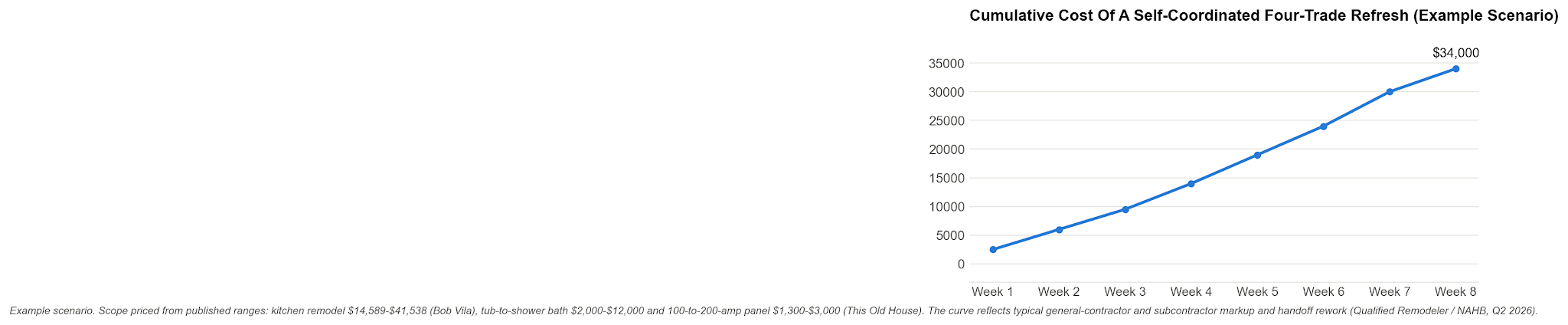
Every time one trade wraps and another begins, someone has to inspect, re-measure, and re-plan around whatever the last crew left behind. That coordination is unpaid work, and on a self-managed job it lands squarely on the homeowner. A May 2026 Angi pulse report found 71% of homeowners leaning into preventive maintenance, while another 71% had postponed a planned project this year. Budgets are already thin before a single handoff even goes sideways. The case we see most often is a two-day gap that quietly stretches into two weeks. The electrician cannot start until the plumber signs off, and the plumber is already across town on someone else’s emergency.
Subcontractor Markups Hide In The Estimate
A general contractor who subs the work out adds a margin on top of each trade’s price, commonly 10 to 20 percent, and that margin is baked into the number you sign. Manage the trades yourself and you skip that markup, but you also inherit every bit of the compliance risk. The US EPA’s Renovation, Repair and Painting Program requires that any job disturbing more than 6 square feet of interior paint per room in a pre-1978 home be handled by a lead-safe certified firm. Baltimore’s rowhouse stock is packed with homes that old. Hire a painter who is not certified, and the fine plus the redo erases whatever the markup would have saved you.
Delays Compound When No One Owns The Job
Anyone comparing home improvements baltimore md quotes across four trades will notice that each one prices only its own slice and assumes the others show up on time. They rarely all do. A homeowner in Hampden lined up a plumber, an electrician, a tiler, and a painter for a $28k refresh. The tiler then sat idle for nine days because the electrician bumped rough-in to squeeze in a bigger commercial job. Every idle day is still a day the financing clock keeps running (interest does not pause for a scheduling mix-up). A single crew that controls its own calendar does not have that failure point built in.
One In-House Team Prices The Whole Scope
Price that same $28k Baltimore refresh as one continuous scope and the arithmetic gets a lot simpler. Say the kitchen runs $14,600, a tub-to-shower bath conversion $6,000, a 100-to-200-amp panel upgrade $2,200, and interior painting $3,600, which is $26,400 in raw trade work. Add a self-managed job’s typical 12 percent for subcontractor markup and handoff rework, roughly $3,170, and the split-trade version comes to about $29,570 all in. The single-crew bid holds close to $28,000. On paper the gap looks small, and in practice it widens fast once the delay weeks get priced back in. That is where the math always catches up with the homeowner who split the work to save.
The Real Total Favors A Single Contractor
The published numbers back the same conclusion. Forbes, citing the Houzz 2026 U.S. Houzz & Home study, reported a median kitchen renovation of $24,000 and a primary-bathroom renovation of $15,000. Those medians assume coordinated, professionally managed work, not a stack of separately bid trades tripping over each other. When one contractor prices, schedules, and warranties the whole job, the markup disappears, the calendar holds, and the compliance sits with one licensed party you can actually call. On a multi-room refresh, that is where the real money lives, not in shaving a few dollars off any single line item. Get the entire scope under one roof, and the total is what improves, not just the individual quotes.