Is your meeting room disproportionately loud, despite everyone speaking at a normal volume?
This can be due to the characteristics of the room, e.g. glass, plaster, concrete, etc., reflecting sound back. This increases the perceived volume, causing the room to sound congested if several people are speaking at once, and reduces intelligibility of the speech.
One solution is to install decorative acoustic wall panels, to reduce these reflections, whilst allowing you to keep some interest in the room’s design. Understanding the benefits, limitations and appropriate use of these will help to achieve this.
What You’ll Learn
- Cause of rooms sounding excessively loud
- Decorating your space with acoustic panels
- How sound reduction works
- Considerations for placement and coverage
- Limitations of acoustic panels
- Summary
Cause of rooms sounding excessively loud
If you were to stand in your kitchen and speak, you’d likely find it sounds different to if you spoke in a living room, with more furniture and soft furnishings, etc. This can be attributed, in part, to the hard, reflective surfaces surrounding you.
These reflected sounds, arriving shortly after the direct sound, can sum together, causing overlapping, unintelligible words and phrases, which is referred to as reverb in the space.
While you may experience distinct echoes, it’s often not this noticeable, and you may simply perceive speech in the room to be congested/loud, or the room to be uncomfortably ‘loud’. Many office environments, meeting spaces, dining rooms, etc., will suffer from this to some extent, but simply increasing the amount of furnishings in the space may not suffice.
Introducing acoustic wall panels to the room, in a suitable manner, can address this issue, discussed further below.
Decorating your space with acoustic panels
Better acoustic performance should not mean covering every wall with dull grey foam.
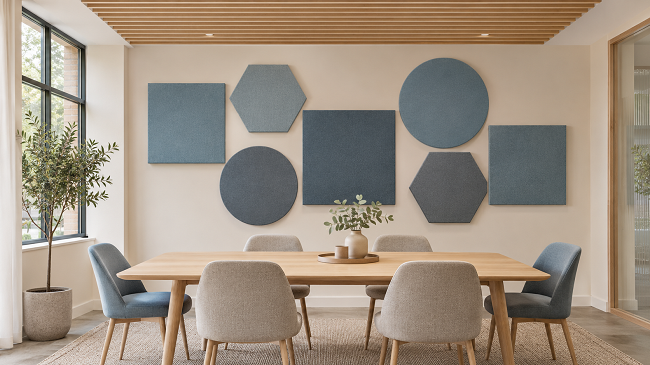
They can be used to create an eye-catching focal point, act as a feature behind, say, a TV, or installed as multiple small decorative pieces around a room. The colour options and design flexibility allow decorative panels to blend into a scheme.
The range on ecomfg.co.uk/decorative-acoustic-panels include various sizes of baffle, from square, round and hexagonal, allowing some imagination with where to place these on a wall, e.g. surrounding an armchair, filling a feature wall etc.
What’s important to bear in mind, however, is the acoustic properties of these decorative panels, i.e. their ability to reduce sound reflections in a room. So whether it’s a fabric wrapped panel, acoustic felt or decorative panel, they must have good absorption properties to deliver a beneficial impact on acoustics.
You should therefore use the design to guide your choice of decorative panel, but ensure it’s also suitable as an acoustic panel.
How sound reduction works
When correctly placed, acoustic wall panels can absorb sound, reducing reflections, and therefore the volume, and reverb, in the space, leading to improved speech clarity, amongst other benefits, including:
- Reduction in perceived volume of the room, due to decreased reverberation, allowing clearer, less overlapping, dialogue,
- Increased clarity of speech, particularly in larger, more reflective spaces,
- An overall more relaxing environment, by limiting the ‘build-up’ of noise/speech in the space, without the user necessarily realising the cause.
This has been observed in a case study, where the reverberation time of a classroom, after installation of acoustic panels, reduced from 1.17s to 0.74s (2025). Again, dependent on the environment, this may vary, but serves as an example of the impact that acoustic panels can have.
Note that this improvement will, of course, depend on the level, type, and placement of treatment, relative to the size and reflectivity of the room, so it’s not possible to claim any definitive benefit from introducing, e.g., a few, small, acoustic wall panels, in a large, highly-reflective, space.
Considerations for placement and coverage
Once aware of any excessive reflections in your space, there are several considerations to make, to ensure optimal, targeted, performance, such as:
- Target areas where sound, particularly speech, will be predominantly generated, and/or received, e.g. opposite walls, facing meeting tables,
- Target walls that may reflect, multiple times, between one another, i.e. hard, parallel, opposing, walls,
- Scale to suit the size of the room, and nature/use, of the space,
- Also consider the ceiling, which may warrant additional, or alternative, treatment, depending on height, materials, etc., of the room,
- Thickness/type of panel, which will dictate the range of frequencies absorbed, i.e. low frequency will require a thicker, or specific, panel, versus mid/high frequencies,
- Check manufacturer’s datasheet/test results, for absorption, across various frequencies, and the conditions under which these were tested, i.e. backed by an air cavity, or affixed directly to wall, etc.
A panel that looks good in a photograph may still be too small for a busy room. Coverage is about more than the size of one board. It also depends on how much of the reflective surface is treated and where the remaining reflections travel. A meeting room used for video calls may need a different layout from a lounge used for quiet conversation. That is why it helps to decide what you want to improve before choosing the final arrangement of panels.
You can perform a quick ‘clap’ test, to get an initial idea, but it’s recommended to seek professional input, if treating a significant space, and/or one requiring specific, acoustic, properties, to establish an appropriate amount of coverage, to treat. Alternatively, for smaller, less critical, spaces, you can treat the key areas, initially, and assess the effectiveness, before proceeding further, if required.
Limitations of acoustic panels
While effective, it should be noted that, in some cases, an acoustic wall panel will not solve your problem, despite being well-designed and installed, such as:
- Sound transmission through a party wall, from an adjacent property, which will not be stopped, or significantly reduced, by introducing acoustic panels, as they do not provide sound insulation,
- Background noise, e.g. from a plant, which will not be eliminated, although, to some extent, may be reduced, however, ideally, the noise source should be addressed, if possible,
- Certain frequencies, e.g. very low, may require a more bespoke solution,
- Some spaces, e.g. performance/music, will benefit from a certain degree of reflection, and may not require, or be suited, to a fully-absorptive, design,
In short, identify your source of unwanted sound, and seek an appropriate solution, to resolve, rather than simply assuming acoustic wall panels will provide a universal cure to all issues!
Summary
Decorative acoustic wall panels can reduce the perceived volume and reverberation, allowing for clearer, and more comfortable conversations, and create an interesting, colourful addition to the room, all whilst providing a functional benefit to your space’s acoustics. By targeting key, reflective areas, selecting panels that provide adequate absorption, and assessing if any complementary solutions are warranted, e.g. ceiling, insulation, etc., you can greatly improve your environment.
Ultimately, aim to create an aesthetically pleasing room that is also comfortable, to inhabit, and facilitate effective communication between occupants.