

A dropshipping business lets you sell products online without buying stock, renting storage, or packing parcels. With print on demand, you add your own designs to custom products, and a supplier prints, packs, and ships each order after a customer pays. Platforms such as Printify and Printful make this model easy for beginners, with no upfront inventory costs and no unsold stock.
This guide shows you how to start a dropshipping business step by step, from choosing products and a print-on-demand partner to setting up your store and managing order fulfillment.
What Is Dropshipping, and How Does Print on Demand Work?
In traditional dropshipping, you list a supplier’s products and the supplier ships them directly to your customer. You keep the difference between your retail price and the supplier’s price. The weakness is competition, because many stores resell the same generic items.
Print-on-demand dropshipping solves that. You upload artwork to blank products such as t-shirts, hoodies, mugs, tote bags, wall art, and blankets, and each item is produced only when someone orders it. You get unique custom products, no minimum order quantities, and no leftover inventory. These platforms connect to your online store, receive orders automatically, and ship to your customers under your brand.
Step 1: Choose a Niche for Your Dropshipping Business
A focused niche gives your store a clear identity and makes marketing easier. Start with an audience you understand, such as runners, dog owners, gamers, teachers, or plant lovers. Check that the community is active online, already spends money on identity-driven products, and responds to designs you can create. Browse social media hashtags and search trends to confirm steady demand. A lasting interest beats a short-lived trend.
Step 2: Choose Custom Products to Sell
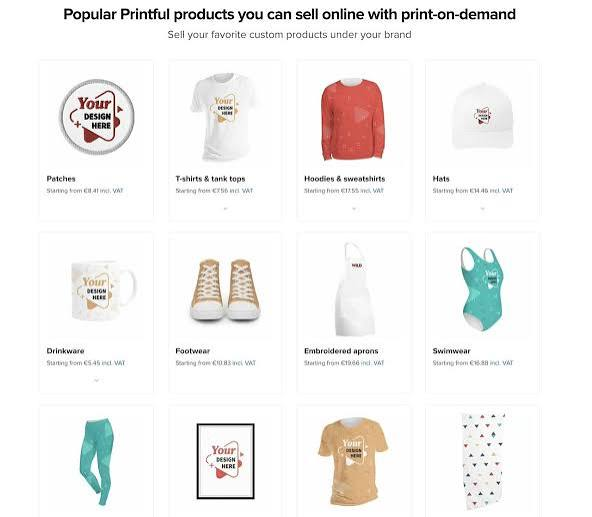
Match products to your audience. Print-on-demand catalogs cover several categories:
- Apparel: custom t-shirts, hoodies, sweatshirts, and hats suit almost any niche.
- Accessories: tote bags, phone cases, and stickers work as low-cost add-ons.
- Home and living: wall art, pillows, blankets, and mugs sell well as gifts.
- Embroidered items: embroidered apparel adds a premium option.
Launch with three to five products, then expand based on sales. Order samples first to check print quality, fabric, and packaging before you promote anything.
Step 3: Compare Print-on-Demand Platforms for Dropshipping
Some platforms work as a marketplace that connects you with a global network of print-on-demand companies. You can compare providers by price, location, and production time, which gives you room to protect your margins. Others run their own fulfillment network with centers in several regions and offers white-label branding, including custom packaging, pack-ins, and packing slips. Both models are free to start, and you pay for production and shipping only when an order sells.
Compare base product costs, shipping rates, production times, print areas, and quality. Providers differ, so read recent merchant reviews and test with samples; some sellers report inconsistent quality or slow fulfillment with any supplier. Many stores use both, choosing per product.
Step 4: Create Designs With a Mockup Generator
You do not need to be a designer. A free mockup generator and built-in design tools let you upload artwork, add text, position it on products, and preview realistic images for your store. Use high-resolution files and simple, audience-focused concepts. Only upload artwork you own or have permission to use, because copyrighted characters and brand logos can get listings removed.
Step 5: Connect Your Online Store
Link your print-on-demand account to a storefront such as Shopify, Etsy, eBay, Wix, Squarespace, or WooCommerce so products and orders sync automatically. Write descriptions that speak to your niche, use clear mockup photos, add an About page, and publish shipping and returns policies. Trust matters for a new brand.
Step 6: Set Prices for Profit
Your profit equals your retail price minus the product cost, shipping, platform and payment fees, and advertising. Check production prices in your dashboard, add those fees, and set a price that leaves a healthy margin. Bundles and multi-item discounts raise your average order value.
Step 7: Manage Order Fulfillment
Order fulfillment is largely automated with print on demand:
- A customer orders from your store and pays you.
- The order flows automatically to your print-on-demand partner.
- The print provider produces your design and packs the item.
- The package ships directly to your customer, often with your branding.
- Tracking details sync back to your store.
Your job is to monitor and communicate. Check the first orders manually before relying on automatic submission, and state production and shipping times clearly on your store. Watch for out-of-stock colors or sizes, and answer customer questions about delays quickly. Learn each platform’s reprint and refund policy for misprints or damaged items, and align your own returns policy with it.

Step 8: Market Your Store and Scale
Build an audience with social media content, email sign-ups, niche creator collaborations, and search-friendly product pages. Short videos and customer photos build trust. Once you see your best sellers, add colors and related designs, retire weak products, and reinvest profits in advertising or branded packaging.
FAQ: Starting a Dropshipping Business With Print on Demand
How much does it cost to start a dropshipping business with print on demand? You can begin with little upfront cost because print-on-demand platforms are free to start and need no inventory. Budget for samples, a store plan, and marketing.
Which is better, a marketplace or an in-house fulfillment platform? Marketplace-style platforms suit sellers who want provider choice and lower costs, while in-house fulfillment platforms suit those who want integrated fulfillment and branding options. Test both with samples.
Do I need design skills? No. Built-in design tools and mockup generators let you create products from simple artwork or text.
Start Your Dropshipping Business Today
Starting a dropshipping business no longer needs a warehouse or a large budget. Choose a focused niche, pick custom products your audience loves, partner with a reliable print-on-demand provider, and manage order fulfillment carefully. Start small, test often, and keep your customers at the center.
Authors Bio:
Muhammad Rehan
Muhammad Rehan is a SaaS and e-commerce link-building specialist who helps digital brands strengthen their online visibility through strategic backlink acquisition and contextual link placements. He focuses on building relevant, high-quality backlinks for SaaS platforms, e-commerce businesses, and Shopify-related brands through editorial outreach and relationship-driven link building. His work centers on topical relevance, organic search growth, and sustainable SEO strategies that help businesses improve their authority and reach the right audience.