Employee engagement models help organizations understand what motivates employees, why they become disengaged, and which workplace changes can improve their experience. However, these frameworks serve different purposes: some assess engagement, others explain its causes, and some guide organizational improvements.
Seven widely used employee engagement frameworks include Gallup Q12, Kahn’s Psychological Conditions, the Job Demands-Resources (JD-R) model, Aon Hewitt’s Say-Stay-Strive, Deloitte’s Simply Irresistible Organization, the Utrecht Work Engagement model, and David Zinger’s Employee Engagement Model.
The key difference is what each framework can actually tell an organization. A low engagement score may indicate a problem without explaining its cause. Similarly, high employee retention does not necessarily mean employees are motivated or committed to their work.
This guide compares seven models, their applications and limitations, and explains how to choose and implement an approach based on specific organizational challenges.
What Are Employee Engagement Models?
An employee engagement model is a framework for understanding, measuring, or improving employees’ psychological involvement in their work and organization.
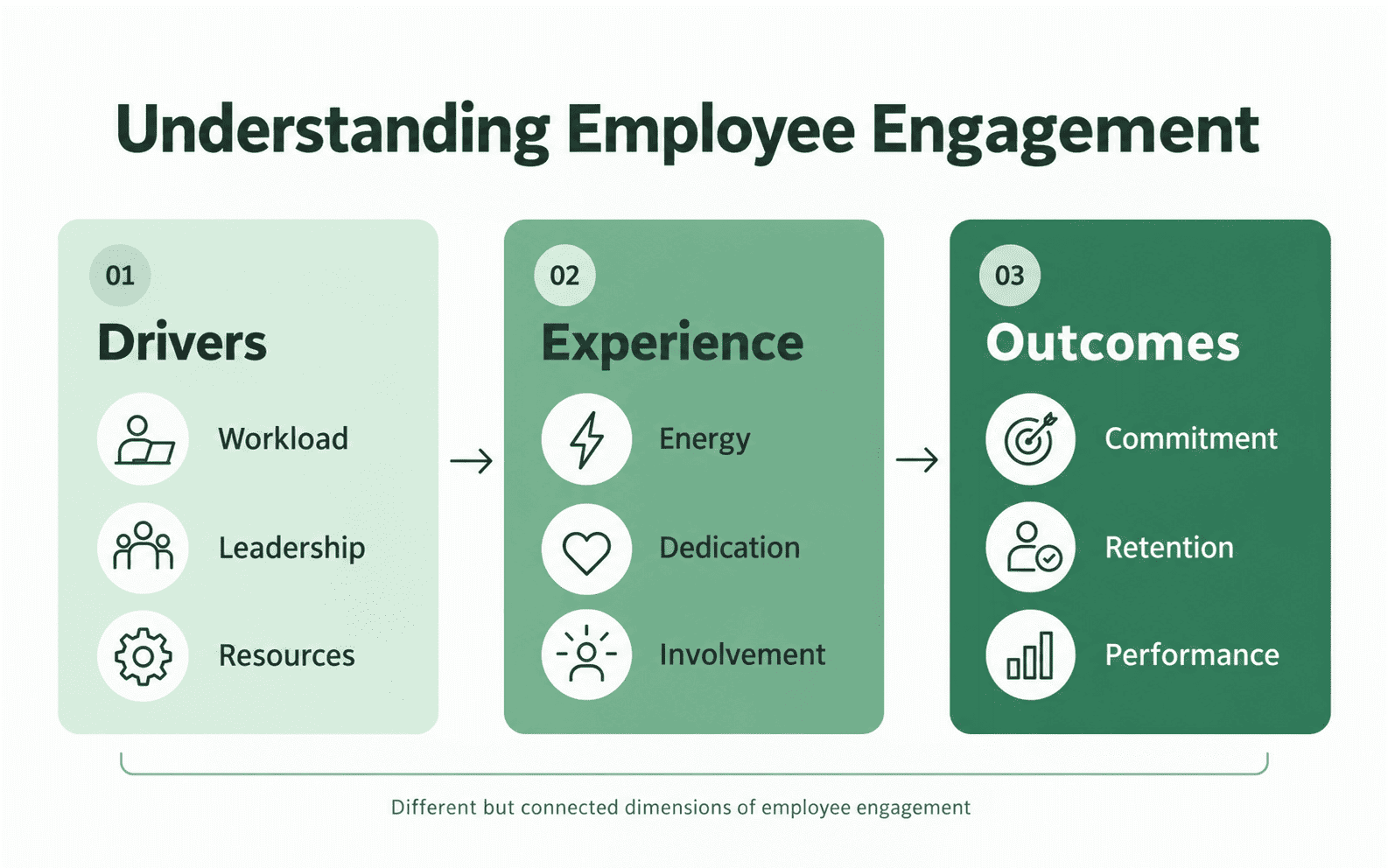
Most frameworks address one or more of three areas:
- Engagement drivers: Workplace conditions such as leadership, autonomy, recognition, workload, and professional development.
- Engagement experiences: Employees’ energy, dedication, motivation, and involvement in their responsibilities.
- Engagement-related outcomes: Organizational commitment, employee advocacy, retention, and work performance.
These categories are related but should not be confused. Job satisfaction, for example, does not automatically indicate strong engagement. An employee may appreciate their salary and working conditions while feeling little enthusiasm for daily tasks.
Likewise, an employee may be highly dedicated to work while experiencing exhaustion. Choosing an appropriate model therefore begins with identifying what the organization needs to understand rather than selecting the most familiar survey.
7 Employee Engagement Models Compared
| Model | Main focus | Best application | Main limitation |
| Gallup Q12 | Workplace conditions | Team engagement surveys | Does not independently establish root causes |
| Kahn’s Psychological Conditions | Meaningfulness, safety, availability | Trust and employee participation | No single prescribed measurement instrument |
| Job Demands-Resources (JD-R) | Job demands and resources | Workload, burnout, job design | Requires occupation-specific assessment |
| Aon Hewitt Say-Stay-Strive | Advocacy, commitment, effort | Retention and employee commitment | Outcomes do not identify every driver |
| Deloitte Simply Irresistible | Management and organizational practices | Company-wide engagement strategy | Broad scope complicates prioritization |
| Utrecht Work Engagement (UWES) | Vigor, dedication, absorption | Measuring work engagement | Does not directly explain causes |
| David Zinger’s Model | Relationships and engagement practices | Manager development and team improvement | Requires separate measurement methods |
The frameworks are not interchangeable. Gallup Q12 examines workplace conditions associated with engagement, whereas UWES measures employees’ psychological experience of work engagement. JD-R helps investigate how workload and available resources may influence that experience.
An organization can combine these approaches when each answers a different question.
1. Gallup Q12 Employee Engagement Model
Gallup Q12 uses 12 survey items to assess workplace conditions associated with employee engagement and performance.
The framework organizes these conditions into four developmental levels:
- Basic needs: Clear expectations and access to necessary resources.
- Individual contribution: Opportunities to use strengths, receive recognition, and obtain managerial support.
- Teamwork: Employee voice, shared purpose, and supportive relationships.
- Growth: Feedback on progress and professional development.
Its practical advantage is that managers can identify specific workplace conditions requiring attention rather than relying on general satisfaction ratings.
For example, a distributed team may report positive relationships but frequent misunderstandings about responsibilities and deadlines. The problem could involve unclear expectations, fragmented information, or inconsistent task ownership.
Providing employees with secure team chat may help coordinate daily work and maintain accessible discussions, but the underlying problem will remain if managers do not clarify responsibilities.
Best for: Regular team-level engagement assessments and identifying workplace conditions that managers can address.
Limitation: Low survey scores require further investigation. Gallup Q12 is also a proprietary instrument, and its use is subject to applicable licensing conditions.
2. Kahn’s Psychological Conditions of Engagement
William Kahn’s 1990 research identified three psychological conditions associated with personal engagement at work.
Psychological meaningfulness refers to whether employees consider their work worthwhile and believe their contributions matter.
Psychological safety concerns whether employees feel comfortable expressing themselves without fearing damage to their reputation, status, or career.
Psychological availability describes whether employees have sufficient physical, emotional, and psychological resources to invest themselves in work.
These conditions help explain why employees may disengage even when compensation and other working arrangements are acceptable.
Consider a team where employees rarely question management decisions. The problem may not be a lack of ideas or motivation. Employees might believe that expressing disagreement carries professional risks.
Kahn’s framework encourages organizations to investigate these psychological barriers rather than interpreting silence as agreement.
Best for: Diagnosing barriers involving trust, employee voice, participation, and psychological readiness.
Limitation: The theory does not prescribe a single standardized survey or intervention process.
3. Job Demands-Resources (JD-R) Model
The Job Demands-Resources model explains employee engagement and well-being through the relationship between work demands and available resources.
Job demands include factors such as excessive workloads, emotional pressure, conflicting responsibilities, and difficult schedules.
Job resources include autonomy, adequate equipment, supportive management, useful feedback, and opportunities for development.
The model describes two connected processes: excessive demands can contribute to strain and exhaustion, while sufficient resources can support motivation and engagement.
For example, a customer support department may experience falling engagement despite positive relationships with managers. A closer assessment reveals growing request volumes and insufficient staffing.
Additional recognition programs might be appreciated, but they would not directly resolve the workload problem.
In distributed teams, video collaboration software can function as a job resource when it helps employees resolve complex questions and coordinate responsibilities. However, excessive meetings can also create interruptions and additional demands.
The effectiveness of a resource depends on how it is integrated into the working process.
Best for: Investigating workload, exhaustion, job design, and resource constraints.
Limitation: Demands and resources vary between occupations. The model must be adapted to actual working conditions rather than applied as a universal checklist.
4. Aon Hewitt’s Say-Stay-Strive Model
Aon Hewitt’s framework describes employee engagement through three forms of employee response:
- Say: Speaking positively about the organization.
- Stay: Demonstrating a desire to remain with the employer.
- Strive: Contributing additional effort toward organizational success.
These dimensions help distinguish advocacy, organizational commitment, and discretionary effort.
For example, an employee may recommend the company and intend to remain but show little interest in taking additional initiative. Another may work enthusiastically while actively considering employment elsewhere.
The organization’s response should differ because the underlying problems are not necessarily the same.
Aon’s broader approach also considers engagement drivers such as leadership, career opportunities, rewards, and work fulfillment.
Best for: Understanding employee commitment, retention intentions, and engagement-related behavior.
Limitation: Intention to remain is not definitive evidence of engagement. Employees may stay because alternative employment opportunities are limited.
5. Deloitte’s Simply Irresistible Organization Model
Deloitte’s Simply Irresistible Organization framework examines five elements that contribute to the employee experience.
| Element | Organizational focus |
| Meaningful work | Autonomy, suitable responsibilities, and opportunities to contribute |
| Hands-on management | Coaching, feedback, and clear expectations |
| Positive work environment | Recognition, inclusion, and flexibility |
| Growth opportunities | Career development, learning, and internal mobility |
| Trust in leadership | Credibility, communication, and consistent decisions |
Unlike frameworks focused primarily on individual psychological experiences, Deloitte’s model provides a broader view of organizational practices.
Consider a company experiencing turnover despite competitive compensation. Interviews indicate that employees rarely discuss career development and see limited opportunities for advancement.
The framework helps management examine career growth and leadership practices rather than assuming that additional financial incentives will resolve the problem.
Best for: Organization-wide engagement strategies involving leadership, management practices, culture, and professional development.
Limitation: Because the framework covers multiple organizational systems, implementation requires clear priorities and responsibilities.
6. Utrecht Work Engagement Model (UWES)
The Utrecht Work Engagement framework measures engagement through three psychological dimensions:
- Vigor: Energy, resilience, and willingness to invest effort in work.
- Dedication: Enthusiasm, inspiration, pride, and a sense of significance.
- Absorption: Concentration and deep involvement in work activities.
These dimensions are assessed through the Utrecht Work Engagement Scale, including established 17-item and 9-item versions.
UWES is different from frameworks that primarily assess organizational policies or working conditions. It measures employees’ reported experience of engaging in work.
For example, a company that introduces more flexible project planning may use UWES to investigate whether employees subsequently report changes in vigor, dedication, or absorption.
However, an improvement in survey results does not automatically establish that the new planning process caused it. Other factors may also contribute.
Best for: Measuring psychological work engagement, organizational research, and repeated assessments.
Limitation: UWES can measure engagement but does not independently identify the workplace conditions responsible for changes.
7. David Zinger’s Employee Engagement Model
David Zinger’s Employee Engagement Model emphasizes meaningful work, relationships, recognition, development, and everyday management practices.
The approach treats engagement as an ongoing process supported through employees’ interactions with colleagues, managers, and organizational objectives.
For example, a distributed company may find that employees rarely receive constructive feedback and have limited visibility into other departments’ contributions.
Managers might introduce regular development conversations, peer recognition, and clearer communication about shared objectives.
These initiatives should be evaluated through an appropriate measurement method rather than assumed to improve engagement automatically.
Best for: Manager development, team relationships, recognition, and practical engagement initiatives.
Limitation: Zinger’s approach is not a standardized psychometric instrument. Organizations need separate methods to measure results.
How to Choose the Right Employee Engagement Model
The choice depends on the organizational problem and the type of evidence required.
| Organizational problem | Suitable model | What to investigate |
| Employees hesitate to express concerns | Kahn | Psychological safety and participation |
| Excessive workload and exhaustion | JD-R | Demands, staffing, autonomy, resources |
| Unclear expectations and weak feedback | Gallup Q12 | Role clarity and managerial support |
| Employees intend to leave | Aon Hewitt | Commitment and retention drivers |
| Declining energy and dedication | UWES | Psychological work engagement |
| Company-wide management problems | Deloitte | Leadership, development, organizational practices |
| Weak recognition and team relationships | Zinger | Feedback and everyday engagement practices |
The table provides a starting point rather than a diagnosis.
A business with high turnover and excessive workloads, for instance, might use Aon Hewitt’s framework to examine commitment and JD-R to investigate working conditions.
The combination is meaningful because the models address different questions. Using multiple frameworks without defining their respective purposes can instead create unnecessary measurement complexity.
How to Implement and Measure Employee Engagement
An engagement model becomes useful when its findings lead to specific actions.
Step 1. Define the Problem and Select the Model
Start with an organizational question, such as why employees are leaving, why certain teams report exhaustion, or why participation in decision-making is declining.
Select a framework that can provide relevant evidence.
For example, a company investigating excessive workloads may choose JD-R, while one seeking to measure psychological work engagement could use UWES.
Step 2. Establish a Baseline
Collect relevant employee feedback using an appropriate assessment instrument or research method.
Depending on the objective, organizations may also examine turnover patterns, workload records, and employee interviews.
Survey confidentiality matters, particularly in small teams where individual responses may be identifiable.
Step 3. Investigate the Results and Implement Changes
Engagement scores should not be treated as complete explanations.
Employees reporting insufficient recognition may actually experience inconsistent feedback, unclear evaluation criteria, or limited interaction with managers.
To investigate, organizations can conduct confidential interviews, small-group discussions, or a live video conference when group participation is appropriate and employees feel comfortable sharing their views.
Interventions should address the identified problem. Excessive workloads may require staffing or scheduling changes, while limited growth opportunities may require career development processes.
Step 4. Evaluate Outcomes
Repeat relevant assessments using consistent methods and examine whether targeted workplace conditions have improved.
Engagement measures should be distinguished from business indicators:
| Category | Examples | Purpose |
| Workplace drivers | Workload, autonomy, feedback | Understand working conditions |
| Engagement experiences | Vigor, dedication, absorption | Assess psychological engagement |
| Organizational outcomes | Retention, absenteeism, performance | Examine related business results |
These measures should not be combined indiscriminately.
For example, lower employee turnover after an engagement initiative may be encouraging, but it does not prove that the initiative caused the change. Labor-market conditions, compensation, and organizational developments may also influence retention.
Practical Example: Combining Gallup Q12 and JD-R
Consider a hypothetical technology company with 180 employees across several offices and remote teams.
The company experiences increasing turnover and declining engagement scores. Management initially proposes expanding employee recognition programs.
However, further investigation reveals three recurring issues: unclear project priorities, excessive meetings, and limited development discussions.
The organization combines two frameworks.
Gallup Q12 helps assess workplace conditions related to expectations, feedback, development, and teamwork.
JD-R helps examine workload, interruptions, autonomy, and available resources.
The company introduces clearer task ownership, reduces unnecessary meetings, establishes regular development discussions, and reviews workload allocation.
After an appropriate period, it repeats its assessments and examines relevant retention and workload indicators.
The objective is not simply to increase a survey score. It is to determine whether the identified working conditions have improved and whether the expected employee outcomes are changing.
This approach illustrates why combining complementary frameworks can provide greater practical value than relying on a single engagement score.
Common Mistakes When Using Employee Engagement Models
Confusing Engagement With Satisfaction or Retention
Job satisfaction, engagement, and retention are related but distinct.
Employees may remain with an organization without feeling motivated, while highly engaged employees may leave for career or personal reasons.
Treating Survey Results as a Diagnosis
A low engagement score identifies an area requiring investigation. It does not automatically explain whether the cause is workload, leadership, compensation, or another condition.
Organizations should investigate the underlying factors before choosing interventions.
Introducing Initiatives That Do Not Address the Problem
Recognition programs, additional meetings, and communication tools cannot substitute for adequate staffing, realistic workloads, or effective management.
The intervention should match the workplace problem identified through the assessment.
Conclusion
Employee engagement models help organizations understand different aspects of employees’ relationships with their work.
Gallup Q12 examines workplace conditions, Kahn explains psychological requirements for engagement, JD-R focuses on job demands and resources, and Aon Hewitt addresses engagement-related commitment and behavior. Deloitte and Zinger emphasize organizational and management practices, while UWES measures psychological work engagement.
The most appropriate model depends on the question an organization needs to answer. Effective engagement programs distinguish measurement from diagnosis, investigate working conditions, and evaluate whether targeted changes produce meaningful improvements.