
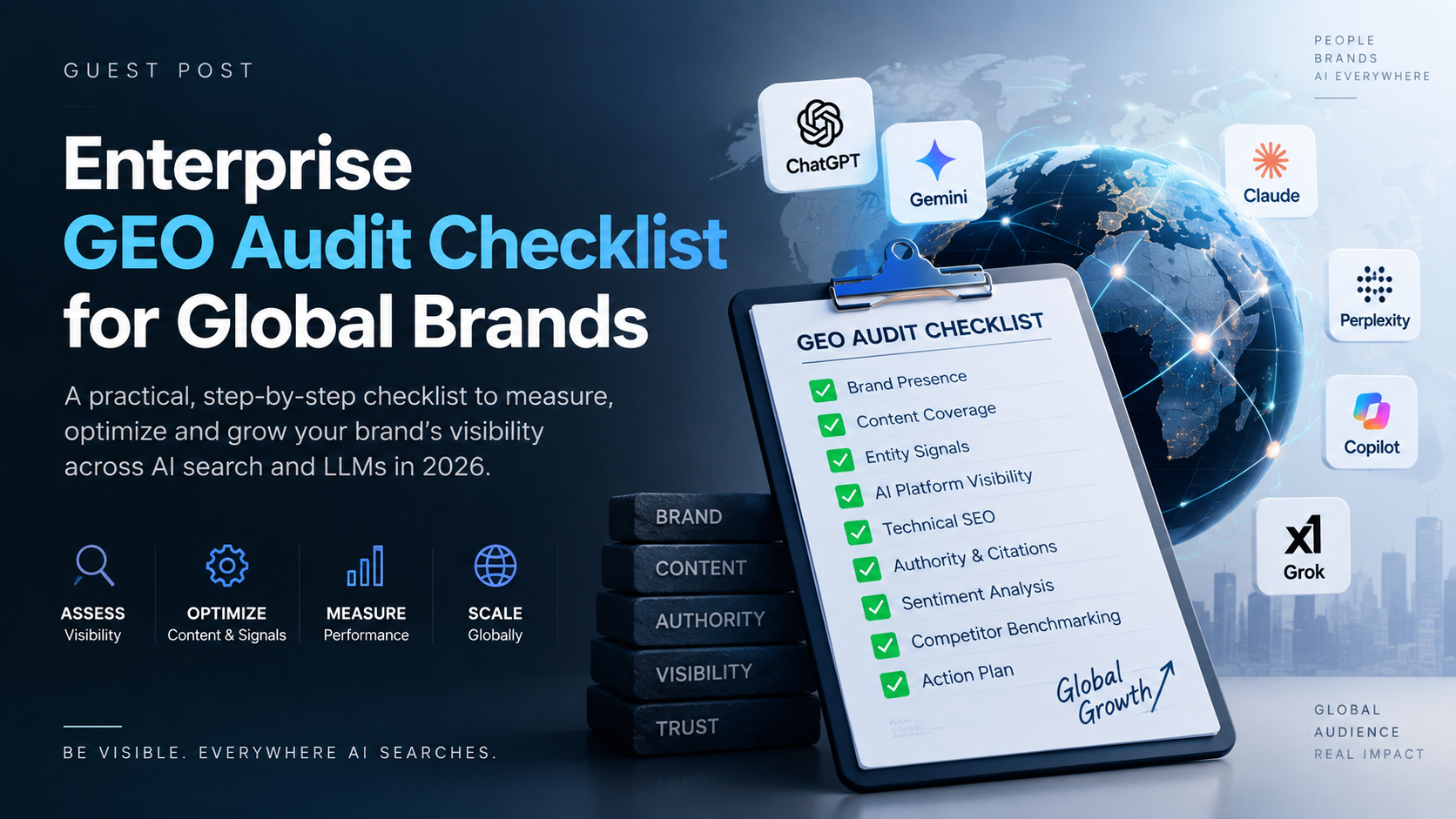
Generative Engine Optimization (GEO) has fundamentally changed how consumers discover products worldwide. A GEO audit checklist is a structured review of how accurately, prominently, and consistently AI answer engines represent and cite a brand. In 2026, relying solely on traditional search metrics leaves massive blind spots for global brand discoverability. AI search visibility audits require a new approach to measure recommendation positions, factual accuracy, and citation correctness across international markets.
Quick Summary
- Measures brand representation and citation quality beyond simple mentions.
- Provides a phased framework for scope, evidence, testing, and scoring.
- Demonstrates how to validate product entities using brand data.
- Guides teams on prioritizing fixes and building ongoing governance.
What Is a GEO Audit Checklist?
A GEO audit checklist is a systematic framework used to evaluate how well AI platforms understand, retrieve, and recommend a brand. It shifts the focus from ranking web pages to ensuring AI models generate accurate claims.
What a GEO Audit Measures
Generative Engine Optimization (GEO) is the practice of improving accurate brand representation and source selection in AI-generated answers. A thorough audit evaluates multiple dimensions of AI visibility.
- AI visibility: The frequency and context of brand appearances in generated answers.
- Recommendation position: Where the brand sits among competitors in a list.
- Factual accuracy: How correctly the model describes products and features.
- Citation quality: Whether the selected source selection actually supports the generated claims.
- Entity consistency: How well the AI understands product discoverability and brand relationships.
AI outputs are probabilistic and change frequently based on context. Teams must evaluate them through repeated tests rather than relying on one single response.
How GEO Differs From Traditional SEO
A generative engine optimization audit requires a different mindset than evaluating conventional search rankings. While crawlability, indexability, structured data, authoritative content, and digital PR influence both disciplines, the primary outputs look completely different.
| Feature | Traditional SEO Audit | GEO Audit | Best For |
| Primary Output | Ranking position | Answer completeness | Comparing visibility types |
| Success Metric | Click-through rate | Citation correctness | Measuring quality |
| Core Focus | Crawlability and indexability | Knowledge graphs and AI-generated recommendations | Directing resources |
How Do You Define the Audit Scope?
You define the audit scope by clearly outlining the business goals, target markets, languages, and cross-functional owners before running any tests. This prevents teams from drowning in irrelevant data.
Set Goals, Markets, Languages, and Owners
A global GEO audit checklist must start with clear boundaries. Do not assume one global result represents all audiences.
- Step 1: Define audit objectives. Focus on qualified traffic, assisted conversions, reputation protection, product discovery, or citation quality.
- Step 2: List market coverage and language coverage. Include different scripts, devices, platforms, and browsing modes relevant to your customers.
- Step 3: Assign cross-functional ownership. Involve SEO, content, product, communications, legal, analytics, and regional teams to ensure full coverage.
Setting clear audit objectives upfront prevents scope creep and keeps the team focused on measurable business impact.
Create a Reproducible Testing Record
Without reproducible AI testing, your GEO audit documentation holds little value. You need a strict test protocol.
- Step 1: Record the exact environment. Note the platform, model version, test date, browsing status, account state, language, market, and device context.
- Step 2: Assign a stable prompt ID. Use this identifier for every exact prompt and preserve raw outputs, citations, and response captures before beginning analysis.
- Step 3: Document repeat-test conditions. This helps teams distinguish real trends from output variability and model hallucination.
How Do You Validate Brand Entities?
Entity validation confirms whether AI systems can identify the correct brand, products, relationships, and attributes. It forms the foundation of any entity health audit.
Map Official Brand and Product Entities
A comprehensive entity health audit starts with documenting canonical entity names, spelling variants, and official domains. You must also map parent relationships, social profiles, and product taxonomy.
- Canonical names: Document exact spellings and official domains.
- Brand relationships: Connect master brands to specific product families and services.
- Entity disambiguation: Identify discontinued products, duplicate names, retailer variations, and ambiguous entities that could create retrieval confusion.
Take Lakmé as an example. An auditor would connect the master brand with collections such as Lakmé 9to5, Lakmé Eyeconic, Lakmé Facelift MultiSlayer, Lakmé Be-Jewel, Lakmé VitC Superglow, and Lakmé Hya Beach Edit.
Check Attributes, Relationships, and Claims
Once entities are mapped, you must conduct a product data audit and claim validation. AI models rely on this attribute consistency to answer complex user questions.
- Attribute checks: Verify ingredients, skin concerns, shades, finishes, wear occasions, application guidance, product formats, and product identifiers.
- Claim validation: Compare official safety context and efficacy claims with retailer listings, reviews, editorial coverage, and structured data.
- Availability data: Ensure stock statuses and regional availability align across authoritative references.
Flag any unsupported efficacy, safety, suitability, or availability statements. These require immediate subject-matter and legal review to protect brand trust.
How Do You Test AI Discoverability?
You test AI discoverability by running a structured matrix of prompts across multiple platforms and recording the generated answers. This reveals exactly how models perceive and recommend your brand.
Build a Global Prompt Matrix
A robust GEO prompt matrix organizes queries by the customer journey. This is a critical workflow in your GEO audit checklist.
- Step 1: Organize prompts by intent. Cover unbranded discovery, category education, problem-solving, comparison, recommendation queries, branded validation, purchase, usage, safety, and post-purchase intent.
- Step 2: Add contextual dimensions. Include market, language, persona, device, platform, and product category variables.
- Step 3: Mix prompt testing types. Include brand-specific questions, competitor questions, product-selection prompts, and prompts that test local availability.
Testing unbranded discovery prompts often reveals the most significant gaps in your AI search visibility audit.
Repeat Prompts Across Platforms
Because AI models generate responses dynamically, answer variability is expected. Repeated AI prompt testing is essential for accurate measurement.
- Step 1: Test across environments. Run the same prompt across multiple AI answer engines, search experiences, browsing modes, and relevant model versions.
- Step 2: Repeat each high-priority prompt. Do this enough times to identify directional patterns, documenting your chosen sample size and test repeatability limitations.
- Step 3: Analyze the model variance. Avoid treating one favorable or unfavorable response as a permanent personalization or ranking signal.
Capture Mentions, Citations, and Claims
Measuring AI visibility requires detailed documentation of what the model actually says and cites.
- Brand representation: Record whether the brand appears, where it appears in a recommendation, and what competitors are included.
- Citation coverage: Capture every cited URL and apply source classification to label it as owned, retailer, editorial, review, social, or database.
- Claim extraction: Separate retrieved evidence from unsupported model inference.
Always preserve the exact claim each citation is expected to support to accurately measure your share of model.
How Should You Score GEO Findings?
You score GEO findings by evaluating mention rates, answer accuracy, and citation quality against a standardized rubric. This framework helps teams quantify subjective AI outputs.
Score Accuracy, Authority, and Visibility
A consistent GEO audit scoring framework transforms raw responses into actionable data. Calculate directional metrics like answer accuracy rate while clearly stating the sample size and test conditions.
| Feature | Measurement Method | Score Guidance | Best For |
| Weighted visibility | Mention rate and recommendation position | Zero to three scale (missing, weak, acceptable, strong) | Tracking brand prominence |
| Answer accuracy | Factual correctness and completeness | Pass, fail, or partial | Managing reputation risk |
| Source authority | Citation coverage and correctness | High, medium, or low | Evaluating trust signals |
Always document your scoring criteria clearly so different team members evaluate responses consistently across regions.
Separate Retrieval Gaps from Inference
When an AI model provides a bad answer, you must determine if it lacked information or guessed incorrectly using Retrieval-Augmented Generation (RAG) principles.
| Gap Type | Root Cause | Examples | Remediation Strategy |
| Retrieval gap | Missing official pages, poor crawlability, weak internal linking, incomplete structured data | Absent third-party evidence or missing source evidence | Improve content and technical access |
| Model inference | Ambiguity, outdated sources, or conflicting information | Unsupported claims or inaccurate statements | Clarify canonical data and run root-cause analysis |
Recommend documenting the source evidence, confidence level, business impact, and the most likely root cause for every finding.
How Do You Prioritize Remediation?
You prioritize remediation by mapping the severity of each finding against its potential business impact and implementation effort. This creates a focused action plan instead of an overwhelming list.
Assign Owners and Set Severity Levels
A successful GEO remediation plan requires a structured cross-functional workflow. Build an action register to track progress.
- Step 1: Classify findings. Group them by visibility opportunity, factual risk, compliance risk, customer impact, implementation effort, and affected markets.
- Step 2: Assign accountability. Give each action a responsible team, accountable executive, reviewer, deadline, evidence requirement, and success metric.
- Step 3: Set risk scoring levels. Use critical, high, medium, and low severity levels with explicit escalation rules for compliance review.
Critical severity should be reserved for factual inaccuracies that pose immediate safety, legal, or severe reputational risks.
Fix High-Risk Entity and Content Gaps
Addressing AI visibility problems often starts with fixing foundational entity remediation issues.
- First-party evidence: Prioritize fixing inaccurate product names, outdated availability, unsupported safety statements, incorrect ownership, and misleading recommendations.
- Content freshness: Improve official pages with clear definitions, expert-reviewed explanations, comparison content, FAQs, product attributes, dates, and transparent evidence.
- Ecosystem alignment: Coordinate digital PR, retailer data, product feed accuracy, and structured data.
Ensure internal links, images, alt text, and video transcripts all reinforce the correct brand narrative.
How Do You Govern Ongoing GEO Audits?
You govern ongoing GEO audits by establishing a regular review cadence, tracking business-linked outcomes, and maintaining a centralized evidence repository. This ensures optimizations keep pace with evolving AI models.
Track Outcomes Beyond Mention Counts
Ongoing GEO monitoring must connect visibility to actual commercial value. Focus on business impact rather than vanity metrics.
- Commercial metrics: Connect GEO metrics with AI referral traffic, branded search demand, assisted conversions, product discovery, sentiment, and reputation risk.
- Trend reporting: Segment data by platform, market, language, intent, product category, recommendation position, and citation type.
- Contextual annotation: Separate directional AI visibility metrics from confirmed business outcomes and annotate major platform or model changes.
AI models update constantly. A drop in visibility might reflect a model update rather than a flaw in your content.
Set Review Cadence and Change Controls
Determining your GEO audit frequency requires balancing resources with risk. Change management is critical.
- Step 1: Run lightweight monitoring. Check priority prompts continuously to catch sudden shifts in visibility.
- Step 2: Schedule deeper audits. Execute full reviews after major launches, site changes, catalog updates, or platform shifts.
- Step 3: Maintain a versioned prompt library. Document changes to models, browsing behavior, product availability, claims, and brand messaging.
- Step 4: Create issue escalation procedures. Prepare protocols for material misinformation, safety concerns, impersonation, or high-risk recommendations.
Document Evidence, Decisions, and Escalation
A robust GEO governance program requires an organized audit evidence repository. This audit trail protects the business.
- Data storage: Store raw responses, screenshots, cited URLs, scoring notes, remediation tickets, approvals, and before-and-after tests in a shared repository.
- Policy tracking: Record limitations, confidence levels, platform terms, privacy considerations, and crawler access governance decisions.
- Reporting formats: Use executive summaries for leadership and detailed quality assurance logs for specialist teams.
Turn Your GEO Audit Into an Operating System
Synthesize the checklist into a repeatable operating model: define scope, validate entities, test prompts, score evidence, prioritize remediation, and monitor business outcomes. A reliable GEO audit measures accuracy and citation quality, not just mentions. Global testing requires controlled prompts across markets, languages, platforms, and customer intents. Every finding should lead to an owned action, documented evidence, and a measurable follow-up test.
GEO works alongside technical SEO, authoritative content, product data, digital PR, analytics, and governance rather than replacing them. Future audits should account for multimodal search, AI crawler policies, changing model behavior, local-language retrieval, product-feed accuracy, and stronger connections between AI visibility and commercial outcomes. Download or adapt the checklist, select a small set of priority prompts, and establish a documented baseline before making optimization changes.
Frequently Asked Questions
What should a GEO audit checklist include?
A comprehensive GEO audit checklist should cover scope, entity health, technical access, content evidence, prompt testing, citations, accuracy, recommendations, remediation, and ongoing measurement. These elements ensure you capture a complete picture of your brand visibility.
How often should a global brand run a GEO audit?
Usually, teams should monitor priority prompts continuously and run deeper audits quarterly or after major platform, product, website, or messaging changes. This balanced cadence prevents surprises while managing team resources effectively.
How many prompts are needed for a useful baseline?
It depends. Start with a documented panel covering priority intents, products, markets, languages, and platforms, then expand after identifying important visibility or accuracy gaps. A focused, well-documented set of prompts is better than a massive, unmanageable list.
Why is citation correctness important in GEO?
Citation correctness confirms that a cited source supports the claim attached to it. High citation volume without supporting evidence can still create trust, compliance, and reputation risks.