In most English-language markets, the conversation around AI video generation is a capability race. Which model handles motion best? Who supports the longest clip? Which one finally got hands right? Marketers entering these markets build their messaging accordingly — benchmarks, sample reels, feature matrices.
Japan does not behave this way, and the search data makes that unusually clear.
The first question is not “what can it do”
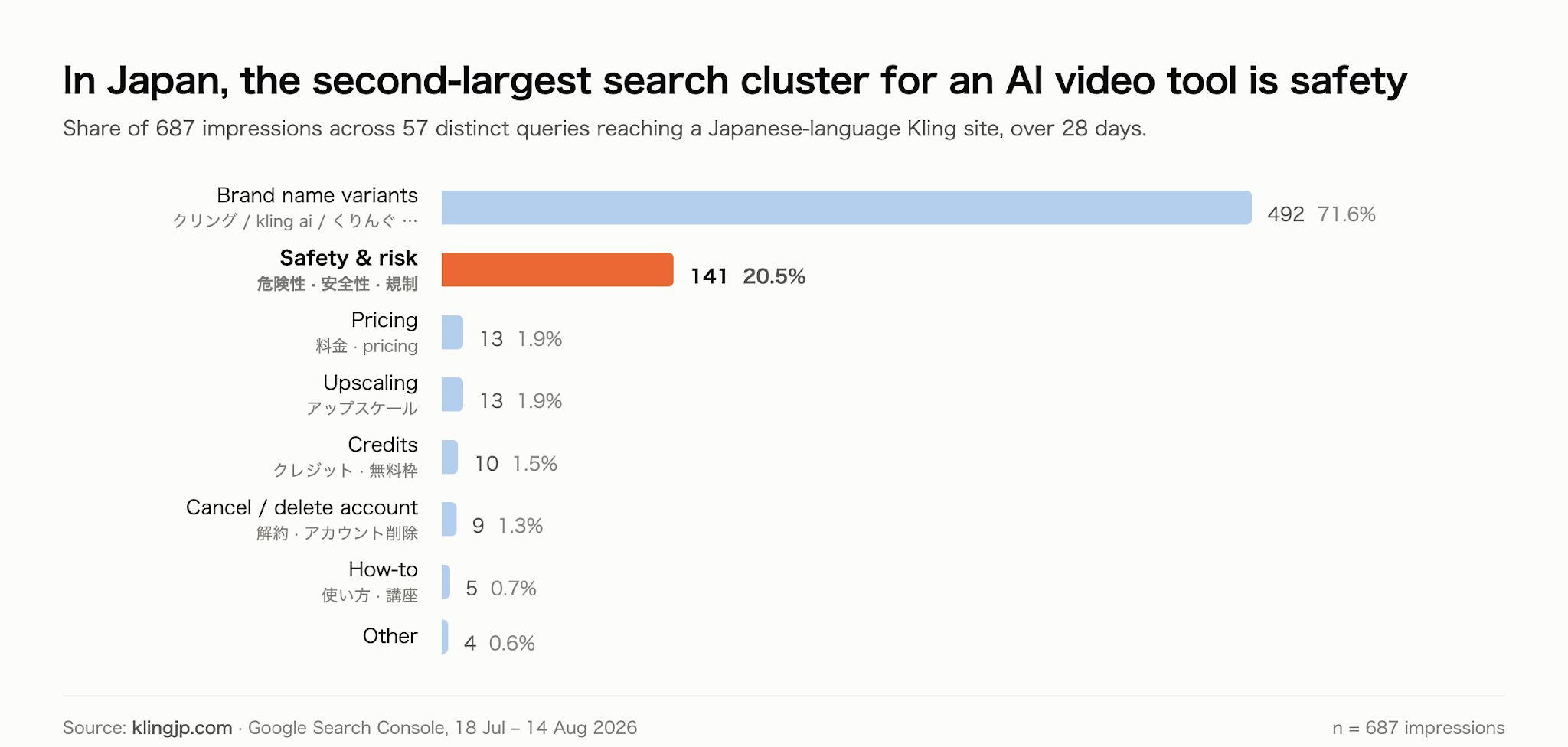
We operate klingjp, a Japanese-language site built on Kling, one of the more widely adopted AI video models in the region. Over a recent 28-day window, Google Search Console recorded 57 distinct queries reaching the site. The single largest cluster was the brand name itself, which is unsurprising. The second largest was not a feature, a price, or a comparison.
It was risk.
Queries built on 危険性 (kikensei, “danger” or “risk factor”) and 安全性 (anzensei, “safety”) accounted for roughly 141 impressions — more than every pricing, tutorial, and how-to query on the site combined. A related term, 規制 (kisei, “regulation”), appeared alongside them.
Safety and risk queries are the largest non-brand cluster — ahead of pricing, credits and how-to combined.
For a category that Western coverage frames almost entirely around creative capability, that is a striking inversion. The Japanese user arriving at an AI video tool is not asking what it can produce. They are asking whether using it will cause them a problem.
The variant spread tells you who is asking
There is a second signal in the data that is easy to miss, and it matters more than the volume.
The brand name arrived in an unusually wide spread of orthographic variants — katakana renderings, hiragana renderings, and multiple romaji spellings, including several that are simply misspellings. In Japanese, a query typed in hiragana rather than katakana is a meaningful signal: katakana is the conventional script for foreign loanwords, so a hiragana or phonetic-romaji spelling generally indicates someone typing what they heard rather than what they read.
That is not a developer evaluating an API. That is a mainstream consumer who encountered the tool socially — a colleague, a video, a conversation — and went to Google to find out if it is safe before touching it.
The scripts also behave completely differently as ranking targets, which is the part most localization plans get wrong. Take one product name written two ways. In the Japanese market, the romaji form — kling ai — draws about 40,500 searches a month. The katakana form of the same thing, Japanese-language Kling AI site, draws about 4,400. Volume says to chase the romaji.
Competitive difficulty says the opposite. On live SERP structure, the romaji form scores around 41 — it is contested by the vendor’s own localized pages and by established tech media, and needs roughly six times the link budget of the katakana form, which scores under 8. Our own site sits at position 72 for the romaji spelling and position 12 for the katakana one, off the same pages and the same authority.
The lesson is that in a two-script market, volume and reachability point in opposite directions, and the bigger number is often the one you cannot have yet. Ranking for what your users type is a different exercise from ranking for what the keyword tool ranks highest.
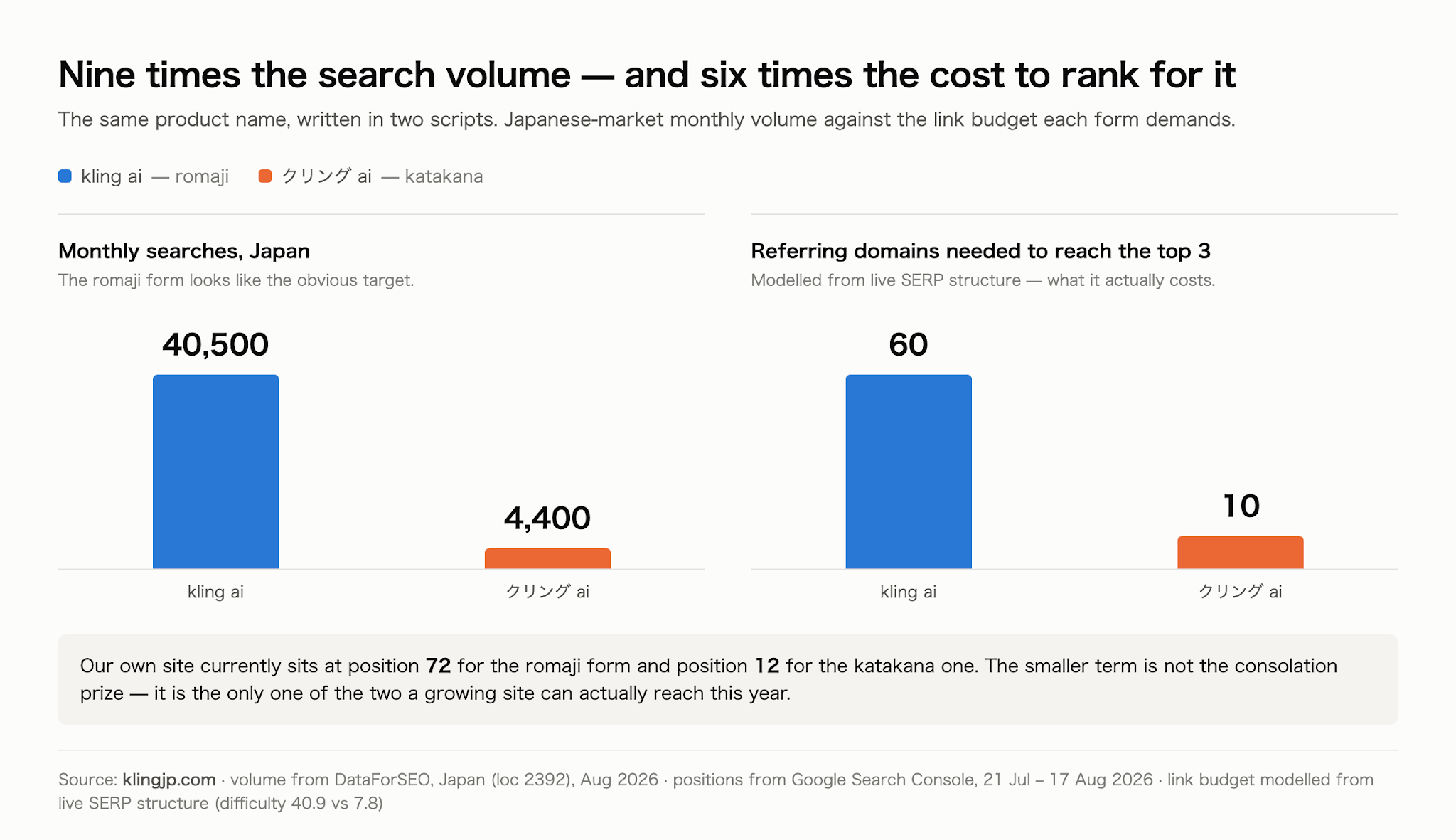
Nine times the volume, six times the link budget. Volume and reachability are not the same axis.
This combination is the actual market condition: broad consumer awareness, arriving ahead of institutional trust. The concerns behind those safety queries are less about model output quality and more about account safety, data handling, and — notably — whether the site the user landed on is the real one at all.
Trust concerns are often infrastructure concerns
When we investigated what was actually driving the safety queries, the dominant concrete harm was not the model. It was impersonation: lookalike domains and unofficial sites collecting payment details from users searching for a tool they had heard about but could not spell.
This reframes the problem for anyone marketing a tool into Japan. The user’s safety question is frequently not “is this technology dangerous” but “am I on the real website.” Those require completely different responses. The first invites a discussion of model governance and training data. The second requires that your legitimate domain rank clearly and unambiguously for every spelling variant your users actually type — including the wrong ones.
Most localization efforts optimize for the correct spelling. The search data suggests a meaningful share of at-risk users never type it.
Why this is a content gap, not a product gap
The practical implication for growth teams is that the highest-intent Japanese queries in this category are not commercial. They are defensive. And defensive queries are consistently underserved, because they are unpleasant to write about.
A vendor writing its own safety page faces an obvious tension: acknowledging that users are worried feels like conceding there is something to worry about. The result is that most vendor-side safety content is either absent or so hedged it answers nothing. Affiliate sites, meanwhile, avoid the topic because risk-framed queries convert poorly compared to “best tools for X.”
That leaves the largest non-brand query cluster in the category with no substantive answer ranking against it. In competitive-difficulty terms, the gap is dramatic. In our own analysis, the brand head term scored a difficulty of roughly 40 — a red-ocean term requiring substantial domain authority to contest. The safety cluster, at around half the impression volume, scored around 7.
Same audience. Same intent depth. A fraction of the competition. The only reason it stays open is that answering it well requires saying plainly what users are afraid of.
The transferable lesson
None of this is specific to one model or one vendor. The pattern generalizes to any category where consumer awareness outpaces institutional trust — which currently describes most of generative AI in most non-English markets.
Three things follow:
Read the query language, not the translated keyword list. Keyword tools will surface the translated equivalents of your English seed terms. They will not tell you that a meaningful share of your market is typing your brand name phonetically because they only ever heard it spoken.
Treat misspellings as a security surface. If impersonation is the concrete harm in your category, then ranking for the variants your users get wrong is not an SEO nicety. It is the mechanism by which they reach you instead of someone else.
Answer the defensive query directly. The instinct to avoid risk-framed content is understandable and, on this evidence, expensive. The users asking whether a tool is safe are not lost customers. They are customers who have already decided they want to use it and are looking for permission.
In a market where everyone is competing on what the model can generate, the open position is often much simpler: be the one who answers the question people are actually typing.