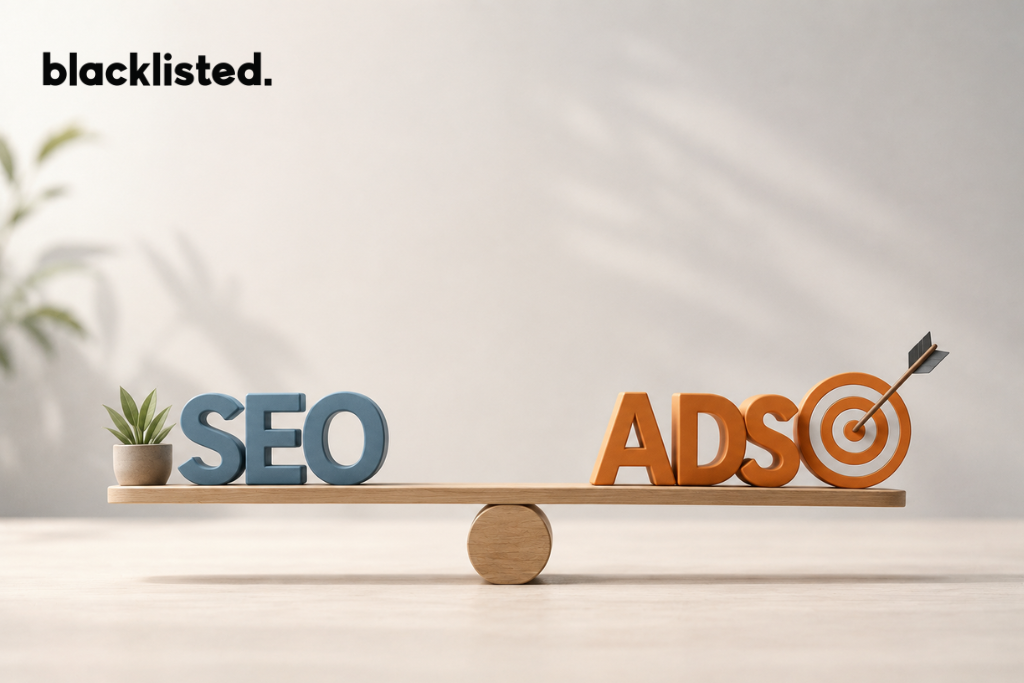
Most business owners will eventually ask themselves this question: invest in SEO or invest in Google Ads? The answer you really need to this question is what you need right now.
In this blog, SEO vs Google Ads will be discussed in detail, using examples of what a leading SEO agency in India, like Blacklisted, does to make this choice easier for their clients.
Understand What SEO Does
SEO is like the long, unpaid road to being found online. You improve your website’s content, technical health, and authority so that Google naturally ranks you for the searches that matter to your business. No one punches “pay” to get there; you earn the spot with relevance and consistency.
The positive aspect of SEO is that once the ranking is achieved, visitors keep coming to your page without incurring any cost on a daily basis. The negative point about SEO is probably patience, as it takes three to six months or more for results to come about, sometimes longer in crowded industries.
Google Ads in Plain Terms
Google Ads, otherwise referred to as PPC, is the exact opposite deal. Here, you have to bid on keywords and pay per click, and your listing is up at the top of search results after just an hour or so of starting your campaign. This is the reason behind the question of SEO vs PPC: one earns attention, the other rents it.
As soon as you run out of money, that’s the end of visibility. There is nothing left in the background once you call it quits. The trade-off dictates what a paid marketing agency will recommend to you in terms of budget allocation and duration of the campaign.
How SEO vs Google Ads Compare
The difference between the two channels becomes clearer when they are compared across the factors that directly affect business growth.
Speed of Results
SEO usually takes time to gain momentum. Search engines must crawl the website, evaluate its content and determine whether it deserves stronger visibility. Depending on the market and competition, noticeable progress may take several months.
Google Ads can begin generating impressions and clicks soon after a campaign is approved. This makes it more suitable for product launches, seasonal campaigns and businesses that need enquiries quickly.
Cost Structure
SEO requires investment in technical improvements, content creation, research and ongoing optimisation. However, businesses do not pay Google whenever someone clicks an organic result.
Google Ads works through a continuing media budget. Businesses may also need to pay for campaign strategy, management, landing-page improvements and conversion tracking. Costs can rise when several advertisers compete for the same keywords.
Control Over Visibility
SEO gives you limited control over when and where a page ranks. Good optimisation can help a business’s chances, but the search engines are the ones who decide which pages are shown.
Google Ads lets you have more control over your budgets, locations, audiences, schedules and campaign messages. “Advertisers can also pause, adjust or redirect spend based on performance.
Long-Term Value
SEO can continue attracting visitors after a page has been published and optimised. Strong content may also support multiple searches, build authority and strengthen other pages across the website.
Paid traffic usually depends on continued spending. Once a campaign stops, its advertisements disappear, and the flow of paid visitors normally ends with it.
Best Business Use
SEO is usually more effective when it comes to establishing authority, conducting customer research, and creating an organic traffic stream.
Google Ads can be more effective in terms of creating an instant demand, testing offers and reaching people who are ready to make their choice.
These differences make the decision practical rather than theoretical. Instead of thinking which one of the channels is better for everyone, businesses should think what kind of channel suits them best depending on their development stage, time frame and budget.
What Changes in 2026
Search is changing itself.” Google’s AI-driven results now answer some informational searches directly on the results page, with no click at all. That has changed SEO from a game about rankings to one about how your content is understood and surfaced in AI-generated summaries.
Paid search feels this shift far less. Ads still sit clearly on the page, and their performance depends more on bidding and relevance than on how AI reshapes organic listings. The trade-off between SEO vs PPC hasn’t disappeared; it’s just gained a new layer worth watching, and it’s reshaping how any SEO vs PPC conversation with a specialist should start.
When SEO Makes Sense
Lean towards SEO, and towards briefing an SEO agency in India, when you’re:
- Building a brand people will search for repeatedly, not just once
- Working with a limited budget that needs to stretch further over time
- Operating in a trust-driven category like education, healthcare, or professional services
- Playing a longer game, with 6 to 24 months in mind rather than this quarter
When Google Ads Makes Sense
In the SEO vs paid advertising decision, lean towards ads when you are:
- Launching something new and needing enquiries immediately
- Testing an offer or landing page before committing budget elsewhere
- Running a seasonal or time-bound promotion
- Chasing high-intent keywords where buyers are ready to act now
Why the Smartest Answer Is Usually Both
Considering SEO vs Google Ads as one or the other is the main pitfall for the majority of companies. You can use Google Ads to create leads and test conversions while working on your SEO and then decrease the use of paid advertising as your rankings improve.
This is precisely the reason that many fast-growing companies hire a paid marketing agency for the speed and testing and an SEO agency in India for their SEO work, rather than asking a single agency to handle both.
A good paid marketing agency hands over campaign data, the keywords and offers that actually convert, so the SEO side isn’t guessing where to focus content next. Measuring success by profit, not just traffic or clicks, keeps this pairing honest.
SEO vs Google Ads Verdict
Speed belongs to Google Ads, while durability belongs to SEO. Businesses that need leads now can’t wait for rankings. If companies want steady growth, they don’t want to be propped up permanently by paid clicks.
That also answers the age-old question of SEO vs paid advertising. Google Ads is better for capturing demand now. SEO is better for building visibility that can be more valuable over time.