
Feed manufacturers comparing hammer mill configurations need clear technical guidance before investing in production equipment. Horizontal and vertical shaft designs create different results in throughput per kW, footprint, heat buildup, and maintenance access. A direct four-way comparison helps companies match equipment structure with production priorities.
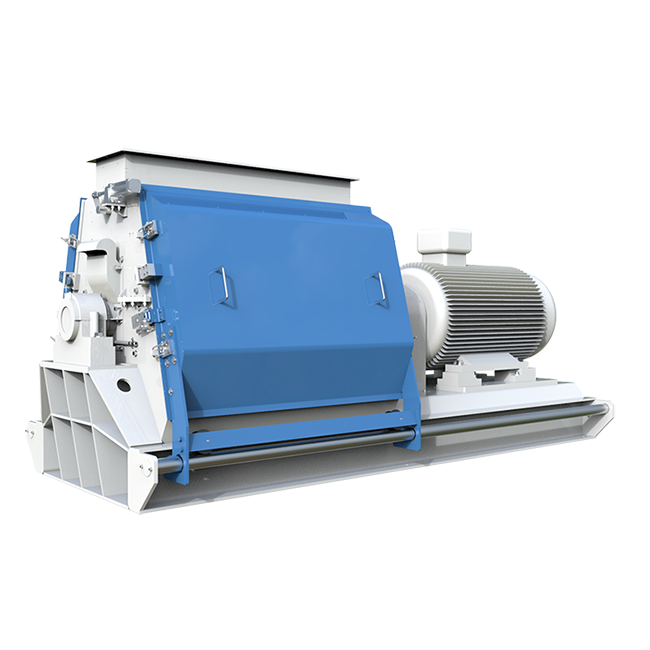
Milling Grinding Throughput Per kW Comparison
Throughput per kW is one of the most important indicators when comparing hammer mill configurations. Horizontal shaft hammer mills generally provide higher output efficiency for large-scale feed production, while vertical shaft hammer mills focus more on compact processing applications with different capacity requirements.
Compared with vertical shaft designs, horizontal shaft hammer mills usually perform better when continuous high-volume grinding is required. Their horizontal rotor structure supports large material handling capacity, making them suitable for feed factories processing significant quantities of grains and other ingredients.
Vertical shaft hammer mills provide advantages where production demand is moderate and installation conditions limit equipment size. Compared with horizontal designs, they are more suitable for facilities that need flexible arrangement rather than maximum production output per installed motor power.
For coarse grinding applications with large throughput targets, horizontal configurations provide stronger efficiency advantages. For smaller production systems requiring space control, vertical configurations provide a practical alternative. FAMSUN offers grinding solutions for different feed processing applications, helping customers evaluate milling grinding requirements according to project conditions.
Footprint Comparison Between Horizontal And Vertical Designs
Footprint is a major difference between the two configurations. Horizontal shaft hammer mills require more floor area because the grinding chamber and drive structure extend across the production space. Vertical shaft hammer mills occupy less floor space because their structure uses a more compact vertical arrangement.
Compared with horizontal shaft mills, vertical shaft mills provide a clear footprint advantage for factories with limited installation areas. This makes them suitable for plant upgrades, compact production lines, and projects where expanding floor space is difficult.
Horizontal shaft mills require more ground area than vertical designs, but they often integrate more easily into production layouts where side access and wider equipment arrangements are available. The additional floor requirement can be acceptable for large plants that prioritize capacity and maintenance convenience.
When comparing grinding equipment layouts, manufacturers should place production demand above footprint alone. A high-capacity feed factory may accept larger horizontal equipment because output efficiency has greater value, while a restricted facility may prioritize vertical equipment because available space becomes the limiting factor.
Heat Buildup Comparison During Grinding Operations
Heat buildup creates different challenges for horizontal and vertical shaft hammer mills. Horizontal shaft designs generally handle high-volume grinding more effectively but require stronger airflow and operating control to manage heat generated during intensive production.
Compared with horizontal shaft mills, vertical shaft hammer mills often benefit from shorter material movement paths in compact applications, which can reduce excessive residence time under suitable operating conditions. However, their thermal performance depends strongly on production load and process settings.
For high-capacity operations, horizontal shaft mills require careful temperature management because greater material throughput creates higher heat generation potential. Vertical shaft mills usually face lower heat pressure in smaller applications because production intensity is often lower.
The heat buildup comparison shows that neither configuration is universally superior. Horizontal designs are better suited for controlled high-output production with proper ventilation, while vertical designs are more suitable where compact processing and moderate capacity help reduce thermal challenges. FAMSUN supports various grinding equipment applications for feed manufacturers with different production conditions.
Maintenance Access Comparison For Long-Term Operation
Maintenance access directly affects production availability. Horizontal shaft hammer mills generally provide easier access to internal components because their structure allows more straightforward inspection and replacement procedures compared with vertically arranged systems.
Compared with horizontal designs, vertical shaft hammer mills require more careful maintenance planning because components are positioned within a compact vertical structure. Their space-saving design can create additional considerations for service access and replacement operations.
Horizontal shaft mills are more suitable for plants where minimizing maintenance downtime is a primary goal. Vertical shaft mills are more suitable where saving production space is more important than achieving the simplest maintenance arrangement.
When evaluating grinding equipment investment, maintenance convenience should be considered together with capacity and installation conditions. FAMSUN provides hammer mill solutions for different feed applications, and they help customers evaluate equipment performance, service requirements, and production objectives.
Four-Way Decision Guide For Feed Production Projects
A direct comparison of four factors shows different priorities for each configuration. Horizontal shaft hammer mills are generally preferred for large production lines because they provide stronger throughput performance and easier maintenance access. Vertical shaft hammer mills are preferred when footprint reduction is the main requirement.
When throughput and operational continuity have the highest priority, horizontal shaft designs should receive greater consideration. When factory space is limited, vertical shaft designs provide a stronger solution. Heat control and maintenance requirements then determine whether the selected configuration matches the production environment.
The most important decision factor depends on project conditions. Large feed mills should prioritize capacity and service efficiency, while compact facilities should prioritize installation flexibility. A balanced review of output demand, available space, temperature control, and maintenance access creates a more reliable equipment decision.
FAMSUN works with feed processing enterprises through different production requirements. They provide engineering solutions that help customers compare machinery options according to application needs, factory conditions, and long-term operating goals before implementing new grinding systems.
Conclusion
Horizontal and vertical shaft hammer mills have clear differences across throughput per kW, footprint, heat buildup, and maintenance access. Horizontal designs fit high-capacity operations requiring production efficiency and service convenience, while vertical designs fit space-limited projects requiring compact installation. A four-way comparison supports better investment decisions.