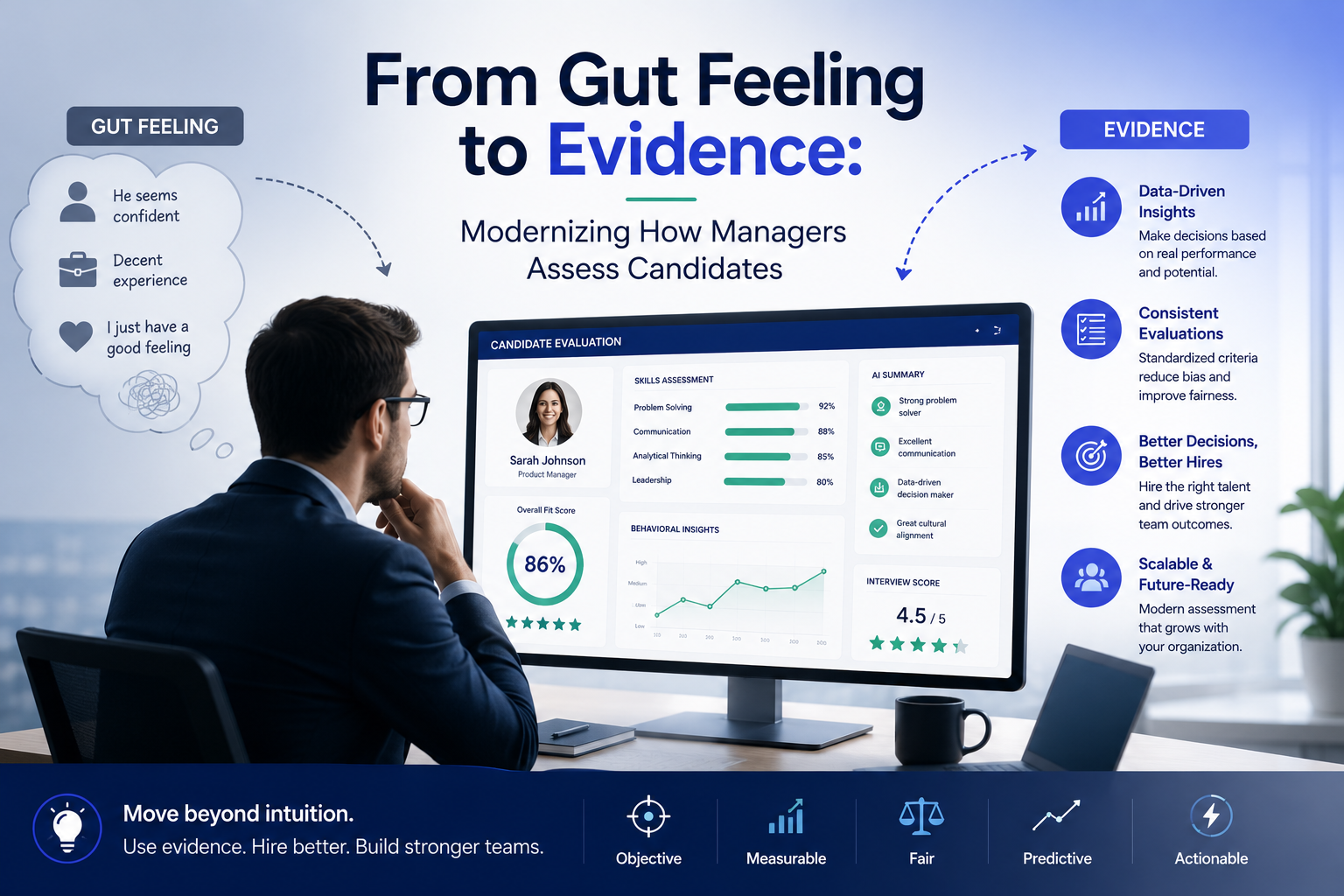
Hiring decisions at large organizations are still, in most cases, made on instinct rather than evidence. Industry research indicates that approximately 85 percent of hiring managers rely primarily on gut feeling when evaluating candidates (Alva Labs, 2023). For an enterprise making thousands of hiring decisions a year, this is not a minor process gap. It is a structural risk sitting inside one of the most consequential functions in the business.
This article examines why intuition-based assessment persists at the enterprise level, what the data says about its cost, and how AI interviews are giving large organizations a defensible, evidence-based alternative without slowing down hiring velocity.
The Scale of the Problem in Enterprise Hiring
For a company hiring at volume, even small inefficiencies in candidate assessment compound quickly across departments, geographies, and business units.
The financial exposure is significant. The U.S. Department of Labor estimates that a bad hire costs at least 30 percent of that employee’s first-year earnings (DistantJob, 2026). The Society for Human Resource Management places the figure considerably higher, estimating replacement costs between 50 and 200 percent of annual salary depending on seniority, with executive-level mis-hires trending toward the upper end of that range (Inop, 2026).
The frequency is higher than most leadership teams assume. A CareerBuilder survey found that 75 percent of hiring managers have hired the wrong person for a role at some point in the past year, with an average direct cost of roughly 17,000 dollars per bad hire (Apollo Technical, 2025).
The operational drag extends beyond the hire itself. Research cited by CFOs indicates that managers spend approximately 17 percent of their time supervising underperforming employees, which is time diverted from strategic priorities and team development (Apollo Technical, 2025).
Time-to-fill remains a persistent constraint. SHRM’s Human Capital Benchmarking data places the average time to fill a role at 42 days, with public sector and highly regulated industries frequently exceeding 60 days (VA Masters, 2026).
For a large enterprise running hundreds of concurrent hiring processes, these figures are not abstractions. They represent a recurring, quantifiable drain on productivity, budget, and leadership bandwidth, and the exposure scales directly with headcount growth.
Why Gut Feeling Persists at the Enterprise Level
If the data on unstructured, intuition-driven hiring is this clear, a reasonable question for any C-suite leader is why the practice remains so entrenched. Several structural factors explain this.
Interviewer autonomy is deeply embedded in management culture. Hiring managers are typically given wide latitude to run interviews as they see fit, with limited standardization enforced across business units. This autonomy feels efficient at the individual level but produces significant inconsistency at the organizational level.
Confirmation bias operates below conscious awareness. Interviewers frequently form an impression of a candidate within the first moments of an interaction and then spend the remainder of the conversation unconsciously seeking information that confirms that initial judgment (Plum, 2018). This pattern is difficult to self-correct because it does not feel like bias from the inside. It feels like judgment.
Affinity bias shapes outcomes in ways leadership rarely sees. Candidates who share an interviewer’s background, education, or interests are more likely to be evaluated favorably, independent of job-relevant qualifications (Alva Labs, 2023). At scale, this produces workforce homogeneity that can conflict directly with stated diversity and inclusion commitments.
Legacy performance management has never demanded better. Because hiring outcomes are rarely traced back to interview methodology in a systematic way, organizations lack the internal feedback loop that would otherwise force a shift toward more rigorous evaluation practices.
What the Evidence Actually Shows
Decades of research in industrial-organizational psychology have produced a consistent and well-replicated finding: structured, criteria-based assessment substantially outperforms unstructured, intuition-based assessment at predicting job performance.
The predictive validity gap is large and well documented. Schmidt and Hunter’s landmark meta-analysis found a predictive validity of 0.51 for structured interviews compared to 0.38 for unstructured interviews (Cogn-IQ, 2026). A more recent large-scale meta-analysis by Sackett and colleagues found an even wider gap, placing structured interview validity at 0.42 against just 0.19 for unstructured interviews, indicating structured approaches are roughly twice as predictive of actual job performance (TestPartnership, 2026).
Consistency matters as much as content. Research shows that a single structured interview can achieve the same predictive validity as three to four unstructured interviews conducted by different interviewers (VidCruiter, 2025). For an enterprise running multi-stage interview loops, this finding alone has direct implications for how much interview volume is actually necessary to make a confident decision.
Structured evaluation reduces legal exposure. Because structured interviews apply consistent, job-relevant criteria to every candidate, they are inherently more defensible in the event of a hiring-related dispute. Legal review of structured interview processes has found them to be reliably upheld when challenged, in contrast to the far greater exposure associated with subjective, unstructured evaluation (Plum, 2018).
The gap between adoption and awareness is striking. Despite the strength of this evidence, structured interviewing remains underused, largely because it has historically been perceived as slow and resource-intensive to implement consistently across a large organization (Knockri, 2022).
This last point is where the opportunity for enterprise HR and talent leaders becomes clear. The evidence in favor of structured, criteria-based assessment has existed for decades. What has been missing is a scalable mechanism to apply it consistently across every hiring manager, every business unit, and every candidate, without adding friction to the hiring process.
How AI Interviews Close the Gap Between Evidence and Practice
AI interviews directly address the structural barriers that have historically prevented enterprises from operationalizing structured assessment at scale.
Consistency is enforced by design, not by policy memo. Every candidate for a given role is evaluated against the same predetermined, job-relevant criteria, regardless of which hiring manager would otherwise have conducted the conversation. This removes the interviewer-to-interviewer variability that undermines standardization efforts built on training and compliance alone.
Evaluation criteria are documented and auditable. Because AI interviews generate a structured record of how each candidate was assessed against defined competencies, HR and legal teams gain a level of documentation and defensibility that ad hoc interview notes have never reliably provided.
Scale no longer requires a tradeoff with rigor. One of the long-standing barriers to structured interviewing has been that it is more time-intensive to design and administer consistently (Knockri, 2022). AI interviews remove this constraint by applying the same rigorous structure to one candidate or ten thousand candidates without additional interviewer hours.
Confirmation and affinity bias are structurally reduced. Because evaluation is anchored to predefined, job-relevant criteria rather than subjective impression, AI interviews reduce the influence of the same-background, same-interests bias patterns that unstructured formats are prone to (Alva Labs, 2023).
Executive-level decisions gain the same rigor as high-volume hiring. Given that the financial exposure from a senior mis-hire scales with seniority, extending structured, evidence-based assessment to leadership pipelines carries a proportionally larger return than applying it only to entry-level roles.
What This Means for the C-Suite
For CHROs, CFOs, and CEOs evaluating where to invest in hiring infrastructure, the case for moving from gut feeling to evidence is not a cultural preference. It is a measurable risk management decision.
Quantify the exposure before deciding on the investment. Multiply your organization’s average bad-hire rate by SHRM’s replacement cost benchmark of 50 to 200 percent of annual salary (Inop, 2026) against your annual hiring volume. For most enterprises, this calculation alone justifies a serious evaluation of structured, AI-driven assessment.
Treat interview methodology as a governance issue, not just an HR process issue. Given the legal defensibility advantages of structured evaluation, boards and legal counsel increasingly have a direct interest in how consistently interview criteria are applied across the organization.
Expect the return to compound with scale. Because the predictive validity gap between structured and unstructured interviews is consistent across roles (TestPartnership, 2026), the financial and quality benefits of AI interviews scale proportionally with hiring volume, making the business case strongest for exactly the kind of high-volume, multi-business-unit hiring environment that characterizes most large enterprises.
Conclusion
The research on structured versus unstructured hiring assessment has been available for decades and the conclusion has not changed with further study. It has, if anything, strengthened. What has changed is the ability to apply that evidence consistently across an entire enterprise without the resourcing burden that once made structured interviewing impractical at scale.
For large organizations still relying on interviewer instinct as the primary hiring filter, the gap between what the evidence recommends and what current practice delivers represents both a quantifiable risk and a clear opportunity. AI interviews give enterprise talent teams a practical path to close that gap, replacing gut feeling with a consistent, defensible, and scalable standard of evidence across every hiring decision the organization makes.