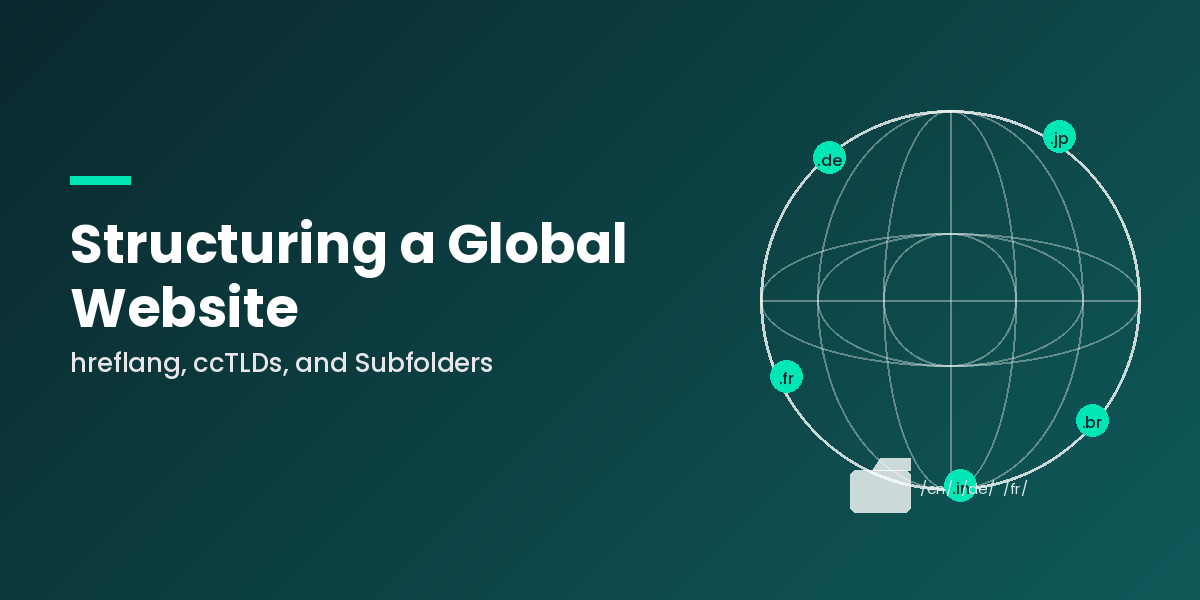
If you’ve ever tried to expand a website into new countries or languages, you already know the technical headaches that come with it. Search engines don’t automatically know that your German page and your French page are meant for different audiences, or that your Australian visitors shouldn’t be served pricing in Indian rupees. This is exactly where a proper technical seo audit becomes non-negotiable. Without one, even the most beautifully translated website can end up invisible in the markets it was built for, simply because Google can’t figure out who should see what.
Global site structure isn’t just a backend decision buried in a developer’s to-do list. It shapes how search engines crawl, index, and rank your content across different regions. Get it wrong, and you risk duplicate content issues, wasted crawl budget, and pages competing against each other instead of ranking together. Get it right, and you create a scalable foundation that grows smoothly as you enter new markets.
Why International SEO Feels More Complicated Than It Should
Most business owners assume that translating a website is the hard part. In reality, translation is often the easy step. The real complexity lies in telling search engines exactly which version of a page belongs to which country and language combination, and doing so in a way that doesn’t confuse crawlers or dilute ranking signals.
This is where three technical elements come into play: hreflang tags, ccTLDs (country-code top-level domains), and subfolders. Each one solves a piece of the international puzzle, but none of them work well in isolation. A common mistake we see during a technical seo audit is a company using hreflang tags incorrectly alongside a messy subfolder structure, essentially sending mixed signals to Google. The result? Pages that should rank well in local search results get buried instead.
The Hidden Cost of Getting Structure Wrong
Imagine running an online store with content for the US, UK, and Canada, all in English. Without proper hreflang implementation, Google might see these as duplicate pages and choose just one to rank, often not the one you intended for a specific region. Shoppers in Canada could land on your US pricing page, get confused by unfamiliar currency, and bounce immediately. That’s a lost sale caused entirely by a technical oversight, not a content or product problem.
Understanding hreflang Without the Jargon Overload
Hreflang is essentially a signal you send to search engines that says, “Hey, this page is for English speakers in Canada,” or “This page is for French speakers in France.” It’s written into your HTML code or sitemap and tells Google which version of a page to show based on a user’s language and location settings.
The tricky part is that hreflang has to be implemented with precision. Every page needs to reference itself and every other language variant, forming a complete loop. Miss one reference, use the wrong ISO code, or forget the self-referencing tag, and the entire setup can break silently. You won’t get an error message; you’ll simply notice, months later, that organic traffic from certain countries never grew the way it should have.
This is one of the most common issues uncovered during a technical seo audit. Many websites have hreflang tags that were implemented once, years ago, and never updated as new language versions were added. The tags become outdated, pointing to pages that no longer exist or missing newer regional pages entirely.
ccTLDs vs Subfolders: Picking the Right Foundation
Before hreflang even comes into play, you need to decide how your international pages will actually be structured on your domain. There are three common approaches, and each has real trade-offs.
Country-code top-level domains (ccTLDs) like .de for Germany or .fr for France send the strongest possible signal to both users and search engines about geographic targeting. They build immediate trust with local audiences, but they’re expensive and time-consuming to maintain since each domain needs its own SEO effort, backlink profile, and technical setup essentially from scratch.
Subdirectories or subfolders, such as yourdomain.com/uk/ or yourdomain.com/fr/, keep everything under one root domain. This approach lets you consolidate domain authority, meaning all your SEO efforts strengthen a single domain rather than being spread thin across multiple ones. It’s generally the most practical choice for small and mid-sized businesses expanding internationally.
Subdomains, like uk.yourdomain.com, sit somewhere in the middle. Search engines sometimes treat them as semi-separate entities, which can dilute authority slightly compared to subfolders.
| Structure Type | Best For | SEO Authority Sharing | Setup Complexity | Maintenance Effort |
| ccTLD (.de, .fr, .jp) | Large enterprises with strong local presence | None (separate domains) | High | High |
| Subfolder (/de/, /fr/) | Most businesses, especially growing ones | Full (shared with root domain) | Low to Moderate | Low to Moderate |
| Subdomain (de., fr.) | Companies needing partial separation | Partial | Moderate | Moderate |
For most companies, subfolders strike the best balance between SEO efficiency and manageable upkeep. That said, the right choice always depends on your specific business goals, budget, and how distinct your regional operations really are.
Where Businesses Typically Go Wrong
There’s a pattern we see repeatedly when reviewing international websites. Companies rush the expansion phase, launching new country pages quickly to capture market opportunity, and treat the technical structure as an afterthought. Six months later, they notice that organic traffic in the new region simply isn’t growing, despite decent content and a reasonable marketing budget.
This is usually when they realize they need outside help. Partnering with an experienced SEO marketing agency at this stage can save months of guesswork. A skilled SEO marketing agency won’t just look at your content quality; they’ll dig into crawl reports, check how search engines are actually interpreting your hreflang setup, and identify whether your chosen structure (ccTLD, subfolder, or subdomain) is actually working in your favor or quietly working against you.
Signs Your Global Structure Needs Attention
A few warning signs tend to show up before things get seriously bad. Traffic from a specific country plateaus or declines even though you’ve added more localized content. Search Console shows hreflang errors that keep piling up. Or you notice that your German page occasionally ranks in Google.com’s US results instead of Google.de, meaning search engines are genuinely confused about which audience each page serves.
None of these issues fix themselves. They require someone to go into the code, the sitemap, and the server configuration to trace exactly where the signals are breaking down.
Building a Structure That Scales With You
The smartest global websites are built with future growth in mind, not just the two or three markets you’re launching in today. That means choosing a folder and hreflang architecture that can easily accommodate a fourth, fifth, or tenth country without requiring a complete technical overhaul each time.
It also means running periodic checks rather than treating international SEO as a one-time setup. Search engines update their crawling behavior, your business adds new regions, and old hreflang references quietly become outdated. A regular technical seo audit, ideally every few months for larger sites, catches these issues before they cost you meaningful traffic and revenue.
Bringing It All Together
Structuring a global website correctly isn’t glamorous work, but it’s foundational. hreflang tags, ccTLDs, and subfolders each play a distinct role, and getting their combination right determines whether your international expansion actually reaches the audiences it was designed for. Skipping this technical groundwork, no matter how good your translated content is, means leaving organic visibility and revenue on the table in every new market you enter.
If your international traffic isn’t matching the effort you’ve put into localization, it might be time to step back and take a genuinely thorough look under the hood. Sometimes the fix is a few corrected hreflang tags. Sometimes it’s a complete restructuring of how your domain handles different regions. Either way, a proper technical seo audit will tell you exactly where things stand, and give you a clear, actionable path forward.